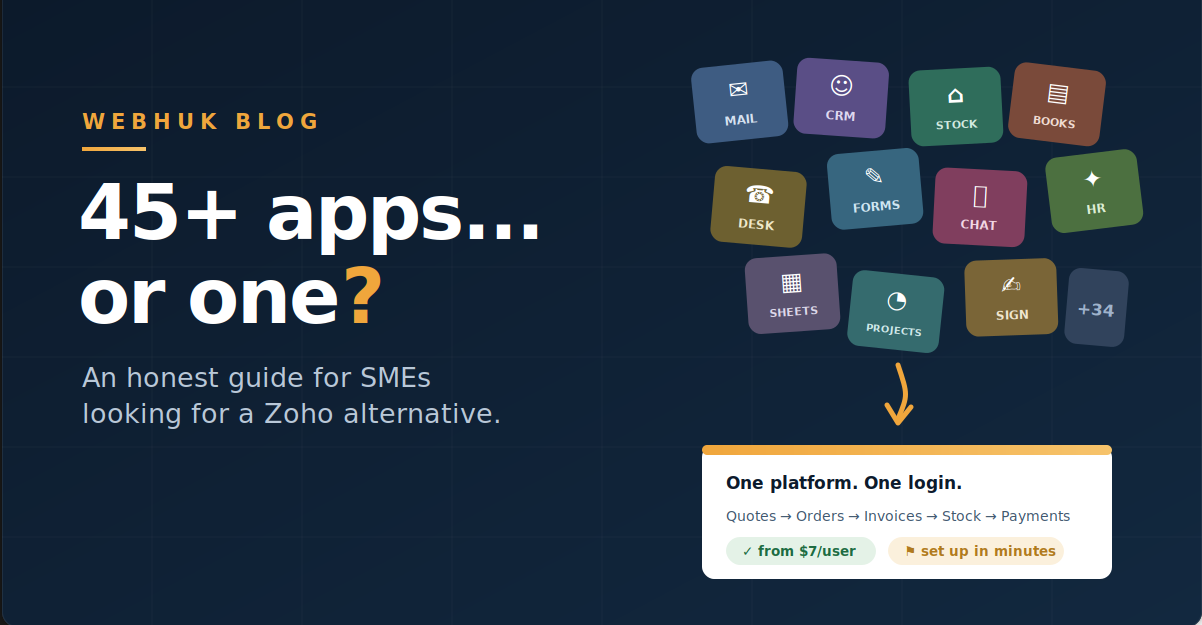
Let's start with something most "Zoho alternative" articles won't say: Zoho is genuinely good software. It's a 45-plus-app suite covering CRM, accounting, inventory, HR, helpdesk, email marketing, and more, at prices that undercut most Western competitors. If you're searching for a Zoho alternative, it's probably not because Zoho is bad — it's because somewhere along the way, you started suspecting it's not built for a business shaped like yours.
This guide is for that suspicion. We'll look honestly at what Zoho does well, where it strains for a small trading business in Ghana or West Africa, what the pricing really works out to in 2026, and how a purpose-built alternative like Webhuk compares — including the cases where you should stick with Zoho.
(A note on fairness: pricing below reflects publicly listed figures as of mid-2026. Software prices change — verify current figures on each vendor's site before deciding.)
What Zoho Actually Is (and Why That's the Issue)
Zoho isn't one product; it's an ecosystem. The bundle most SMEs consider, Zoho One, packages 45+ applications under two licensing models: All-Employee pricing at roughly $37 per user per month (billed annually; ~$45 monthly) — with the condition that you license every employee on your payroll — or Flexible User pricing at roughly $90 per user per month (annually; ~$105 monthly) if you only want licenses for some staff.
Alternatively, you can subscribe to individual apps — Zoho Books for accounting, Zoho Inventory for stock, Zoho CRM for customers — each with its own plans, tiers, and limits.
And that's the fork in the road every SME hits: buy the whole universe, or assemble your own constellation. Both paths work. Both also carry costs that don't show up on the pricing page.
Where Zoho Strains for a Small Trading Business
1. Your core workflow is split across apps. A trading company's daily loop — enquiry, supplier quotes, sales quotation, order, invoice, stock movement, payment — crosses at least three Zoho apps (CRM, Inventory, Books). They integrate, but you do the integration work: matching settings, syncing customers and items, and training staff on three interfaces that behave like three products, because they are.
2. The All-Employee catch. Zoho One's headline price assumes you license everyone on payroll. A 20-person trading business where only 8 people touch software still pays for 20 seats on the All-Employee plan — or jumps to the much higher Flexible rate for 8. For lean SMEs, the "cheap" bundle quietly stops being cheap.
3. Setup is a project, not an afternoon. Zoho's flexibility is real, and so is the configuration burden that comes with it. Many businesses engage Zoho partner consultants for implementation. That's a reasonable path for a 100-person company; it's a heavy lift for a 10-person trading firm that just wants quotations going out on letterhead this week.
4. Depth you'll never use, gaps where you live. You get email campaign automation, web forms, and a helpdesk — and yet the workflow a West African trading business actually runs daily has no first-class home: collecting supplier quotes into one customer quotation with markup, or calculating the landed cost of imported goods with duties and clearing included. Those are buildable in Zoho with effort. They're not built.
What a Purpose-Built Alternative Looks Like
Webhuk takes the opposite bet: instead of 45 apps for every business, one platform shaped around how trading SMEs actually operate — with the enquiry-to-invoice workflow, procurement, inventory, and payments as native, connected features rather than an integration project.
Concretely, in one system and one interface:
- Enquiry → quotation → order → invoice, each generated from the last with one click, on your branded letterhead, with approval steps and emailing built in
- Tradeboard for the RFQ workflow: send RFQs from a customer enquiry, let vendors submit quotes through a link, combine the best prices into one sales quotation with markup and freight, and see profit per deal
- Inventory across branches and containers, deducted automatically by sales, with landed price calculation rolling duties and shipment costs into true per-unit costs
- Multi-currency quoting and invoicing (cedis alongside USD, GBP, or any currency you add)
- Payments recorded against invoices and customer accounts, with aging reports for tracking customer debts
- Role-based access, tasks, sales funnels, and callsheets for the team
Pricing is flat and simple: $7 per user per month (Startup) or $15 (Business) — you license the people who use it, nobody else — with a 14-day free trial and setup measured in minutes via a guided wizard, not weeks of configuration.
Zoho vs Webhuk: The Honest Comparison Table
| Zoho One | Webhuk | |
|---|---|---|
| What it is | Suite of 45+ separate apps | One integrated platform |
| Best for | Broad needs: marketing, helpdesk, HR, projects, plus core ops | Trading/importing SMEs focused on quote-to-cash operations |
| Price (2026) | ~$37/user/mo (annual, must license ALL employees) or ~$90/user/mo flexible | $7–$15/user/mo, license only actual users |
| Trading workflow (enquiry→RFQ→quote→invoice) | Assembled across CRM + Inventory + Books | Native, one-click between stages |
| Vendor RFQs & quote comparison | Not a built-in workflow | Built-in (Tradeboard, vendor self-service quotes) |
| Landed cost for imports | Possible with configuration | Built-in calculation |
| Setup | Days to weeks; partners often engaged | Guided wizard, ~20 minutes to start |
| Breadth (email marketing, helpdesk, custom apps…) | Exceptional — best in class for the price | Not the focus |
| Learning curve | One per app | One |
When You Should Choose Zoho Anyway
An honest comparison cuts both ways. Zoho One is likely the better choice if:
- You need serious marketing automation, a customer helpdesk, or custom app building — Zoho's breadth there is genuinely unmatched at its price
- You're 50+ people across many departments, where per-department apps and an admin team make sense
- Nearly everyone on payroll will use the software, making All-Employee pricing genuinely economical
- You have (or will hire) in-house capacity to administer a multi-app environment
If that's you, Zoho is excellent value. No purpose-built tool should pretend otherwise.
When a Purpose-Built Platform Wins
Webhuk is likely the better fit if:
- You're a 5–50 person trading, importing, distribution, or services business and your software need is the operational core: quotes, orders, invoices, stock, suppliers, payments
- You want this week's quotations going out of the new system, not a configuration project — especially if you're just moving off spreadsheets
- Only part of your team needs licenses, and paying for every employee on payroll makes no sense
- Your margins live in supplier quote comparison and import costing, and you want the RFQ workflow and landed cost handled natively
- You want one interface to train staff on, in a business where staff turnover is a reality
The Cost Math for a Typical SME
Take a 15-person Accra trading company where 6 staff need software access:
- Zoho One, All-Employee: 15 × $37 = $555/month (annual billing) — because every employee must be licensed
- Zoho One, Flexible: 6 × $90 = $540/month
- Webhuk Business: 6 × $15 = $90/month — or $42 on the Startup plan
The Zoho figure buys enormously more breadth. The question — the only question — is whether your business will use that breadth, or whether you'd be paying roughly six times more for apps that sit unopened while your team works in three of them.
The Bottom Line
Don't choose software by feature count; choose it by the shape of your business. Zoho is a superb general-purpose suite, and if you need its breadth, buy it with confidence. But if you're a growing trading SME whose entire operation is the loop from customer enquiry to supplier quote to invoice to payment, a platform built natively around that loop — at a fraction of the per-user cost — will get you running in days and stay out of your way. Webhuk's 14-day free trial is long enough to run a real deal through the whole workflow before you pay anything. Run one, and let the comparison settle itself.
Start a 14-day free trial
Frequently Asked Questions
What is the best Zoho alternative for a small business? It depends on what you use Zoho for. If your need is operational — quotations, invoicing, inventory, supplier quotes, payments — a purpose-built platform like Webhuk covers that loop natively at $7–$15 per user per month. If you rely on Zoho's marketing, helpdesk, or custom-app breadth, staying with Zoho may serve you better.
How much does Zoho One cost in 2026? Publicly listed pricing is about $37 per user per month on annual billing under All-Employee licensing (which requires licensing every employee on payroll; ~$45 billed monthly), or about $90 per user per month annually (~$105 monthly) under Flexible User licensing. Always verify current pricing on Zoho's website.
What's the difference between Zoho One's All-Employee and Flexible plans? All-Employee offers the lower per-seat rate but requires a license for every person on your payroll, whether or not they use the software. Flexible User lets you license only actual users at a substantially higher per-seat price.
Is Webhuk cheaper than Zoho? Per licensed user, yes: Webhuk runs $7 (Startup) or $15 (Business) per user per month versus Zoho One's $37–$90 equivalent — and you only license actual users. Zoho includes far more applications, so the real question is whether you need that breadth.
Can Webhuk replace Zoho Books, Zoho Inventory, and Zoho CRM? For a trading SME's core operations, that's precisely the territory Webhuk covers in one platform: customer and vendor records, quotations and invoices, multi-branch inventory with landed costs, payments and account balances. It does not aim to replace Zoho's marketing, helpdesk, or custom-app products.
How long does it take to switch from Zoho or spreadsheets to Webhuk? Initial setup runs through a guided wizard in about 20 minutes, and customers and stock items import from CSV. A realistic full migration — data cleanup, documents, stock counts, payments — takes around four weeks alongside normal operations.