A sachet water producer in Accra buys film rolls, runs them through the machine all day, and bags the output. A bakery takes flour, sugar and shortening in the morning and has bread on the rack by noon. A cosmetics producer measures oils and butters into a batch and gets jars at the end.
Ask any of them a simple question — "this morning you issued 200 kg of material; how many units should that have produced, and how many actually came out?" — and you'll usually get a pause. Not because they don't care, but because the stock records only know two things: what was bought, and what's on the shelf to sell. Everything that happens between those two points is invisible.
That invisible middle is where manufacturing businesses quietly lose money. This guide covers production inventory management for small manufacturers: why stock needs three states rather than two, how the daily issue-and-confirm cycle works, what yield variance tells you, and how to stop the same value being counted twice.
The Two-Bucket Problem
Most small factories track stock the way a trading business does: things you bought, and things you sell. Raw materials in one list, finished goods in another.
The trouble starts the moment materials leave the store. Deduct them from raw materials and the business appears to be holding less than it is — the value didn't vanish, it's sitting on the factory floor as half-made product. Don't deduct them, and the raw material count says you have film rolls that were used three hours ago.
Worse is the version where the day's output gets added to finished goods before anyone checks it, while the materials are still sitting in the raw-material count. Now the same value appears twice: once as material, once as product. Your stock valuation is inflated, your margins look better than they are, and nobody can tell where the error came from.
The Fix: Three States, Not Two
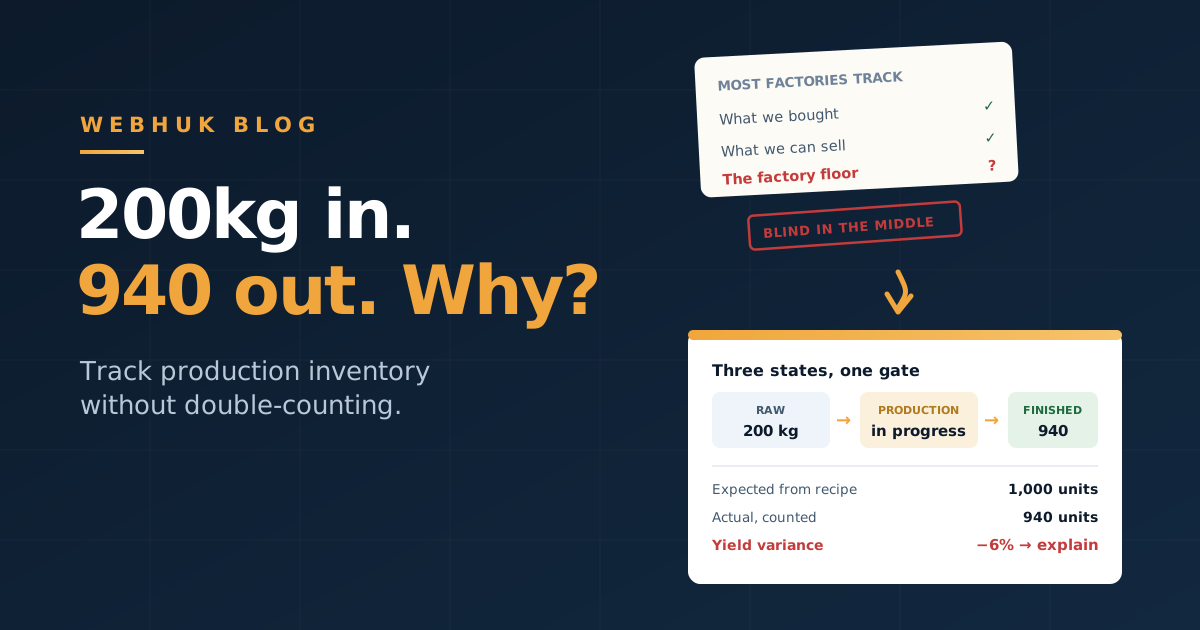
Production inventory needs a third state between the other two:
- Raw materials — bought, received, sitting in the store, not yet committed to anything.
- Production (work in progress) — materials issued to the factory floor for a specific day or batch. They have left raw materials but are not yet sellable product.
- Finished goods — confirmed output, counted and accepted, available to sell.
The rule that makes it work: stock only moves between these states on a recorded event, and nothing enters finished goods without confirmation. Production stock is never part of finished goods — not "temporarily," not "to be sorted out later." It's a separate place with its own balance, and it should be visible as such on your stock reports.
That single discipline eliminates double-counting, and it gives you something the two-bucket method never can: a number for what's currently on the factory floor.
The Daily Cycle
Here's the loop, as it runs in a well-organised small factory:
1. Know the recipe. For each product, record what it takes to make one unit — materials and quantities, plus a realistic expected wastage. Bakers call it a recipe, engineers call it a bill of materials; the principle is the same. Without this, nothing downstream can be checked, because there's no standard to check against.
2. Request materials for the day. The production manager raises a requisition for the day's planned run: this much film, this much flour, this many litres of base oil.
3. Issue the materials. The store issues against that request, and the stock moves out of raw materials and into production. Raw material balances drop at this moment — not at the end of the day, and not when the goods are eventually sold.
4. Produce. Materials are now work in progress. The value is on the floor, visible in its own bucket.
5. Reconcile before confirming. This is the step most small factories skip, and it's the one that pays. Compare what should have been produced from the materials issued, using your recipe, against what actually came out:
200 kg of material at a standard of 5 units per kg = 1,000 units expected Actual output counted: 940 units Variance: −60 units (−6%)
6. Explain the variance, then confirm. A small variance within your expected wastage is normal. A large one is information: a machine running out of calibration, a new operator, a bad batch of material, spoilage, or — uncomfortably — material leaving the building. The manager records the reason, and only then confirms the day's production.
7. Move to finished goods. On confirmation, the output enters finished goods inventory and becomes sellable. Anything genuinely lost is written off from production, with its reason attached, rather than silently disappearing.
8. Handle the leftovers deliberately. Material issued but unused either returns to the store (recorded) or stays in production for tomorrow (also recorded). What it must not do is sit in nobody's count.
Why Yield Variance Is the Most Useful Number in a Small Factory
Most SME manufacturers watch sales and bank balance. Yield variance — the gap between expected and actual output — is more diagnostic than either, because it isolates what's happening on the floor from everything else in the business.
Tracked daily, over a few weeks, it tells you things nothing else will:
- A consistent small loss is your real wastage rate. Update your recipe standard to match it, then your product costing becomes accurate — and accurate costing is what makes your pricing honest.
- A sudden jump on one day points to an event: a spoiled batch, a breakdown, a mis-measured mix.
- A loss that appears on particular shifts or with particular operators is a training issue — or a shrinkage issue.
- Gradual drift upward usually means equipment, not people.
And the costing consequence is direct: if your standard says 5 units per kg but you reliably get 4.7, every price you've set from the standard is built on a cost that's about 6% too low. That's the same silent margin leak importers get from pricing off a supplier invoice instead of landed cost — different cause, identical result.
Who Should Be Able to Do What
Production records only stay honest if the right things need authorisation. A practical split:
- Store keeper — issues materials against an approved requisition. Cannot adjust stock quantities.
- Production manager — raises requisitions, records actual output, explains variances, confirms the day's production.
- Nobody on the floor — should be able to edit a confirmed production record, or adjust stock quantities without a reason and a trail.
The point isn't suspicion; it's that a system where any figure can be quietly changed produces numbers nobody can rely on. The same logic applies here as to who can adjust stock anywhere else in the business.
Getting There Without a Factory ERP
You don't need a full manufacturing suite to run this properly. What you need is: a defined recipe per product, a separate stock location for production, recorded movements in and out of it, a daily expected-versus-actual check, and confirmation before anything becomes sellable.
If you're using Webhuk, you already have the structural pieces for the stock side. Branches and containers let you model the factory floor as its own stock location, separate from the raw-material store and the finished-goods store, so the three states are genuinely three places rather than three columns in someone's notebook. Stock movements between locations are recorded rather than assumed, approval steps and role-based access control who can move and confirm what, and reports show what each location holds. Products and their costs sit in the same system as your purchasing, so material costs come from what you actually paid.
Honest note on scope: recipe-based expected-output calculation and automated yield variance are production-specific capabilities. If your business runs daily manufacturing, tell us what your process looks like — the shape of real production floors is exactly what should drive how that works, and the reconciliation above is the workflow worth building toward.
Webhuk plans start at 80 GHS per user per month with a 14-day free trial.
The Bottom Line
A manufacturing business that tracks only "bought" and "sellable" is blind in the middle, where its money actually gets made or lost. Give production its own place in your records. Issue materials against a request, reconcile expected output against actual before anything is confirmed, record the reason for every gap, and only then move goods into finished stock.
Do that and three things follow: your stock valuation stops double-counting, your product costs become real, and the factory floor starts telling you — in numbers, daily — what it's costing you to make what you sell.
Start a 14-day free trial
Frequently Asked Questions
What is work in progress (WIP) inventory? Stock that has left raw materials but isn't yet finished product — materials issued to the factory floor and currently being worked on. It needs its own category because counting it as raw material overstates your store, and counting it as finished goods makes unfinished product look sellable.
Why shouldn't production stock be added to finished goods inventory? Because it hasn't been checked or confirmed yet. Adding it early inflates your stock valuation, can make the same value appear twice (once as material, once as product), and allows output that failed reconciliation to be treated as sellable.
How do I calculate expected output from raw materials? Use a recipe or bill of materials: the standard quantity of each material per unit produced. Materials issued divided by the standard per unit gives expected output. For example, 200 kg issued at 5 units per kg gives 1,000 units expected.
What is yield variance and why does it matter? The difference between expected and actual output from the materials issued. It isolates what's happening on the production floor — wastage, spoilage, machine problems, training gaps, or theft — and it's also what makes your product costing accurate, since costing built on an unrealistic standard understates true cost.
How often should production be reconciled? Daily, before confirming output into finished goods. Daily reconciliation catches problems while the day is still fresh and someone remembers what happened; monthly reconciliation finds a number nobody can explain.
What should happen to raw materials left over at the end of a production run? They either return to the raw-material store or stay in the production location for the next run — but the movement must be recorded either way. Unrecorded leftovers are the most common source of production stock discrepancies.