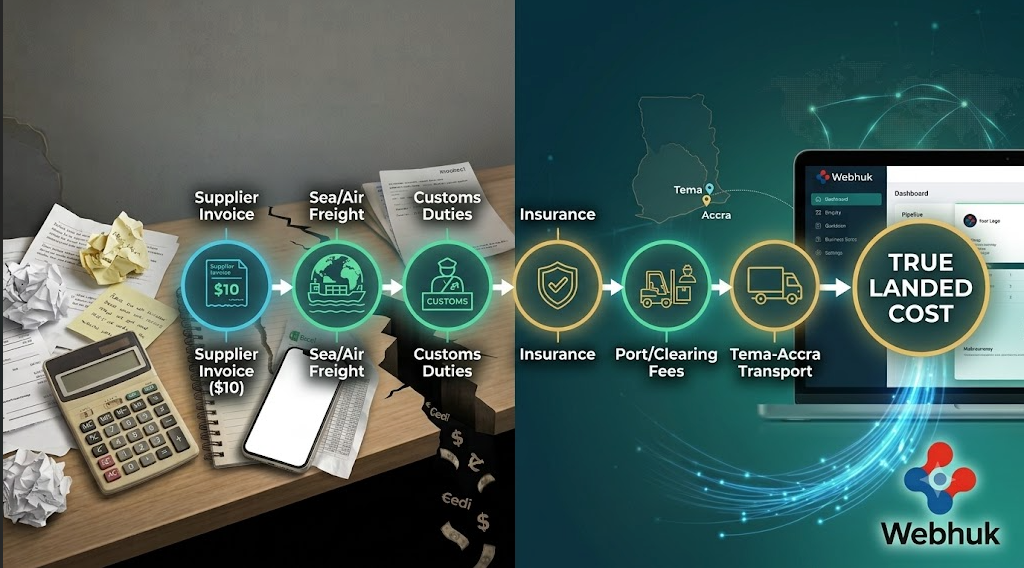
You buy an item from your supplier in China at $10. You sell it in Accra for the cedi equivalent of $14. That looks like a 40% margin — until you remember the sea freight, the insurance, the customs duty, the VAT and levies, the clearing agent's fees, the transport from Tema to your warehouse, and the fact that the cedi moved between the day you paid your supplier and the day you cleared the goods.
By the time all of that lands on your shelf, the item didn't cost you $10. It may have cost $13.20. Your "40% margin" was actually 6%, and one price-sensitive customer negotiation away from a loss.
This is why landed cost calculation is the single most important piece of arithmetic in an import business. This guide explains what landed cost is, walks through the formula with a worked example, covers the cost components specific to importing into Ghana, and shows how to stop doing it all in a fragile spreadsheet.
What Is Landed Cost?
Landed cost is the total cost of getting one unit of a product onto your shelf, ready to sell — not just the price on your supplier's invoice. It includes:
- The purchase price of the goods
- International freight (sea or air) and insurance
- Customs duty and import taxes and levies
- Port handling and clearing agent fees
- Local transport from the port to your warehouse
- Currency conversion at the rates you actually paid
Only when you know the landed cost per unit can you set a selling price that protects your margin, decide which products are worth importing again, and value your inventory correctly in your accounts.
Why the Supplier's Invoice Is Not Your Cost
The most common — and most expensive — mistake importers make is pricing off the supplier's invoice. That invoice reflects only the goods (and, depending on your trade terms, possibly freight). Everything that happens after the goods leave your supplier is your cost, and in West African import trade those downstream costs are substantial relative to the goods value, especially for heavier or duty-rated product categories.
The second mistake is treating clearing costs as one lump "business expense" instead of allocating them to the specific shipment. If the clearing bill for a mixed container is not spread across the items inside it, you literally do not know what any of those items cost you.
The Landed Cost Formula
The formula itself is simple:
Landed cost per unit = (Goods cost + Freight + Insurance + Duties, taxes & levies + Clearing & handling + Local transport) ÷ Number of units
The difficulty is not the arithmetic — it is capturing every cost, in the right currency, and allocating it to the right items. Let's make it concrete.
Worked Example (illustrative figures)
Ama imports 500 electric kettles from a supplier in Guangzhou:
| Cost item | Amount |
|---|---|
| Goods: 500 units × $10 (FOB) | $5,000 |
| Sea freight to Tema | $900 |
| Marine insurance | $60 |
| CIF value | $5,960 |
| Duties, VAT and levies (assessed on CIF — illustrative) | $2,150 |
| Clearing agent + port handling | $450 |
| Truck from Tema to Accra warehouse | $150 |
| Total landed cost | $8,710 |
Landed cost per kettle = $8,710 ÷ 500 = $17.42 — not $10.
If Ama had priced the kettles at a "healthy" 40% markup on the $10 supplier price ($14), she would have sold every single kettle at a loss of over $3. With the true landed cost in hand, she knows her floor price and can set her retail price deliberately.
The duty and levy figure above is illustrative. Actual rates in Ghana depend on the product's HS code and the current schedule of duties and levies — always confirm through your clearing agent or the Ghana Revenue Authority's ICUMS system before committing to an order.
Cost Components to Capture When Importing into Ghana
To make your landed cost calculation reliable, capture these six buckets for every shipment:
1. Goods cost. The supplier invoice, converted to cedis at the exchange rate you actually paid — not the rate on the day you do the calculation. If you paid in dollars bought at a forex bureau rate, that is your real rate.
2. Freight and insurance. Sea freight for containers or groupage (LCL) shipments, or air freight for urgent goods. Insurance is small but part of the customs value, so record it.
3. Duties, taxes and levies. Import duty is assessed on the CIF value of the goods and varies by product category (HS code). On top of duty, imports into Ghana attract VAT and a set of statutory levies. Rates change with budget cycles, so treat the assessment from ICUMS as the source of truth and record the total actually paid.
4. Clearing and port charges. Clearing agent fees, terminal handling, shipping line charges, and any demurrage if the container overstayed. Demurrage is a silent margin killer — track it separately so you can see what delays actually cost you.
5. Local logistics. Transport from the port to your warehouse, offloading labour, and any transit insurance.
6. Exchange rate effects. If weeks pass between paying the supplier and clearing the goods, the cedi may have moved. Using one consistent, actual-cost exchange rate per shipment keeps your numbers honest.
CIF vs FOB: Why Your Trade Terms Change the Math
Your incoterms determine which of these costs are already inside the supplier's price:
- FOB (Free On Board): the supplier's price covers the goods delivered onto the vessel. Freight and insurance are yours to arrange and add.
- C&F / CFR (Cost & Freight): freight is included in the supplier's price, but insurance is not.
- CIF (Cost, Insurance & Freight): goods, insurance, and freight to the destination port are all in the supplier's price. Duties, clearing, and local transport are still yours.
Two suppliers quoting "$10 per unit" — one FOB, one CIF — are not quoting the same price. Always normalise quotes to landed cost before comparing vendors.
Common Landed Cost Mistakes (and Their Symptoms)
- Pricing from the supplier invoice. Symptom: sales are strong but the bank balance never grows.
- Lumping clearing costs into general expenses. Symptom: you can't say which products are profitable.
- Allocating shared costs equally instead of proportionally. A container with blenders and phone cases shouldn't split freight 50/50 per item type — allocate by value or volume.
- Ignoring exchange-rate drift. Symptom: margins look fine in dollars and terrible in cedis.
- Doing it once, not per shipment. Freight rates and duty assessments change; last year's landed cost is not this year's.
Automating Landed Cost Instead of Wrestling Spreadsheets
Most importers run this calculation in Excel — one worksheet per shipment, formulas copied from the last one, and a silent prayer that no cell got overwritten. It works until it doesn't: a mistyped exchange rate or a forgotten demurrage bill quietly corrupts every price decision downstream.
This is a problem better solved inside the same system that already holds your purchase orders and inventory. In Webhuk, the flow looks like this:
- Raise the purchase order to your overseas vendor in their currency — the platform's multi-currency accounting handles USD, GBP, or any currency you add alongside cedis.
- Generate the purchase invoice with one click from the order — no retyping of line items.
- When the shipment arrives, use "Prepare for Arrival" to receive the goods into a specific branch and container (say, "Tema Warehouse → Bay 3"), so stock is tracked where it physically sits.
- Run the built-in Landed Price Calculation, which rolls duties, customs charges, and shipment costs into a true per-unit cost for the items received.
- Set your selling price from the landed cost, not the supplier price — and because the same system runs your enquiry-to-invoice workflow on the sales side, the margin you planned is the margin you quote.
The result is one thread from purchase order to priced shelf stock, with the per-unit truth calculated for you instead of reconstructed in a spreadsheet at midnight.
Webhuk plans start at 80 ghs per user per month, setup takes minutes, and there is a 14-day free trial — enough time to run your next shipment through it from order to arrival and see your real landed costs.
The Bottom Line
Importing profitably in Ghana is not about finding the cheapest supplier — it is about knowing, to the pesewa, what each unit truly costs by the time it reaches your shelf. Master the landed cost calculation, capture every cost bucket per shipment, and price from the landed figure. The importers who survive currency swings and duty changes are the ones who never guess their costs.
Start a 14-day free trial
Frequently Asked Questions
What is landed cost in simple terms? Landed cost is the total cost of one unit of imported goods once it reaches your warehouse — supplier price plus freight, insurance, duties and levies, clearing fees, and local transport, divided by the number of units.
How do I calculate the landed cost of imported goods? Add the goods cost, international freight, insurance, all duties and levies paid at customs, clearing and port charges, and transport to your warehouse. Divide the total by the number of units in the shipment. Use the exchange rates you actually paid when converting to cedis.
What costs are included when importing goods into Ghana? Beyond the supplier's price: freight and insurance, import duty assessed on the CIF value (varying by HS code), VAT and statutory levies, port and terminal handling, clearing agent fees, possible demurrage, and inland transport. Confirm current rates through your clearing agent or the GRA's ICUMS platform.
What is the difference between CIF and FOB pricing? FOB means the supplier's price covers goods loaded on the vessel only — you pay freight and insurance separately. CIF means goods, insurance, and freight to your port are included. Duties, clearing, and local transport are excluded from both and remain your cost.
How does exchange rate affect landed cost? Since supplier payments and freight are usually in foreign currency while you sell in cedis, the rate at which you actually bought that currency directly changes your cost per unit. Record the real rate paid per shipment rather than an average.
Can software calculate landed cost automatically? Yes. Platforms like Webhuk include a built-in Landed Price Calculation that rolls duties, customs charges, and shipment costs from your purchase invoice into a per-unit cost when goods are received — so selling prices are set from true costs rather than supplier invoices.