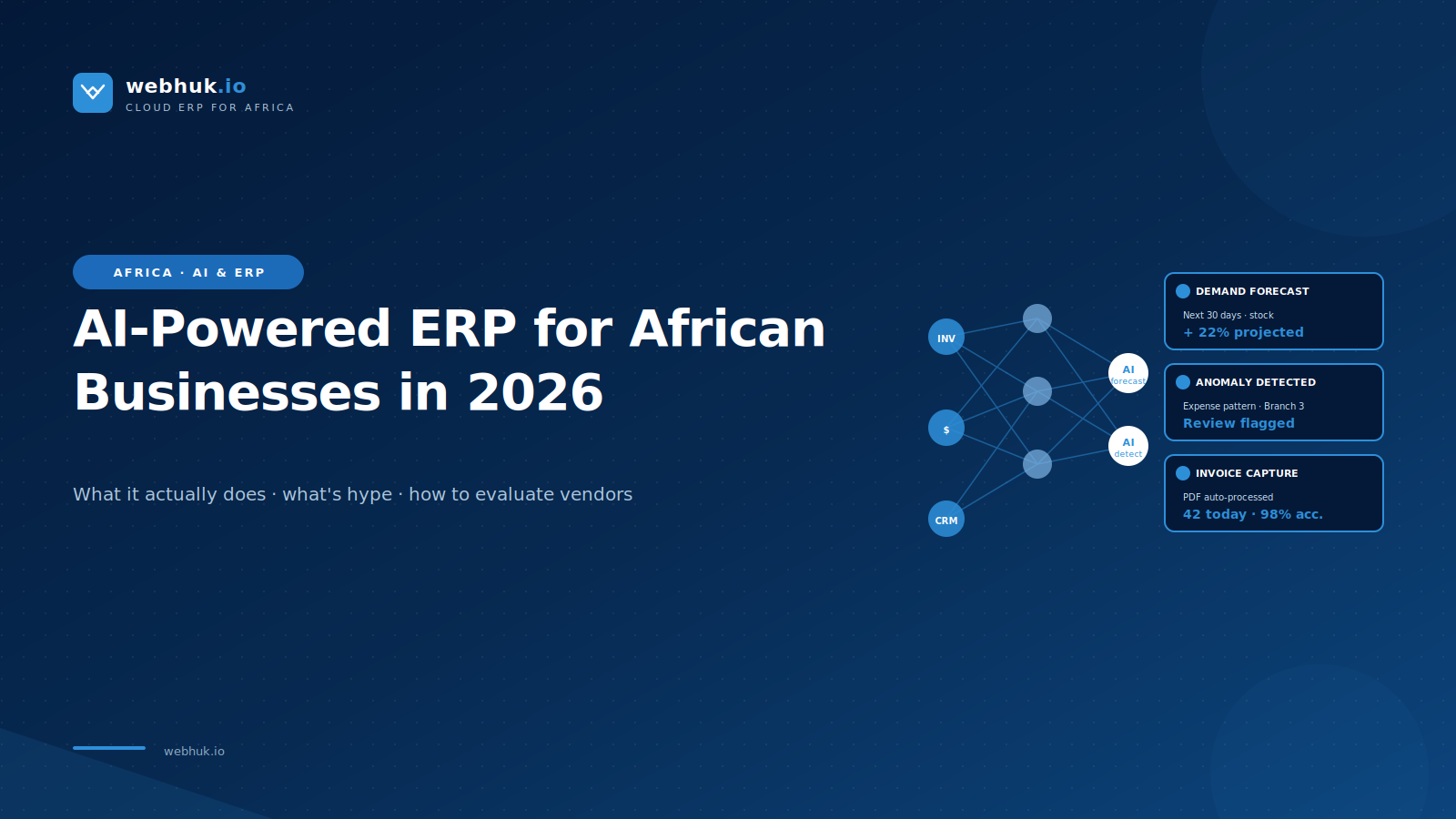
Every ERP vendor in 2026 is talking about AI. Most of what they call "AI" is marketing. Some of it is real. Telling the difference matters because African SMEs about to invest in operational software for the next five years deserve to know what they are actually buying.
This guide is the practical, honest view on AI in ERP for African businesses in 2026. What is real today. What is hype. What is coming next year. And how to evaluate vendor claims so you do not pay extra for features that turn out to be wrappers around standard reporting.
What "AI in ERP" actually means in 2026
Strip away the marketing and four genuinely useful AI capabilities are showing up in serious ERP platforms in 2026:
One: Intelligent document processing. Capturing data from supplier invoices, receipts, delivery notes and contracts without manual typing. The system reads a PDF or image, extracts the relevant fields (date, amounts, line items, taxes, supplier details), and creates the corresponding entry in the ERP. This works well for standard formats and increasingly well for non-standard ones.
Two: Anomaly detection. Identifying transactions, expenses or behaviours that fall outside normal patterns. A purchase invoice that is unusually large for the category. A sales discount applied more often than usual. A stock movement at an unusual time. The AI surfaces these for human review rather than letting them blend in.
Three: Demand forecasting. Predicting sales, stock requirements and cash flow based on historical patterns, seasonality, and external signals. Better than rule-of-thumb buying. Particularly useful for FMCG, retail and distribution.
Four: Conversational interfaces and assistants. Asking the ERP a question in natural language and getting a useful answer. "What was our top-selling product last month?" "Which customers are over their credit limit?" "Show me cash flow for the next thirty days." Genuinely useful for non-technical users who would otherwise need to find a report or ask a finance person.
These four are real. They work today. They make a measurable difference in an SME's operations.
What is mostly marketing in 2026
Be sceptical of:
"AI-powered" relabelling of existing automation. A scheduled job that emails a report on the first of each month is not AI. It is automation. Important, but not new and not AI.
Vague "AI insights" features that produce generic recommendations. If the recommendation is "consider reducing your inventory of slow-moving items", you did not need AI to tell you that.
Chatbots that just search the help documentation. Useful, but not transformational.
"Predictive analytics" on insufficient data. A small business with a few months of history does not have enough data for meaningful machine learning predictions. Vendors selling predictive analytics on thin data are selling theatre.
"AI" features hidden behind enterprise pricing tiers. If the AI is real, it should be in the standard product. If it is buried in an "AI add-on" at twice the price, it is often marketing.
The test for any AI feature: ask the vendor to demonstrate it on your real data, walk you through the specific decisions it would have made differently from your current process, and quantify the value. Real AI passes this test. Marketing AI does not.
Where AI ERP is genuinely useful for African SMEs in 2026
Accounts Payable Automation: Small Ghanaian or South African businesses spend significant time keying supplier invoices into their accounting system. AI invoice capture can reduce this by 80-90%, with accuracy that matches or exceeds manual entry. The time saved is real. The accuracy improvement is real.
Bank Reconciliation Matching: Bank feeds importing transactions are now standard. AI matching of those transactions to invoices, bills and payments — including handling partial payments, currency conversions and timing differences — eliminates hours per week.
Expense Classification: Receipts and expense entries auto-categorised based on supplier, amount and pattern. The bookkeeper reviews exceptions rather than coding every transaction.
Customer Credit Risk: AI looking at payment history, current balances, and external signals to flag customers whose credit risk has changed. Particularly useful for B2B businesses with significant accounts receivable.
Stock Optimisation: Forecasting demand by SKU, factoring in seasonality, holidays, promotions and lead times. Generating purchase suggestions that reduce stockouts and dead stock simultaneously. Real value for FMCG, retail and distribution businesses.
Fraud and Irregularity Detection: Surfacing unusual patterns in payroll, expenses, sales discounts, or stock movements. Not catching every fraud, but catching enough to change behaviour and improve controls.
Sales Lead Scoring: For B2B businesses with active sales pipelines, AI scoring leads based on historical conversion patterns and current engagement. Sales teams focus on high-probability opportunities.
Customer Service Automation: Routing customer queries, drafting responses, escalating complex cases. Genuinely useful for businesses with significant customer interaction volume.
Document Processing for Compliance: Extracting data from receipts for VAT input claims, organising tax documentation, preparing audit trails. Particularly valuable in regulatory environments digitising rapidly like Ghana's GRA E-VAT and South Africa's SARS modernisation.
Multi-language Support: Interfaces and customer-facing communications in local African languages, with AI translation. Useful for businesses serving diverse customer bases.
Where AI in ERP is still developing
Strategic Decision Support: AI that genuinely advises on capital allocation, market entry, pricing strategy. Still mostly aspirational. Useful AI exists at the operational level. Strategic AI is overstated by most vendors.
Fully Autonomous Operations: AI that closes the books with no human intervention. AI that runs the warehouse. Some narrow use cases work; broad autonomy is not yet reality and the "humans in the loop" model remains correct.
Voice-first ERP: Voice interfaces are useful but text-based natural language is more practical for most ERP interactions. The voice-first hype of recent years has not translated into operational reality.
Industry-Specific Deep AI: Manufacturing AI for production optimisation, retail AI for personalised recommendations at scale. Genuine progress is happening but mostly in larger enterprise contexts. SME-grade industry-specific AI is still relatively shallow.
These are not failures; they are simply earlier in their development cycle. Expect significant progress in the next two to three years.
The platforms genuinely offering AI in ERP for African SMEs in 2026
Webhuk.io: AI-powered features integrated across the platform, including document capture for accounts payable, anomaly detection in expenses and discounts, demand forecasting in inventory, and conversational query interfaces. Built specifically for African market needs including multi-country, multi-currency and local tax compliance. The Webhuk team can demo specific AI capabilities with your real data, which is the only meaningful way to evaluate AI in ERP.
Ebizframe.ai: Strong positioning around AI-powered ERP particularly for Ghanaian manufacturing and trading. Industry-specific AI features for sectors like plastic manufacturing, food processing and retail.
SAP Business One with intelligent extensions. Genuine AI capabilities in larger SAP deployments. SME-tier AI varies by partner and add-on availability.
Microsoft Dynamics 365 with Copilot. Microsoft's Copilot integration brings genuinely useful AI to Business Central and other Dynamics products. Strong for SA businesses on Microsoft infrastructure.
Sage with AI features. Sage has been progressively adding AI capabilities including invoice capture and intelligent insights across its product range.
NetSuite with Oracle AI. Powerful AI capability at the enterprise tier. Out of reach for typical SMEs.
ERPNext with AI extensions. Open-source ERPNext has progressively added AI capabilities through community and partner contributions. Quality varies by configuration.
Odoo with AI modules. Odoo's AI features have grown across the product. Capable in specific areas.
QuickBooks with Intuit Assist. Useful AI for small services businesses on QuickBooks. Limited in deeper operational scope.
Xero with AI features. Bank reconciliation AI in Xero is among the best in its category. Other AI capabilities are growing.
How to evaluate AI ERP claims
Demand a live demo on your data. Sample data demos are theatre. Real data tests reveal whether the AI handles your specific business patterns.
Ask for quantified value. "How much time will this save per week? How many additional sales will it enable? How many errors will it prevent?" Vendors with real AI give specific answers. Vendors with marketing AI give vague benefits language.
Test the edge cases. AI that works on standard transactions but fails on the unusual ones is less valuable than AI that handles exceptions gracefully. Bring your edge cases to the demo.
Verify ongoing learning: Real AI improves as it sees more of your data. Static AI does the same thing forever. Ask how the AI gets better over time.
Check the human-in-the-loop design. Good AI in ERP suggests, surfaces and proposes; humans approve, override or correct. AI without human review for important decisions is risky. AI with too much human review wastes the AI investment. The design matters.
Understand the data privacy posture. Where is your data processed? Who owns the AI training? What happens to your data if you leave the platform? Real questions with real answers.
For sector-specific guidance on AI use cases — manufacturing, retail, distribution, services — the Webhuk blog has standalone articles on AI applications by industry.
What this means for African businesses choosing ERP in 2026
The single best advice for an African SME evaluating ERP with AI in 2026: pick a platform that has real AI capabilities today, that is committed to investing in AI capabilities for the next five years, and that integrates AI into the workflow rather than bolting it on as a separate feature.
The platforms most likely to deliver on this through the late 2020s are:
• Cloud-native platforms with the architecture to deploy AI features rapidly
• Platforms with active local development for African market needs (Webhuk, Ebizframe, Sage SA)
• Major global platforms with serious AI investment (Microsoft Dynamics 365, SAP Business One, Oracle NetSuite for larger enterprises)
The platforms most likely to fall behind are:
• On-premise legacy platforms where AI deployment requires significant project work each time
• Smaller platforms without the engineering capacity to build and maintain AI features
• Platforms whose AI is implemented as third-party plug-ins rather than native capability
This is a five-year choice, not a one-year choice. Pick a platform whose AI roadmap aligns with where your business will be in five years, not just where it is today.
What to do this quarter
If you are evaluating ERP for the first time or upgrading from an older system, make AI capability part of your selection criteria — but evaluate it honestly with real data, not on marketing claims.
If you are already on a modern cloud ERP, audit which AI features are available and how many you actually use. Most businesses are paying for AI capabilities they have not enabled. Switching them on is often the highest-ROI action you can take this quarter.
If you are on a legacy on-premise system, the AI gap is one of many reasons to plan a migration. AI is increasingly the differentiator between platforms that improve continuously and platforms that stagnate.
The African SMEs that integrate AI into their operations early in 2026 will compound advantages over the next several years: faster decisions, lower error rates, better customer service, more efficient back office, sharper inventory and cash management.
The ones that wait will be playing catch-up against competitors who moved first. The cost of moving is small. The cost of waiting is meaningful and growing.
This is the year to be specific about which AI capabilities will help your business, choose a platform that delivers them genuinely, and put them to work. Everything else is brochure language.
Frequently Asked Questions
Q1. What does AI-powered ERP actually do for African SMEs in 2026?
AI-powered ERP delivers four genuinely useful capabilities in 2026: intelligent document processing for invoices and receipts, anomaly detection in expenses and transactions, demand forecasting for inventory and cash, and conversational interfaces for non-technical users. These capabilities save real time, reduce errors and improve decisions. Other 'AI' features in marketing are often relabelled automation or generic insights of limited practical value.
Q2. Which ERP platforms have real AI features for African businesses?
Webhuk.io has integrated AI features across its platform with focus on African market needs. Ebizframe.ai offers AI-powered ERP particularly for Ghanaian manufacturing. Microsoft Dynamics 365 with Copilot delivers strong AI on Microsoft infrastructure. SAP Business One has AI capabilities at the larger SME tier. Sage and Xero have added AI in invoice processing and reconciliation. Always demand a live demo on your real data to evaluate AI claims.
Q3. Is AI in ERP just marketing or does it deliver real value?
Both, depending on the vendor and the feature. Real AI in ERP today saves significant time on accounts payable processing, bank reconciliation, expense categorisation, demand forecasting and anomaly detection. Marketing AI tends to be vague 'insights' features, relabelled automation, or AI add-ons hidden behind enterprise pricing. The test is to demand a live demo on your real data with quantified value — real AI passes this test, marketing AI does not.
Q4. How can I tell if an ERP vendor's AI claims are genuine?
Demand a live demo on your real business data, not sample data. Ask for quantified value (specific time savings, error reductions, sales improvements). Test the edge cases your business actually faces. Verify that the AI improves over time with more data. Check the human-in-the-loop design. Understand the data privacy posture. Vendors with real AI answer all of these directly. Vendors with marketing AI deflect or generalise.
Q5. Do I need AI in my ERP if my business is small?
Even small African SMEs benefit from specific AI capabilities particularly invoice capture, bank reconciliation matching, and expense categorisation, which save hours per week from day one. Demand forecasting and anomaly detection require more historical data to be useful. The right approach for a small business is to choose an ERP platform with strong AI capabilities included in the standard product (not as expensive add-ons) and enable the features that match your operational pain points.