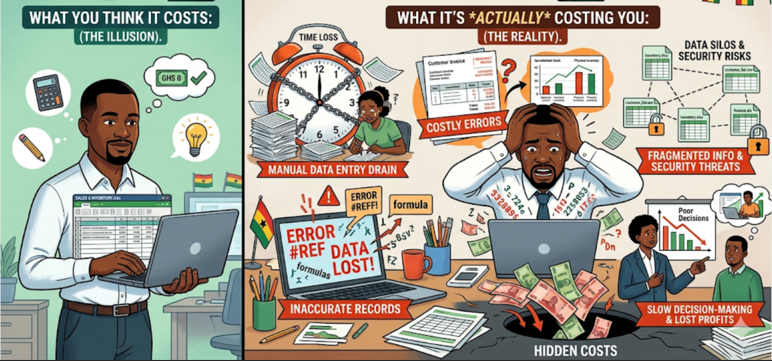
Spreadsheets are comfortable. They are familiar, flexible, and free. For a business just starting out, Excel or Google Sheets can handle nearly everything — tracking orders, managing a small inventory, sending invoices, even basic bookkeeping.
But there is a point where that comfort becomes a trap. And most SME owners do not realise they have crossed it until the problems start compounding — missed orders, incorrect invoices, stock discrepancies that nobody can explain, and month-end reconciliations that consume entire weekends.
If your business has grown beyond a handful of customers and a single location, your spreadsheets are probably costing you more than you think.
Where Businesses Go Wrong: When Spreadsheets Become the System
The problem is not spreadsheets themselves. The problem is when spreadsheets become the backbone of your operations — when your quoting process, your inventory tracking, your procurement, and your invoicing all depend on manually maintained files that exist in isolation.
Industry surveys consistently show that spreadsheet use remains deeply entrenched among SMEs. Nearly 60 percent of small businesses still use spreadsheets for core finance tasks, and among financial planning professionals, Excel usage is nearly universal. This is not because spreadsheets are the best tool for the job. It is because they are the tool people already know.
The trouble starts when these spreadsheets multiply. One for price lists. Another for customer orders. A third for inventory counts. A fourth for vendor purchase orders. A fifth for tracking who has paid and who has not. Each file holds a version of the truth, and none of them talk to each other.
A Scenario You Might Recognise
Amina runs a wholesale cosmetics and household goods business in Kumasi. She has two shops and supplies smaller retailers across the region. Her inventory spreadsheet lives on her laptop. Her sales tracker is a Google Sheet shared with her two sales reps. Her invoices are created in a free invoicing app. And her procurement — orders to suppliers in Lagos and Guangzhou — is managed through WhatsApp messages and a separate Excel file.
Every Monday, Amina spends three hours trying to reconcile what was sold, what was invoiced, and what is left in stock. The numbers rarely match. Last month, she quoted a retailer a price for a bulk order of shampoo, only to discover after delivery that her cost spreadsheet had not been updated with the latest shipping charges. She lost margin on the entire order without realising it until she did her monthly review.
Amina is not careless. She is organised. But her systems are working against her.
What This Is Costing You
The hidden costs of spreadsheet dependence show up in four places.
Time That Disappears Into Reconciliation
When data lives in multiple disconnected files, someone has to manually cross-check them. For most SME owners and their admin staff, this means two to six hours per week spent on work that adds no value — copying numbers from one sheet to another, hunting for discrepancies, and fixing errors. Over a year, that is hundreds of hours diverted from selling, serving customers, or making strategic decisions.
Errors That Erode Your Margins
Manual data entry is inherently error-prone. A transposed digit in a price. A SKU code mistyped when moving data between the inventory sheet and the invoice. A formula that breaks when someone accidentally edits the wrong cell. These are not dramatic failures. They are quiet, persistent leaks. Businesses that migrate from spreadsheets to integrated platforms typically see billing and invoice errors drop by 60 to 90 percent — which tells you how many errors were happening before.
Inventory You Cannot Trust
A spreadsheet only reflects reality at the exact moment someone updates it. Between updates, stock moves — items are sold, returned, transferred between branches, or received from suppliers. If those movements are not captured in real time, your inventory numbers are fiction. Over-ordering ties up capital. Under-ordering means stockouts and lost sales. For small retailers and distributors, excess inventory alone can tie up 20 to 60 percent of working capital.
Cashflow Blind Spots
When invoices are generated in one tool and payment tracking lives in a spreadsheet, you lose visibility into what is actually owed to you. Aging reports are only as accurate as the last time someone manually updated them. Late payments slip through. Follow-ups are delayed. And the real cash position of your business becomes a guess rather than a fact.
A Better Way to Operate: From Scattered Sheets to a Single System
The solution is not to build a better spreadsheet. It is to replace the spreadsheet-as-system model with a purpose-built operational platform that handles quotes, orders, inventory, invoicing, and payment tracking in one connected workflow.
This does not mean buying a complex enterprise ERP that takes six months to implement and costs tens of thousands of dollars. For most SMEs, what is needed is far simpler: a system where a quotation becomes a sales order becomes an invoice becomes a tracked payment — automatically, with one set of data flowing through every step.
When your inventory updates in real time as sales and purchases happen, you stop guessing what you have in stock. When your invoices are generated from the same data as your quotes, pricing errors vanish. When payment status is visible on a dashboard instead of buried in a spreadsheet tab, you stop chasing payments you forgot were overdue.
How Webhuk Replaces Spreadsheet Chaos With Operational Clarity
Webhuk is designed for exactly this transition. It is a cloud-native operational platform built for SMEs who have outgrown spreadsheets but do not need — or want — the cost and complexity of a traditional ERP.
With Webhuk, your entire business workflow lives in one place. Customer enquiries flow into quotations. Approved quotes convert into sales orders with a single action. Inventory across all your branches updates in real time as goods move in and out. Invoices are generated from the same data, so they always match the original agreement. And your receivables dashboard shows exactly who owes what, when it was due, and how long it has been outstanding.
For businesses managing imports, Webhuk includes container-based pricing logic that automatically calculates landed costs and allocates them to each SKU. That means your price lists always reflect true costs — no more manually updating a spreadsheet every time a new shipment clears customs.
Webhuk also supports multi-currency invoicing with automatic exchange rate management, which is essential for businesses trading across borders.
The platform is designed for speed. Most businesses go live within 30 days, with no heavy consulting or technical setup. It is not about replacing everything overnight. It is about giving your operations a single source of truth so you can stop spending your time reconciling and start spending it growing.
Ready to move beyond spreadsheets? Start your free 7-day trial of Webhuk and see how a connected system transforms your daily operations.
Learn more: Real-Time Multi-Branch Inventory Management
Explore: Multi-Currency Invoicing and Exchange Rate Management
Frequently Asked Questions
When should an SME stop using spreadsheets for operations?
Once your business has multiple customers, more than one location, or a team of people involved in sales, procurement, and finance, spreadsheets become a liability. The telltale signs are frequent data errors, hours spent on reconciliation, and an inability to see real-time stock or cash positions.
Can spreadsheets and an operational platform work together?
Yes. Most businesses transition gradually. You can start by moving your core workflow — quoting, ordering, invoicing — into a platform like Webhuk while still using spreadsheets for ad hoc analysis. Over time, as the platform captures more of your operational data, the need for spreadsheets diminishes naturally.
What is the difference between an ERP and an operational workflow platform?
Traditional ERP systems try to cover every business function, from HR to manufacturing. An operational workflow platform like Webhuk focuses on the core processes that drive revenue and cash: quotation, sales, procurement, inventory, and payment. This makes it faster to deploy and easier to adopt without the cost and complexity of full ERP.
How much do spreadsheet errors actually cost a small business?
The cost varies, but studies show that businesses relying on disconnected spreadsheets experience higher rates of billing errors, longer payment cycles, and more frequent inventory discrepancies. When these are quantified — lost deals, disputed invoices, excess stock — the hidden cost often runs into thousands per month for even a modestly sized operation.
Does Webhuk require technical expertise to set up?
No. Webhuk is designed for business owners and operations managers, not IT teams. Most SMEs go live within 30 days with guided onboarding and pre-configured workflows. There is no heavy implementation or consulting required.
See also: Excel vs. Cloud ERP: 5 Signs Your Business Has Outgrown Spreadsheets