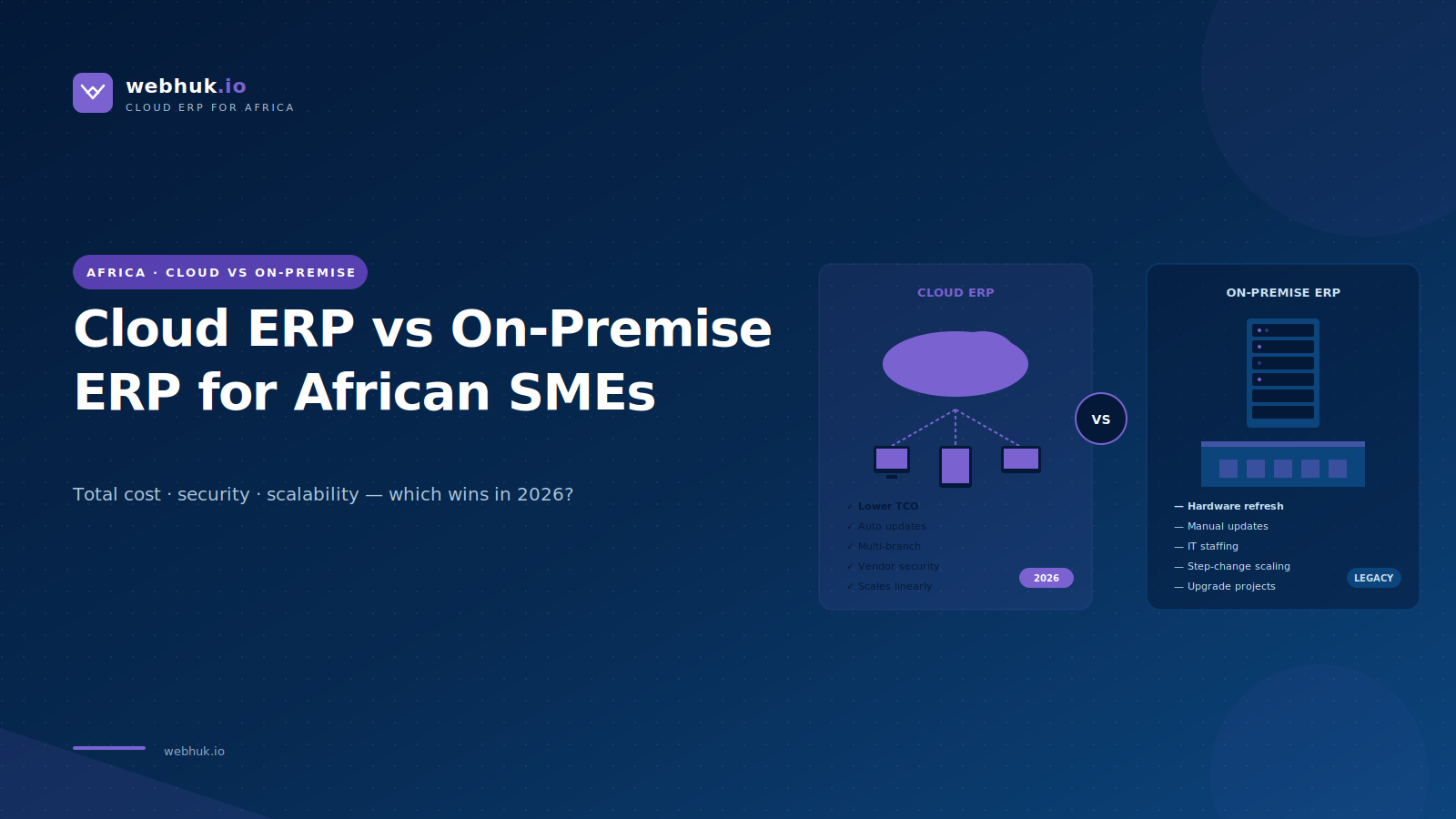
For most of the last twenty years, the answer to "cloud or on-premise?" was complicated. The cloud option was not always reliable. African connectivity varied dramatically. On-premise systems gave you control. Cloud systems gave you flexibility. Reasonable people landed on different sides of the debate depending on their specific circumstances.
In 2026, the answer has simplified. For the overwhelming majority of African SMEs, cloud wins. The question is no longer whether to go cloud, but how to do it well, with which platform, and how to manage the genuine edge cases where on-premise still makes sense.
This guide is the honest comparison for African SME decision-makers — owners and CIOs in Ghana, South Africa, Nigeria, Kenya and beyond — wrestling with the architecture choice in 2026.
What "cloud" and "on-premise" actually mean
Cloud ERP: The software runs in a data centre operated by the vendor or a hosting provider. You access it via the internet, typically through a browser. Updates are pushed automatically. Backup, security and infrastructure are the vendor's problem. You pay a monthly or annual subscription.
On-premise ERP: The software runs on servers physically located at your office, factory or warehouse. You buy the licence outright (or pay annual maintenance). You buy and maintain the server hardware. You handle backup, security, updates and infrastructure. You typically need internal IT capacity or an external IT services provider.
Hybrid: Some workloads in the cloud, others on-premise, with integration between them. Common in transitional or specific-use cases.
The architectural choice cascades through every aspect of cost, capability and risk for the business. It is not a small decision.
The cost comparison nobody runs honestly
Most ERP vendors will show you a five-year total cost of ownership comparison. Most of these are gamed in favour of whichever option the vendor sells.
The honest cost picture:
On-premise total cost over five years includes:
• Software licence (often a substantial up-front payment)
• Server hardware (initial purchase, refresh after three to five years)
• Operating system and database licences (often substantial)
• Network and physical security infrastructure
• Backup hardware and software
• Annual software maintenance (typically 15-22% of licence cost)
• Internal IT staff time or external IT services contract
• Power, cooling, physical space
• Disaster recovery setup and testing
• Periodic upgrade projects (every two to four years, often costing as much as initial implementation)
Cloud ERP total cost over five years includes:
• Monthly subscription fees per user or per module
• Implementation and configuration cost
• Training cost
• Integration cost for connected systems
• Internal time managing the relationship with the vendor
For a typical mid-market African SME doing GHS 30m / ZAR 50m / NGN 1bn in revenue, the five-year total cost of cloud is usually 30-50% lower than equivalent on-premise. For smaller businesses, the gap widens further.
Vendors selling on-premise often skip or minimise the hidden costs of hardware refresh, IT staffing, upgrade projects and disaster recovery. Once these are properly accounted for, the cost case for cloud becomes overwhelming for most businesses.
Where on-premise still genuinely makes sense
Honesty matters. On-premise still has legitimate use cases:
Industries with extreme regulatory data residency requirements. Some jurisdictions require certain data — typically defence, sensitive financial services, certain government contracts — to remain physically within country borders. Cloud platforms with local data centres often address this, but for the strictest cases on-premise remains the only option.
Operations in extremely remote locations with no reliable internet. A mining operation deep in a remote area with intermittent satellite connectivity may genuinely need on-premise infrastructure. The exception is shrinking as connectivity improves.
Very large enterprises with deep existing on-premise investments. A business with an existing data centre, internal IT staff, decades of customisation and integration with on-premise systems may find the migration cost to cloud genuinely high. These are the cases where hybrid often becomes the answer.
Specific compliance requirements for particular workloads. Even within a primarily cloud business, some specific systems may need on-premise treatment.
For the typical African SME — retail, distribution, manufacturing, services, hospitality, not handling defence-classified data — none of these exceptions apply. Cloud is the rational choice.
The connectivity question, honestly answered
The historical objection to cloud in Africa was internet reliability. In 2026, this objection has weakened significantly but not disappeared.
Reality varies dramatically by location:
Major urban centres (Accra, Lagos, Johannesburg, Nairobi, Cape Town, Kampala, Dakar). Connectivity is broadly reliable, with multiple ISPs, fibre availability, redundant options, and acceptable mobile data fallback. Cloud is essentially always viable.
Secondary cities and towns. Connectivity is good and improving. Most cloud ERP works well, with periodic outages handled by offline mode in well-designed platforms.
Rural areas, mining sites, remote operations. Connectivity remains inconsistent. Cloud-only without offline mode is risky. Cloud-with-strong-offline or hybrid architectures are the realistic answer.
For any business operating primarily in major and secondary urban centres, cloud is reliable enough in 2026. The remaining edge cases — remote operations — are the legitimate territory for hybrid or on-premise.
The other piece of this puzzle is that modern cloud ERP for Africa, including Webhuk, is built with offline tolerance from day one. Sales can continue at a POS during connectivity drops. Stock movements are queued. Reconciliation happens automatically when the connection returns. This is fundamentally different from older cloud architectures that broke completely when the internet went down.
The Webhuk team can walk through specific connectivity considerations for your business locations and explain how the offline mode handles outages in real-world African conditions.
Security: who actually does it better?
The instinct that "data on my own server is safer than data in someone else's data centre" is widespread and almost always wrong.
Cloud security advantages in 2026:
• Vendor-grade physical security in tier-3 or tier-4 data centres
• Vendor-grade cybersecurity with full-time security engineering teams
• Automatic patching and updates
• Encrypted data at rest and in transit by default
• Multi-factor authentication standard
• Automated backup with off-site replication
• Disaster recovery built into the architecture
• Compliance certifications (ISO 27001, SOC 2, etc.)
On-premise security in practice for African SMEs:
• Physical security of the office or warehouse where the server lives
• Local IT staff (often part-time or external) handling security
• Patching that may or may not happen on schedule
• Backups that may or may not work when needed
• Often no formal disaster recovery
• Often no certifications or formal security audit
The cloud vendors employ thousands of security engineers, run twenty-four-hour security operations centres, and invest billions in security infrastructure. The typical African SME has one IT person who is also responsible for printer paper. The security comparison is not close.
The cases where on-premise security genuinely beats cloud are rare and usually involve either extreme regulatory requirements or very large enterprises with serious internal security capability — neither of which describes the typical SME.
Scalability and flexibility
Cloud scales linearly. Add a user, increase the subscription. Open a new branch, expand the licence. Spin up a test environment, get one. Decommission a module, reduce the subscription. The infrastructure is the vendor's problem.
On-premise scales in step changes. Add a few users, no problem. Add many users, you need a bigger server. Open a new branch, you need network infrastructure or a separate server installation. Test environments require separate hardware. Every step of growth involves capital expenditure and IT project work.
For businesses growing or planning to grow — most African SMEs in 2026 — cloud's elasticity is a genuine operational advantage, not just a cost difference.
Updates and capability evolution
Cloud platforms push updates continuously. New features, security patches, regulatory updates. Compliance with new tax rules from the GRA, SARS, FIRS or KRA arrives automatically without you running an upgrade project.
On-premise platforms update on a release cycle, often annually or every two years for major releases. Each upgrade is a project. Some businesses skip upgrades to avoid the project cost, ending up on increasingly outdated versions.
In a regulatory environment that is digitising rapidly across Africa — e-invoicing, real-time tax reporting, digital labour reporting — being on a continuously updated platform is a meaningful advantage.
The migration question
Businesses currently on on-premise systems often hesitate to move to cloud because of migration cost and disruption. This is understandable but typically overestimated.
A realistic migration project for a mid-market African SME:
• Three to nine months end-to-end depending on complexity
• Cost typically 50-150% of one year of cloud subscription, paid once
• Involves data migration, configuration, training and parallel running
• Recovers the cost in cloud savings within twelve to twenty-four months for most businesses
• Brings significant operational improvements beyond pure cost — reporting, collaboration, mobile access, automation
The businesses most successful at migration are the ones that:
• Treat it as a business transformation project, not just a software change
• Take the opportunity to clean and standardise data
• Document and improve processes during migration
• Train staff thoroughly
• Run a proper parallel period
The businesses that struggle are typically the ones that try to replicate their existing on-premise system exactly in the cloud, missing the chance to improve while migrating.
What to actually do in 2026
For new businesses, businesses upgrading from spreadsheets, or businesses on legacy systems past their useful life: Go cloud. The case is no longer close. Cloud SME ERP platforms — Webhuk, Sage Business Cloud, Xero with apps, Zoho One, ERPNext on cloud, Odoo Online — are mature, capable, locally relevant, and economically rational.
For businesses on relatively recent on-premise systems with three or more years of useful life remaining: Plan the migration but don't necessarily rush it. Run the cost comparison honestly. Begin building the case for migration in two to four years.
For businesses on truly old on-premise systems running on aging hardware: Migrate this year. The risks of running outdated infrastructure are larger than the migration cost.
For genuinely complex enterprise operations with significant existing on-premise investments: Hybrid is often the realistic answer. Move the easier workloads to cloud. Keep the deeply customised core on-premise until the migration economics improve.
For sector-specific guidance on cloud migration considerations in retail, manufacturing, distribution and services, the Webhuk blog has detailed sector articles worth reading before starting the project.
The straight answer
For the typical African SME in 2026 — a business doing GHS 5m to GHS 500m / ZAR 10m to ZAR 1bn / NGN 50m to NGN 5bn in revenue, operating in retail, distribution, manufacturing, services or hospitality, in major or secondary urban centres — cloud ERP is the rational choice. Lower total cost. Better security. Better scalability. Better resilience. Faster compliance with evolving regulatory requirements. Modern user experience that the workforce expects.
On-premise remains the right answer for specific edge cases — extreme regulatory requirements, genuinely remote operations, very large existing investments. For the rest of the market, the question has been settled.
The businesses still debating cloud versus on-premise in 2026 are usually really debating something else: comfort with change, internal political dynamics, sunk-cost reluctance to abandon existing systems. The economic and operational case is no longer in serious doubt.
This is the year to act on it.
Frequently Asked Questions
Q1. Is cloud ERP cheaper than on-premise ERP for African SMEs?
Yes, for most African SMEs in 2026 cloud ERP delivers 30-50% lower total cost of ownership over five years compared to equivalent on-premise systems. The savings come from eliminating server hardware, IT staffing, infrastructure costs, periodic upgrade projects, disaster recovery infrastructure, and physical space. The gap is wider for smaller businesses and narrower for very large enterprises with significant existing investments.
Q2. Is cloud ERP secure enough for African businesses?
Yes, in 2026 cloud ERP is generally significantly more secure than typical on-premise deployments at African SMEs. Cloud vendors operate tier-3 or tier-4 data centres, employ full-time security engineering teams, push automatic patches and updates, encrypt data at rest and in transit by default, and maintain compliance certifications. The typical SME on-premise environment has none of these. The instinct that local servers are safer than cloud is almost always wrong.
Q3. Does cloud ERP work with unreliable internet in Africa?
Modern cloud ERP designed for African conditions includes offline mode that allows continued operation during connectivity outages. Sales at POS continue, stock movements are queued, and reconciliation happens automatically when the connection returns. This is different from older cloud architectures that broke completely when the internet went down. For businesses in major and secondary urban centres, cloud with offline mode is reliable. For genuinely remote operations like mining sites, hybrid or on-premise may still be appropriate.
Q4. How long does it take to migrate from on-premise to cloud ERP?
A typical migration for a mid-market African SME takes three to nine months end to end, depending on complexity. The cost is usually 50-150% of one year of cloud subscription, paid once during the project. The migration recovers cost within twelve to twenty-four months through reduced infrastructure, IT staffing and upgrade project costs. The businesses most successful at migration treat it as a business transformation, not just a software change.
Q5. When is on-premise ERP still the right choice in 2026?
On-premise ERP remains the right choice for specific edge cases: industries with extreme regulatory data residency requirements like defence and certain financial services, operations in genuinely remote locations with no reliable internet, very large enterprises with deep existing on-premise investments where migration cost is high, and specific compliance requirements for particular workloads. For the typical African SME in retail, distribution, manufacturing, services or hospitality, none of these apply and cloud is the rational choice.