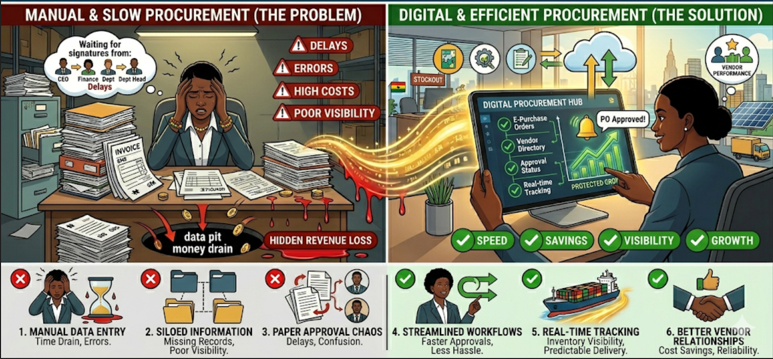
Procurement does not get the attention it deserves in most small and medium enterprises. Sales is visible. Invoicing is urgent. But the process of sourcing goods, requesting quotes from suppliers, comparing bids, raising purchase orders, and tracking deliveries? That tends to live in a grey zone of emails, phone calls, and informal agreements.
Until something goes wrong. A supplier delivers the wrong quantity. A purchase order was never formally raised, so there is no paper trail when a dispute arises. The price you paid does not match the price you were quoted because the quote was buried in a WhatsApp thread from three weeks ago. Or worst of all, you only discover you are out of a critical item when a customer order cannot be fulfilled.
For growing SMEs, a disorganised procurement process is not just an inconvenience. It is a direct drag on margins, cash, and customer trust.
Where Businesses Go Wrong: Procurement by Inbox and Instinct
In most SMEs, procurement starts with a need — stock is running low, a customer has placed a large order, or a new product line needs to be sourced. What happens next is usually informal: the business owner or a procurement lead reaches out to known suppliers via email or messaging apps, asks for pricing, and makes a decision based on whoever responds first or offers the best-sounding deal.
The problems with this approach are structural, not personal.
First, there is no centralised record of supplier quotes. When you receive pricing from three vendors through three different channels — one via email, one via WhatsApp, one via a phone call — comparing them side by side requires manual effort. Details get lost. The quote that included free shipping but a longer lead time gets forgotten in favour of the one that arrived most recently.
Second, purchase orders are either not raised at all or raised after the fact. Many SMEs operate on verbal agreements with suppliers, only creating documentation when something goes wrong. This leaves the business exposed to disputes over quantities, pricing, and delivery terms.
Third, procurement and inventory are disconnected. The person ordering goods may not have real-time visibility into what is actually in stock across all branches. This leads to either over-ordering — tying up capital in excess inventory — or under-ordering, which results in stockouts and missed sales.
A Scenario You Might Recognise
Daniel imports electronics accessories from Shenzhen and distributes them across three retail outlets in Lagos. When stock runs low at one branch, the store manager sends him a WhatsApp message. Daniel then contacts two or three suppliers in China, negotiates prices over email, and places an order — often without a formal purchase order.
Last quarter, a shipment arrived with 500 units of the wrong phone case variant. Daniel had no written PO specifying the exact model numbers. The supplier insisted the order matched what was discussed. Without documentation, Daniel had to absorb the loss — stock he could not sell sitting in his warehouse for months.
Meanwhile, his Ikeja branch had been re-ordering the same USB cables he already had in excess at his Lekki location. Nobody could see the full inventory picture across branches, so procurement decisions were made branch by branch, in isolation.
What This Is Costing You
Overpaying Suppliers Without Realising It
When you cannot easily compare vendor quotations side by side — with all terms, lead times, and pricing visible in one place — you make decisions based on incomplete information. Over time, this means consistently paying more than you need to, or choosing suppliers whose total cost (including shipping, duties, and lead time) is actually higher than alternatives.
Capital Locked in the Wrong Inventory
Procurement without inventory visibility leads to ordering what you think you need rather than what you actually need. The result is a warehouse full of slow-moving items and empty shelves where your best sellers should be. For distributors and retailers, excess inventory can lock up 20 to 60 percent of working capital — money that could be generating returns elsewhere.
Disputes Without a Paper Trail
Every informal purchase agreement is a dispute waiting to happen. When there is no documented purchase order with agreed quantities, specs, and pricing, the business has no leverage when a supplier delivers short, late, or at a different price. These disputes consume management time and often end with the business absorbing the cost.
Slower Operations Across the Board
A slow procurement process has a ripple effect. If sourcing takes days instead of hours, customer orders are delayed. If purchase orders are not tracked, goods arrive without anyone prepared to receive and allocate them. Every inefficiency in procurement shows up downstream — in inventory, in sales, and ultimately in cashflow.
A Better Way to Operate: Structured Procurement That Feeds Your Entire Workflow
The fix is not hiring a procurement specialist or building a more elaborate spreadsheet. It is embedding procurement into your operational system so that every purchase request, vendor quote, and purchase order is captured, tracked, and connected to the rest of your business.
A structured procurement workflow looks like this: when stock falls below a defined threshold or a customer order requires items you do not have, the system flags the need. You send a request for quotation to your registered suppliers directly from the platform. Vendor responses are captured in one place, making side-by-side comparison straightforward. Once you select a supplier, a purchase order is generated automatically with the agreed terms. That PO links to your inventory, so when goods arrive, stock levels update and costs flow through to your pricing and accounting.
This is not complex. It is disciplined. And the discipline pays for itself almost immediately in fewer errors, faster cycles, and better supplier relationships.
How Webhuk Brings Procurement Into Your Operational Flow
Webhuk treats procurement as a core part of the business workflow, not an afterthought. Within the platform, you can manage your full supplier database, send automated requests for quotation, compare vendor bids side by side, and generate purchase orders that are linked directly to your inventory and financial records.
When a purchase order is raised in Webhuk, it connects to your multi-branch inventory. As goods are received, stock levels update in real time across all locations. Landed costs — including shipping, duties, and container charges — are allocated automatically to each SKU, so your pricing always reflects true costs.
For businesses managing imports, this is especially powerful. Webhuk’s container-based pricing logic means you do not need to manually calculate cost-per-unit every time a new shipment arrives. The system does it for you and pushes the correct figures into your quotes and invoices.
The result is a procurement process that is fast, documented, and fully connected to everything that happens after the goods arrive — from warehousing to sales to payment collection.
Ready to bring structure to your procurement? Try Webhuk free for 7 days and see how connected workflows eliminate procurement chaos.
Learn more: How Enquiries, Quotations, Orders and Invoices Work in Webhuk
Explore: Webhuk Multi-Branch Inventory Management
Frequently Asked Questions
What is an RFQ and why does it matter for SMEs?
An RFQ (Request for Quotation) is a formal process of asking suppliers to submit their pricing and terms for specific goods. It matters because it creates a documented, comparable basis for purchasing decisions — reducing the risk of overpaying or ordering from the wrong supplier.
How does poor procurement affect inventory levels?
When procurement operates in isolation from inventory data, businesses either over-order (tying up capital) or under-order (causing stockouts). Connecting procurement to real-time stock visibility ensures purchasing decisions are based on actual demand rather than guesswork.
Can Webhuk manage international suppliers and imports?
Yes. Webhuk supports multi-currency transactions and includes container-based pricing logic designed specifically for importers. Landed costs are automatically calculated and allocated to each SKU as goods are received.
What happens if I do not use formal purchase orders?
Without documented purchase orders, you have no enforceable record of what was agreed with a supplier. This exposes your business to disputes over quantity, pricing, specifications, and delivery terms — disputes that almost always cost you money.
How quickly can I set up procurement in Webhuk?
Procurement modules are part of Webhuk’s core platform. Once your supplier database and SKUs are configured, you can start sending RFQs and generating purchase orders immediately. Most businesses are fully operational within 30 days.