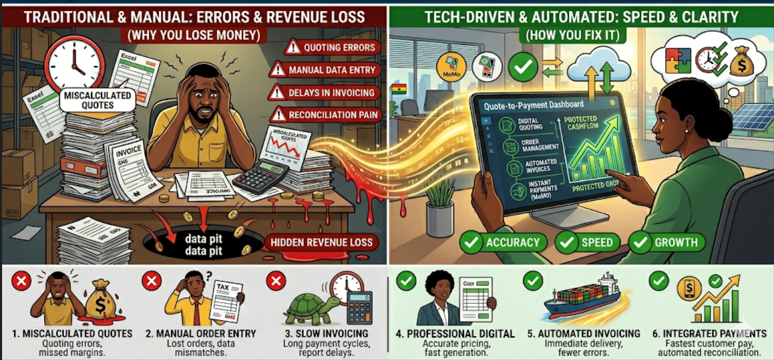
Every business owner knows the feeling. A customer asks for a quote. You pull up a spreadsheet, check prices, type out the numbers, and email it across. Days later, they accept. Now you need to raise a sales order, check stock, coordinate with procurement, generate an invoice, and track whether payment actually arrives.
Between that first quotation and the final payment hitting your account, there are dozens of steps where things go wrong. And for most small and medium enterprises, they do go wrong — regularly.
The result is not just inconvenience. It is lost revenue, delayed cash, damaged customer relationships, and hours of wasted effort every single week.
Where Businesses Go Wrong: The Quotation-to-Payment Gap
For most SMEs, the journey from quotation to payment is not a single workflow. It is a patchwork of disconnected tools and manual handoffs.
The sales team creates quotes in one system — often a spreadsheet or a standalone invoicing app. When the customer approves, someone manually creates a sales order in another tool. Procurement checks inventory availability in yet another place. The finance team generates the invoice from a different platform. And collections? That is usually a mix of memory, sticky notes, and periodic email reminders.
Each handoff between tools requires someone to manually re-enter data. SKU codes get mistyped. Prices from the original quote do not match the invoice. Line items are missed. Delivery terms agreed in the quotation never make it to the order confirmation.
A Scenario You Might Recognise
Consider Kwame, who runs a building materials distribution business in Accra with two branches. A contractor requests a quote for 200 bags of cement and 50 sheets of roofing material. Kwame checks prices in his spreadsheet, confirms availability by calling his warehouse manager, and emails the quote.
The contractor accepts three days later. Kwame now needs to create a sales order, but the prices in his spreadsheet have changed since the original quote. He cannot remember if he quoted the old price or the new one, because the email thread is buried. He raises the invoice manually, but forgets to include the delivery charge they agreed on verbally. The contractor disputes the invoice. Payment is delayed by two weeks.
Meanwhile, his second branch sold 80 of those cement bags to a walk-in customer. Kwame only finds out when the contractor’s delivery falls short. Now he needs to arrange an emergency transfer from his supplier, eating into his margin.
This is not an unusual story. It is the daily reality for thousands of SMEs operating with fragmented tools.
What This Is Costing You
The costs of a broken quotation-to-payment process are not always visible on a profit and loss statement, but they are real and they compound.
Time Lost to Manual Work
Business owners and admin staff in SMEs typically spend between two and six hours every week on reconciliation, re-keying data between systems, and chasing down discrepancies. That is time not spent on selling, serving customers, or growing the business.
Revenue Leakage from Invoice Errors
When quotes, orders, and invoices live in different systems, errors are inevitable. A wrong price here, a missing line item there. Each error triggers a dispute, and every dispute delays payment. Research consistently shows that businesses moving from spreadsheets to integrated systems reduce billing errors by 60 to 90 percent.
Slower Cash Collection
Delayed or incorrect invoices directly increase your days-sales-outstanding. If your average DSO is 45 days but it could be 30, that is 15 extra days of cash sitting in your customer’s account instead of yours. For a business processing a few hundred thousand in monthly revenue, that gap represents significant working capital locked up unnecessarily.
Lost Deals from Slow Response
In competitive markets, the business that quotes fastest often wins. If your quoting process involves checking multiple spreadsheets, calling the warehouse, and manually calculating landed costs, you are slower than a competitor whose system generates quotes in minutes. Buyers will not wait. They will go to whoever responds first with a clear, professional quotation.
A Better Way to Operate: The Connected Workflow Approach
The fix is not buying more tools. It is connecting the ones that matter into a single operational flow.
Instead of treating quotation, ordering, invoicing, and payment as separate tasks handled by separate systems, leading SMEs are adopting platforms that map the entire journey in one place: enquiry to quotation to sales order to invoice to payment — with shared data flowing through every step.
When a quote is approved, it converts directly into a sales order. The sales order pulls live inventory data, so you know immediately whether you can fulfil from your current stock. The invoice is generated from the same data, so prices, line items, and terms match exactly what was quoted. Payment tracking links back to the original transaction, so finance can see the full picture without reconciling across three different spreadsheets.
What Changes When You Connect the Flow
Manual reconciliation drops dramatically. Businesses that move to integrated quote-to-cash workflows typically save 50 to 80 percent of the time previously spent on data re-entry and reconciliation.
Invoice accuracy improves because every document in the chain pulls from a single source of truth — one SKU master, one price list, one customer record. There is no room for the copy-paste errors that plague multi-tool setups.
Cash collection accelerates. When invoices go out faster and without errors, customers pay faster. Businesses adopting end-to-end invoice automation commonly see DSO improve by 5 to 15 days.
How Webhuk Solves This
Webhuk is built specifically for this problem. It is a cloud-native operational platform designed for SMEs — particularly distributors, traders, and multi-branch businesses — that maps the complete workflow from customer enquiry through to payment reconciliation in a single system.
With Webhuk, a quotation converts into a sales order with one action. That sales order links directly to your inventory across all branches, so stock availability is checked in real time. The invoice is generated from the same record, ensuring prices, quantities, and terms are consistent. Payment status flows back into your receivables dashboard, giving your finance team a live view of what is owed, what is overdue, and where to focus collection efforts.
For importers and distributors, Webhuk also includes container-based pricing logic, so landed costs are automatically allocated to each SKU. This means your quotes reflect true costs from day one, protecting your margins without manual calculation.
The platform is designed for fast deployment. Most SMEs go live with core sales and inventory modules within 30 days — without the heavy consulting fees and months-long implementations associated with traditional ERP systems.
If your business is still running the quotation-to-payment process across spreadsheets, emails, and disconnected tools, the leakage is happening whether you can see it or not. A connected workflow is not a luxury. For a growing SME, it is a necessity.
Ready to close the gap between your quotes and your cash? Try Webhuk free for 7 days and see how a connected workflow changes your operations.
Learn more: How Enquiries, Quotations, Orders and Invoices Work in Webhuk
Explore: Webhuk Multi-Branch Inventory Management
Frequently Asked Questions
What is a quote-to-cash workflow?
A quote-to-cash workflow is the complete business process that starts when a customer requests a quotation and ends when payment is received and reconciled. It includes quoting, order management, invoicing, and collections. When these steps are connected in one system, errors drop and cash flows faster.
Why do SMEs lose money between quotation and payment?
Most SMEs manage quotes, orders, and invoices in separate tools. Each handoff between systems requires manual data entry, which introduces pricing errors, missed line items, and delayed invoices. These errors lead to payment disputes, longer collection cycles, and lost revenue.
How much time can a connected workflow save?
Businesses that move from spreadsheets and disconnected tools to an integrated operational system typically reduce reconciliation and data re-entry time by 50 to 80 percent. For a small team, that can mean saving several hours every week.
Is Webhuk suitable for businesses with multiple branches?
Yes. Webhuk is built for multi-branch operations. Inventory, pricing, and sales data are synchronised across all locations in real time, so quotes always reflect actual stock availability regardless of which branch is fulfilling the order.
How long does it take to set up Webhuk?
Most SMEs go live with core modules within 30 days. Webhuk is designed for fast deployment without heavy consulting or technical implementation, so your team can start seeing results quickly.