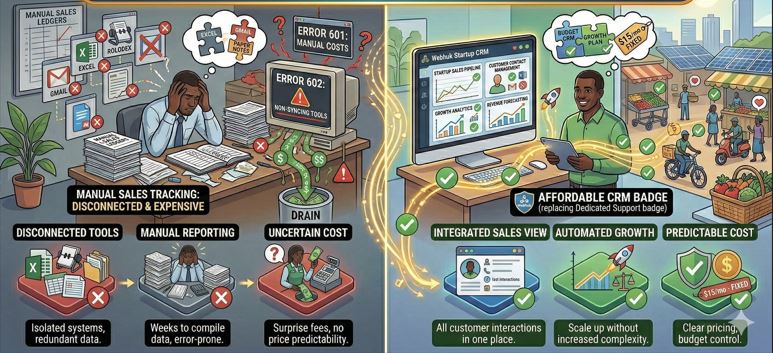
Startups don’t fail only because of product or funding — many fail because they can’t build a predictable sales engine. If your leads are scattered across Excel sheets, WhatsApp chats, email threads, and team notebooks, you will lose deals simply due to poor tracking and delayed follow-ups.
That’s exactly where a CRM becomes essential.
But startups have one more challenge: budget discipline. You need a CRM that fits your current stage without locking you into heavy recurring costs or complex implementation cycles.
This guide breaks down what “affordable CRM” really means for startups, the best pricing models to consider, what features you must not compromise on, and how to choose a CRM that grows with you.
What “Affordable CRM” Actually Means for Startups
Many founders assume affordable = cheapest monthly plan. In practice, affordability is total cost over time.
A CRM can look cheap at ₹1,000/month and still become expensive because of:
-
Per-user pricing that scales faster than your revenue
-
Paid add-ons for automation, integrations, reports
-
Setup fees and customization charges
-
Training overhead and low adoption
-
Data migration or switching costs later
So, a truly affordable CRM is one that offers:
-
Low total cost of ownership (TCO) over 12–36 months
-
Quick onboarding and high adoption
-
Essential features included (not locked behind upgrades)
-
Flexible scaling without “surprise” cost jumps
Common CRM Pricing Models (And Which Works Best for Startups)
1) Free CRM Plans (Entry-Level)
Some CRM platforms offer a free tier to get you started.
Best for:
-
Solo founders
-
Very small teams
-
Early-stage experimentation
Watch-outs:
-
Limits on users, contacts, storage, or features
-
Automation and integrations often locked
-
Reporting may be basic
Use free plans when you’re validating your process, but prepare to upgrade once leads increase.
2) Subscription CRM (Monthly / Annual)
This is the most common model: pay monthly per user, per feature, or per bundle.
Best for:
-
Startups wanting fast cloud setup
-
Teams expecting quick scaling
-
Businesses okay with recurring cost
Watch-outs:
-
Per-user pricing grows quickly (especially sales teams)
-
Key features (automation, workflows, API) often require higher tiers
-
Vendor lock-in can be strong
This model is convenient but can become costly if your team grows from 5 users to 30 users.
3) One-Time Payment CRM (Ownership Model)
Some startups prefer a one-time payment CRM customized to their workflow.
Best for:
-
Startups wanting long-term cost control
-
Teams needing customization (industry-specific process)
-
Businesses that dislike per-user pricing limits
-
Companies wanting full ownership
Watch-outs:
-
Requires proper implementation partner
-
You must ensure support/AMC clarity
-
Better suited when your workflow is stable
For many Indian startups, this model becomes more affordable over 2–3 years, especially when user count increases.
What Features Startups Must Have (Even in Budget CRMs)
A CRM that only stores contacts is not enough. For startups, the “affordable” CRM must still cover the sales reality.
1) Lead Capture + Pipeline
Your CRM must track leads and convert them via a pipeline like:
New → Contacted → Qualified → Proposal → Negotiation → Won/Lost
If pipeline visibility is missing, forecasting becomes guesswork.
2) Follow-Up Management (Tasks + Reminders)
Startups win deals by speed. A CRM should ensure:
-
No lead goes cold
-
Every follow-up is scheduled
-
Team accountability is visible
3) Email / WhatsApp Communication Logging
Your CRM should connect or at least log communication so your team has context.
Ideal capabilities:
-
WhatsApp integration or click-to-chat tracking
-
Email sync or email templates
-
Notes and call logs per lead
4) Reporting That Matters
Founders and managers need instant answers:
-
What is the current pipeline value?
-
Which lead source converts best?
-
Which salesperson is performing?
-
How long does a deal take to close?
Even a startup needs these basic analytics.
5) Excel Import & Data Migration
Most startups start in Excel. Your CRM must support:
-
Excel/CSV import
-
Field mapping
-
Duplicate prevention
This reduces onboarding time dramatically.
Hidden Costs Startups Must Check Before Buying CRM
Even “affordable” CRMs can become expensive through hidden pricing mechanics. Always check:
-
Per-user cost at 10/25/50 users
-
Costs for automation workflows
-
WhatsApp or SMS integration add-ons
-
API access costs
-
Reporting/analytics add-ons
-
Storage/attachment limits
-
Support tiers (email-only vs dedicated support)
A simple way: calculate your CRM cost for the next 24 months assuming your team doubles.
How to Choose the Right Affordable CRM Service
Here’s a founder-friendly decision framework:
If you are a small team (1–5 users)
Choose a CRM that is:
-
Easy to implement
-
Includes pipeline + tasks
-
Has basic reportin
-
Offers free trial or entry plan
If you are growing fast (5–20 users)
Choose a CRM that:
-
Has automation and integrations available
-
Won’t punish you with aggressive per-user pricing
-
Offers onboarding support
-
Scales without heavy upgrades
If you want long-term affordability (20+ users planned)
Consider:
-
One-time payment ownership model
-
Unlimited users (or flat pricing)
-
Custom modules aligned with your business
-
Strong reporting for management
For startups building a stable sales operation, this can be a strategic advantage.
Where Webhuk.io Fits in This Conversation
If your startup needs:
-
A CRM aligned to your workflow (not generic templates)
-
Excel import + field mapping
-
Automation (WhatsApp/email follow-ups, reminders)
-
Reporting for management
-
A model that avoids heavy per-user recurring costs
Then a customized CRM approach from webhuk.io can be positioned as a cost-effective, scalable alternative—especially for startups planning team growth.
The key value is this: your CRM should be a growth engine, not a recurring cost burden.
Frequently Asked Questions (FAQs)
1) What is the most affordable CRM for a startup team?
The most affordable CRM is one that meets essential sales needs (pipeline, follow-ups, reporting) while keeping total cost low as your team grows. Free or low-tier plans work for early stage, but consider scalability and hidden add-ons.
2) Is a free CRM good enough for startups?
Free CRM can be good for very early-stage startups. However, limitations on automation, integrations, and reporting usually appear quickly once lead volume increases.
3) How do I calculate the real cost of a CRM?
Calculate cost across 12–36 months including: per-user pricing, add-ons (automation, integrations), onboarding/training, support plans, and any upgrade costs as you scale.
4) Should startups choose subscription CRM or one-time payment CRM?
Subscription CRM is flexible for fast start, but can become expensive as users increase. One-time payment CRM can offer better long-term affordability and ownership, especially for startups with stable workflows.
5) What CRM features matter most for startups?
Startups should prioritize pipeline management, follow-up automation, communication tracking (email/WhatsApp), Excel import, and sales reporting. These directly impact conversion and revenue.