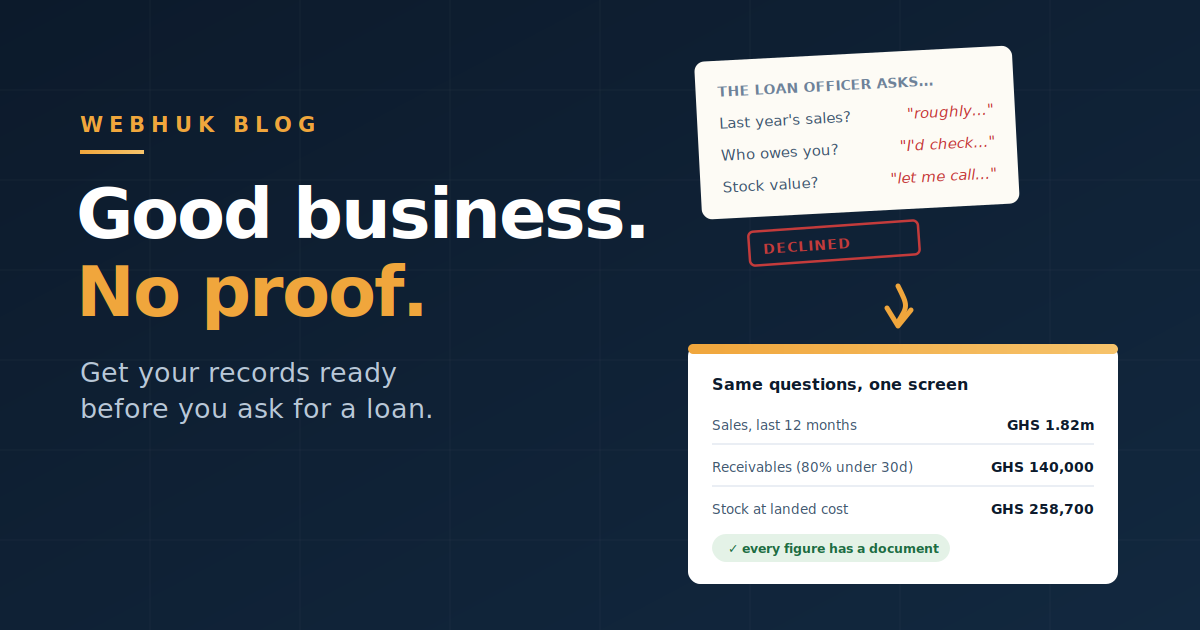
A trader walks into a bank in Accra to ask for working capital ahead of the December season. The business is real: eight years old, two branches, loyal customers, genuinely profitable. The loan officer asks three questions — What were your sales last year? What do customers currently owe you? What's the value of your stock? — and the answers are "roughly," "a lot, I'd have to check," and "let me call the shop."
The application stalls. Not because the business is weak, but because nothing about it can be shown.
This is one of the most frustrating patterns in SME financing across Ghana and West Africa: sound businesses declined, or offered far less than they need, because their records can't prove what their owners already know. This guide covers what lenders typically want to see, how to prepare it, the red flags that quietly sink applications, and how to be permanently loan-ready rather than scrambling six weeks before you need money.
(A note on scope: this is about preparing your records, not financial advice. Requirements differ between banks, microfinance institutions, and other lenders, and they change — always confirm the current checklist with the specific institution, and consider speaking with an accountant for your own circumstances.)
How Lenders Actually Think
Every loan decision comes down to one question: will this business generate enough cash to repay, and can we verify that? Everything a lender asks for is an attempt to answer it.
That means your records aren't paperwork — they're evidence. And when evidence is missing, lenders don't assume the best; they price for the risk (a higher rate, a smaller amount, more collateral) or decline. Which is why two identical businesses can walk into the same bank and leave with completely different outcomes, based purely on what they could show.
The Documents Lenders Commonly Ask SMEs For
Requirements vary, but most SME applications in Ghana touch these:
1. Registration and statutory documents. Business registration certificate, TIN, and any relevant permits or licences. Keep them current — expired documents stall applications immediately.
2. Bank statements. Usually six to twelve months. Lenders read these closely, and here's the point most owners miss: if most of your trade happens in cash and never enters the bank, your statements make a busy business look small. Banking your takings consistently, well before you apply, is one of the most effective things you can do for your borrowing profile.
3. Financial statements. Profit and loss, and a balance sheet. Larger facilities may require audited or accountant-prepared accounts. The ability to produce these quickly depends entirely on whether your sales, costs, and payments have been recorded all along.
4. Sales history. Monthly or annual sales, ideally with seasonality visible. A December-heavy trading business is easier to lend to when the pattern is documented rather than described.
5. Receivables position. What customers owe, and how old those debts are. This is where an aging report earns its keep — "GHS 140,000 outstanding, 80% under 30 days" tells a very different story from "GHS 140,000 outstanding" with no detail. If you've been tracking customer debts properly, this is a report, not a research project.
6. Inventory records. Stock on hand and its value — ideally per location. For trading businesses, stock is often the largest asset on the books and sometimes the basis for the facility itself. Valuing it at true landed cost (not the supplier invoice) keeps that number defensible.
7. Supplier and payables information. Who you owe, and your payment record with them. Good supplier relationships are a positive signal.
8. A statement of purpose and repayment. What the money is for, and how it will be repaid. Specificity wins: "GHS 120,000 to import Christmas stock ordered in September, sold October to December, repaid from those sales by February" is far stronger than "working capital."
The Red Flags That Sink Applications
Loan officers see hundreds of files. These patterns make them cautious:
Records that disagree with each other. Your sales figure says one thing, your bank statements another, your stock sheet a third. Inconsistency reads as either disorganization or worse — and the officer doesn't have to decide which to decline.
Cash-only trading with nothing banked. If the business is invisible to the banking system, the bank has almost nothing to verify.
Mixed personal and business money. One account for the shop and the school fees makes it impossible to see business performance. Separating accounts is basic, free, and hugely improves how your application reads.
Old, stale receivables. A large 90+ days bucket suggests either weak collections or debts that were never real. Clean this up before applying — it improves the numbers and the impression together.
No documentation behind the numbers. Claims without invoices, payments without records, stock counts without a system. Numbers that can't be traced back to documents don't carry weight.
Last-minute, reconstructed records. Officers notice books assembled in a week. Records that were maintained monthly all along look — and are — different.
Get Loan-Ready in 90 Days
If you expect to need financing, start about three months ahead:
Month 1 — Separate and bank. Open (or start actually using) a dedicated business account. Bank your takings consistently — this is the single highest-impact change, and it only works with time behind it, which is why it comes first.
Month 2 — Clean the records. Bring invoicing and payment recording current. Chase the aged receivables so your aging report shows a healthy profile. Do a physical stock count and value it properly. If you're still on paper or spreadsheets, this is the natural moment to move off spreadsheets so the next two months of records are system-generated rather than reconstructed.
Month 3 — Assemble and rehearse. Put together a simple pack: registration documents, bank statements, sales summary, receivables aging, stock valuation, supplier list, and your one-page statement of purpose and repayment. Then rehearse the three questions from the top of this article — sales, receivables, stock value — until you can answer each in one sentence, with a document to back it.
Walk in able to do that and you are, immediately, in a different category of applicant.
Being Permanently Loan-Ready
The best position isn't "prepared for this application" — it's a business whose records are always current, so financing becomes available on the timeline opportunities actually appear (a supplier discount, a bulk order, a December window), not three months later.
That's the quiet argument for running operations in one system. In Webhuk, the documents lenders ask for are by-products of daily work rather than projects: sales history and reports come from the invoices you raised; receivables aging is built in with printable PDFs; stock value per branch is always current, with landed price calculation making the valuation defensible; payment records sit against invoices and financial accounts; and customer, supplier, and purchase histories are all traceable to documents. Your monthly business review keeps it honest month to month — so "get the records ready" stops being a phase and becomes a state your business is permanently in.
From 80 ghs per user per month with a 14-day free trial — and if you're 90 days out from an application, starting now means three months of clean, system-generated records by the time you walk in.
The Bottom Line
Lenders aren't only assessing your business; they're assessing what you can prove about it. Bank your sales consistently, separate business from personal money, keep receivables current and aged, value your stock properly, and be able to answer the three questions — sales, receivables, stock — in one sentence each with a document behind it.
None of that makes a weak business fundable. What it does is stop a strong business from being mistaken for a weak one — which, for far too many SMEs in Ghana, is the only thing standing between them and the capital they've already earned the right to.
Start a 14-day free trial
Frequently Asked Questions
What documents do I need for a business loan in Ghana? Typically business registration and TIN, six to twelve months of bank statements, financial statements, a sales history, receivables and inventory records, supplier information, and a clear statement of purpose and repayment. Requirements vary by lender — confirm the current checklist with the specific institution.
Why do banks decline small businesses that are actually profitable? Usually because profitability can't be verified. Cash trading that never enters the bank, mixed personal and business accounts, inconsistent records, and undocumented claims leave lenders unable to confirm the business generates enough cash to repay — so they price for risk or decline.
How far in advance should I prepare for a loan application? About 90 days. Banking your takings consistently needs time behind it to show on statements, receivables cleanup takes weeks, and records that were maintained all along read very differently from records assembled in a hurry.
Does keeping business records in software help with getting a loan? It helps by making the required documents producible on demand — sales history, receivables aging, stock valuation, payment records — and by keeping them consistent with each other, which is what lenders check. It doesn't guarantee approval; the underlying business performance still decides that.
Should I separate my business and personal bank accounts? Yes. Mixed accounts make it impossible for a lender (or you) to see actual business performance, and it's one of the most common weaknesses in SME applications. Separating them is free and improves how every future application reads.
What is a receivables aging report and why do lenders want it? It sorts unpaid customer invoices by how overdue they are (0–30, 31–60, 61–90, 90+ days). Lenders use it to judge how much of your receivables is likely to be collected — a large 90+ bucket suggests weak collections or debts that may never be recovered.