Ask ten SME owners in Ghana how they set their prices and you'll hear three answers: "I add my percentage," "I check what the next shop is charging," or — most honestly — "I just know."
All three can work for a while. None of them survive a year of currency movement, rising freight, and a competitor who's willing to sell at a loss to win market share. And all three hide the same quiet danger: a business can be busy, popular, well-stocked, and still be pricing its way to zero.
This guide covers how to price products for profit in a trading business: the real cost you should price from, the formula difference that costs SMEs the most money, three pricing methods and when each applies, and how to review prices before inflation does it for you.
Step 1: Know Your Real Cost (Not the Invoice)
Pricing starts with a number most businesses get wrong. Your cost is not what the supplier charged you — it's everything it took to get that item onto your shelf, ready to sell.
For imported goods, that's the landed cost of imported goods: supplier price, freight, insurance, duties and levies, clearing and port charges, and inland transport, all divided by the units received — converted at the exchange rates you actually paid, not today's convenient rate.
For locally sourced goods: purchase price, transport, loading, and any repackaging.
Price off the supplier invoice instead and you're building your business on a number that is simply wrong — usually 20% to 40% wrong for imports. Everything downstream inherits that error.
Step 2: Don't Forget the Costs That Aren't on Any Invoice
Landed cost gets you to gross margin. But rent, salaries, electricity, fuel, data, bank charges, and shrinkage all have to be paid out of that margin before anything is actually profit.
A quick way to see whether your margins clear the bar:
- Add up last month's operating expenses — everything not directly the cost of goods. Say GHS 18,000.
- Take last month's total gross margin (sales minus landed cost of what you sold). Say GHS 24,000.
- The difference — GHS 6,000 — is roughly your operating profit.
If that number is thin or negative while sales look healthy, your prices are too low or your mix is wrong. It isn't a sales problem; it's a pricing problem wearing a sales costume.
Step 3: Markup vs Margin — The Confusion That Costs Real Money
This is the single most expensive misunderstanding in SME pricing, so let's be precise:
- Markup is measured against your cost:
Markup % = (Selling price − Cost) ÷ Cost × 100 - Margin is measured against your selling price:
Margin % = (Selling price − Cost) ÷ Selling price × 100
Same cedis, different percentages — and the gap widens as numbers grow:
| Cost | Selling price | Markup | Margin |
|---|---|---|---|
| GHS 100 | GHS 130 | 30% | 23% |
| GHS 100 | GHS 150 | 50% | 33% |
| GHS 100 | GHS 200 | 100% | 50% |
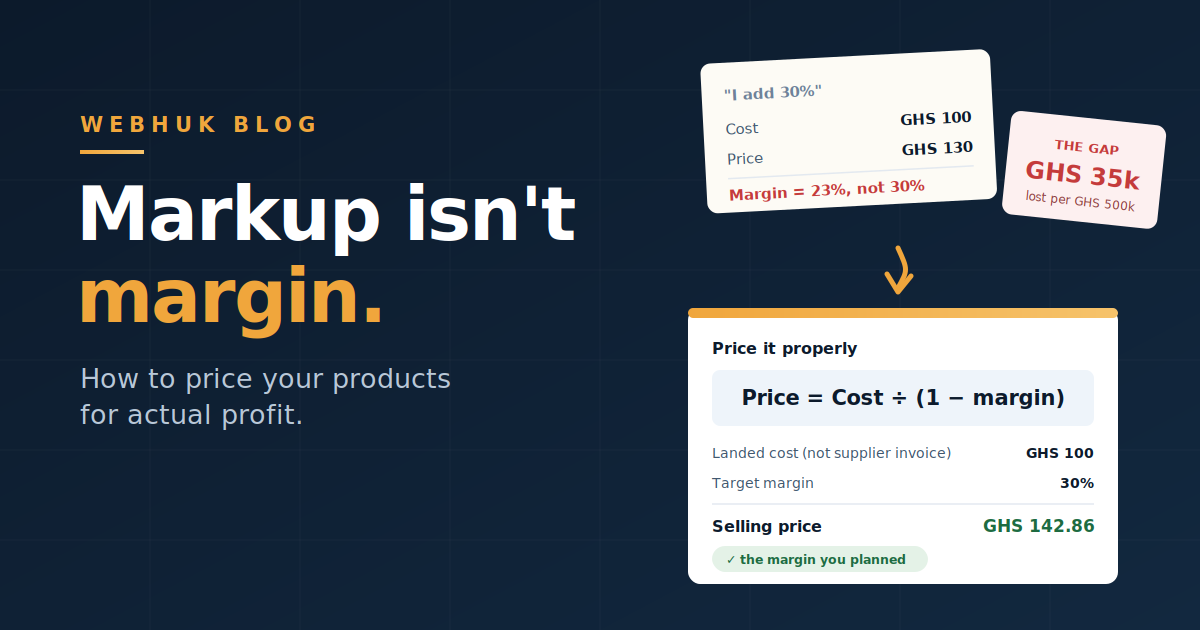
Where businesses lose money: an owner decides they need a "30% margin," then adds 30% to cost — and actually earns 23%. On GHS 500,000 of annual sales, that gap is roughly GHS 35,000 of profit that was planned for and never arrived.
The formula to price from a target margin:
Selling price = Cost ÷ (1 − margin as a decimal)
Want 30% margin on an item that landed at GHS 100? 100 ÷ 0.70 = GHS 142.86. Not GHS 130.
Pick one language — margin or markup — and make sure everyone who quotes prices in your business uses the same one.
Step 4: Choose Your Pricing Method
Three approaches, each with its place:
Cost-plus. Landed cost plus a target margin. Simple, defensible, and the right default for commodity goods where customers compare openly. Its weakness: it ignores what the market will actually pay — you may be leaving money on the table or pricing above what buyers accept.
Market-based. Price against what competitors charge. Necessary information — but a terrible master. Competitors may have different landed costs (better freight rates, bigger volumes, older stock bought at a better exchange rate), or they may simply be pricing badly. Use competitor prices as a boundary, never as your calculation.
Value-based. Price on what the customer gains — you deliver same-day, you stock the spare parts nobody else does, you give 30-day terms, you'll take the return without argument. In practice, this is why two shops sell the same item at different prices and both survive.
Most trading SMEs should run cost-plus as the floor, market as the ceiling, value as the reason you sit above the middle.
Step 5: Don't Price Everything the Same Way
A flat percentage across your whole range is leaving money on the table. Segment it:
- Known-value items — the few products customers know the price of by heart. Price these sharply; they're how customers judge whether you're expensive.
- Everything else — where the customer has no strong reference, so your margin can be healthier without any resistance.
- Slow movers — stock that ages is stock losing money. Discounting to move it is usually better than holding it, especially when you need the cash for the next shipment.
- Wholesale vs retail tiers — set them deliberately, per customer type, so a wholesale price never gets quoted to a retail buyer because someone was guessing.
Step 6: Review Prices on a Schedule, Not a Shock
The most common SME pricing failure is not pricing wrongly — it's pricing correctly, once, and then leaving it while costs move underneath. Currency slides, freight rises, duty schedules change, and the price list from six months ago slowly turns into a discount nobody approved.
Build a rhythm instead:
- Monthly, as part of your monthly business review: check margins against target. If they slipped two months running, that's the trigger.
- On every shipment, price new stock from its own landed cost — not the last shipment's. Replacement cost is what matters if you intend to restock.
- When your multi-currency exposure moves sharply, review imported lines immediately rather than at month-end.
And on raising prices: do it deliberately, on specific lines, with notice to regular customers — rather than in an apologetic panic across everything at once. Quote validity is your friend here; a short validity period on quotations means old prices expire naturally instead of being honoured six months late. (See how to write a quotation.)
Step 7: Protect the Price Once It's Set
A price is only real if it survives the counter. Two leaks to close:
Uncontrolled discounting. A salesperson giving "small small" discounts to close deals can quietly erase the margin you carefully calculated. Set a discount anyone can give without asking, and require approval above it.
Untracked price changes. If anyone can edit a price and nobody knows who or when, your price list is a rumour. Restricting who can change prices is one of the highest-value controls a growing business can put in place.
Doing This Without a Spreadsheet Nightmare
Pricing well means holding three numbers together per item — true landed cost, target margin, and current selling price — across every product, currency, and customer tier. That's exactly where spreadsheets collapse.
In Webhuk, the pieces sit in one place: landed price calculation rolls duties, freight, and clearing into a true per-unit cost as stock is received; each SKU carries its price per currency so cedi and dollar prices are set deliberately rather than converted from memory; quotations and invoices pull those prices automatically, so what you calculated is what the customer is quoted, whoever prepares the document; reports show what actually sold and at what value for the monthly margin check; and role-based access keeps price changes with the people who should be making them. From $7 per user per month, with a 14-day free trial.
The Bottom Line
Price from landed cost, not the supplier invoice. Know the difference between markup and margin, and use Cost ÷ (1 − margin) when you mean margin. Let cost set your floor, the market set your ceiling, and your service justify where you sit between them. Segment your range instead of applying one percentage to everything. Review monthly and on every shipment. Then defend the price with discount limits and controlled changes.
Do that, and pricing stops being the thing you hope works out — and becomes the lever you pull deliberately, which is what it was always meant to be.
Start a 14-day free trial
Frequently Asked Questions
What is the difference between markup and margin? Markup is calculated on cost; margin is calculated on the selling price. Adding 30% to a GHS 100 cost gives GHS 130 — a 30% markup but only a 23% margin. To achieve a 30% margin you would price at GHS 142.86.
How do I calculate a selling price from a target margin? Use: Selling price = Cost ÷ (1 − margin as a decimal). For a 35% margin on an item costing GHS 200: 200 ÷ 0.65 = GHS 307.69.
What cost should I use when pricing imported products? Landed cost — supplier price plus freight, insurance, duties and levies, clearing charges, and inland transport, divided by units received, at the exchange rates actually paid. Pricing from the supplier invoice alone typically understates cost significantly.
How often should a small business review its prices? Monthly against margin targets, and on every new shipment (price from that shipment's landed cost, not the previous one). Review imported lines immediately after sharp currency movements rather than waiting for month-end.
Should I match my competitor's prices? Use competitor prices as a ceiling and a sanity check, not as your calculation. Their costs, volumes, and stock age differ from yours, and some competitors price badly. Your floor must always come from your own landed cost plus target margin.
How do I stop staff from discounting away my profit? Set a discount percentage anyone may give without approval, require authorization above it, and restrict who can change prices in your system. Software with role-based access and approval steps enforces this without you policing every sale.