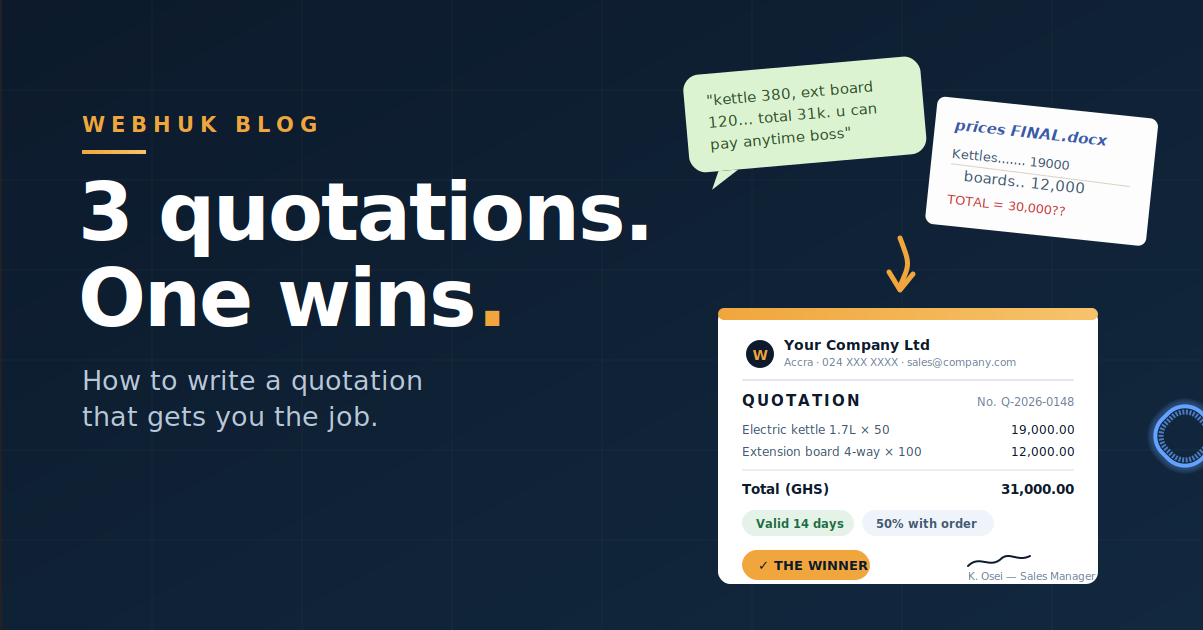
Somewhere right now, a procurement officer in Accra is holding three quotations for the same supply of goods. One is a WhatsApp message with prices typed in a chat. One is a Word document with the supplier's name in a different font from the rest. And one is a clean, numbered document on company letterhead — itemized prices, clear terms, validity period, a signature over a printed name.
Two of those suppliers might even be cheaper. Guess which one gets the call.
A quotation is not paperwork you produce because the customer asked. It's a sales document — often the only thing a new customer will ever see of your business before deciding whether to trust you with their money. This guide covers how to write a quotation properly: the complete structure, a worked example for supply of goods, the mistakes that quietly lose jobs, and how to produce winning quotations in minutes instead of days.
First, Get the Document Right: Quotation vs Estimate vs Proforma
Three documents get mixed up constantly, and using the wrong one signals inexperience:
- A quotation is a formal, fixed offer: exact items, exact prices, valid for a stated period. If the customer accepts within that period, you're expected to honour those prices.
- An estimate is an educated approximation used when the final scope isn't known — common for services and repairs. It signals "around this figure," not a commitment.
- A proforma invoice comes after the customer has agreed to buy: it's a preliminary bill, typically used in Ghana to request advance payment before goods are released or work begins.
For supply of goods to a company or institution, they want a quotation. Send exactly that.
The 10 Things Every Quotation Must Include
Run every quotation you send against this checklist:
1. Your business identity, up top. Company name, logo, address, phone, email — ideally on a letterhead. This is the first trust signal, and its absence is the first red flag.
2. The word "QUOTATION" and a unique number. "QUOTATION — No. Q-2026-0148." The number matters more than it looks: it's how the customer's purchase order will reference you, how your team finds it later, and how follow-up calls stay precise.
3. Date of issue. Anchors the validity period and the exchange-rate context of your prices.
4. Customer's details. Company name, contact person, address. Addressed documents read as prepared-for-you; unaddressed ones read as copy-paste.
5. Itemized lines — description, quantity, unit price, line total. One row per item, with descriptions specific enough that there's no ambiguity about what's being supplied ("Electric kettle, 1.7L, stainless steel, 2200W" — not "kettles"). If you use SKU codes internally, include them; they make the eventual purchase order and delivery checking painless.
6. Taxes, shown clearly. Whether your prices are VAT-inclusive or exclusive, say so explicitly, and show the tax as its own line. Institutional buyers in particular cannot process a quotation that's silent on tax.
7. Grand total — with the currency stated. "GHS 48,600.00" — never a bare number. If you quote in USD for imported goods, state it and consider noting the basis. Ambiguous currency has sunk more deals (and relationships) than high prices ever did.
8. Validity period. "This quotation is valid for 14 days from the date above." This protects you — from exchange-rate swings and supplier price changes — and gently pressures a decision. A quotation with no expiry is an open-ended liability.
9. Terms: payment and delivery. How much upfront (if any), when the balance is due, how and when delivery happens, and who bears delivery costs. Terms stated on the quotation are terms agreed calmly in advance; terms raised later are disputes.
10. Signature, name, and designation. A quotation signed "Kwabena Osei, Sales Manager" carries authority. An unsigned document is a price list.
A Worked Structure: Supply of Goods
Here's how those ten elements assemble for a typical supply quotation:
[LETTERHEAD: logo, company name, address, contacts]
QUOTATION — No. Q-2026-0148 | Date: 7 August 2026 To: The Procurement Officer, [Customer Company], Accra
Dear Sir/Madam, following your enquiry of 4 August, we are pleased to quote as follows:
# Description Qty Unit Price (GHS) Total (GHS) 1 Electric kettle, 1.7L stainless steel, 2200W 50 380.00 19,000.00 2 Extension board, 4-way, surge protected, 3m 100 120.00 12,000.00 Subtotal: 31,000.00 | VAT & levies: [shown per current rates] | Grand Total: GHS [amount]
Validity: 14 days from the date above. Payment: 50% with order, balance on delivery. Delivery: Within 5 working days of order confirmation, delivered to your Accra premises.
Signed: Kwabena Osei, Sales Manager
Simple, complete, and — crucially — leaving the buyer nothing to chase you about. Every question a procurement officer would ask is already answered on the page.
7 Mistakes That Lose the Job
1. Sending it slowly. In competitive supply situations, the first professional quotation frames the comparison — everyone after is measured against it. If your quotation takes four days because prices need checking and the Word template needs wrestling, you're losing jobs you never knew you were in.
2. Vague descriptions. "Office chairs — 20 — GHS 15,000" invites the cheapest possible interpretation, then a dispute at delivery. Specific descriptions protect both sides.
3. No validity period. Three months later the customer "accepts" — at prices from a different exchange rate. Now you either lose money or start the relationship with a retraction.
4. Springing costs later. Delivery, installation, or "handling" appearing on the invoice but not the quotation is the fastest way to turn a won job into a payment fight. Everything the customer will pay belongs on the quotation.
5. Quoting blind on cost. If the goods are imported, quoting off the supplier's price instead of the true landed cost means your "profitable" quote may already be a loss. Know your floor before you price.
6. Inconsistent, unprofessional formatting. Different fonts, misaligned columns, arithmetic that doesn't add up. Buyers reason — not unfairly — that a supplier careless with a two-page document may be careless with a delivery.
7. No follow-up. Most quotations don't lose; they expire. A polite call at the halfway point of validity ("Did you receive it? Any questions?") converts deals that silence would have killed.
What Separates Winning Quotations
Beyond correctness, three habits raise your win rate:
Speed is a feature. Same-day quotations tell the customer what working with you will feel like. This is the single highest-leverage change most SMEs can make.
Quote the problem, not just the items. Where there's room, a one-line opening that mirrors the customer's request ("following your enquiry for electrical supplies for your new office…") signals attention. Buyers reward being heard.
Make accepting easy. Clear next step ("To confirm, reply to this email or call…"), your bank details ready for the deposit, and terms that anticipate their process (institutions will send a purchase order — reference your quote number).
From Word Template to System
Everything above can be done in Word — the tenth time is just as slow as the first, and each quotation is one typo away from an arithmetic error. This is why quotation-writing is the workflow SMEs most feel the difference on when they move to a system.
In Webhuk, the quotation is generated from the recorded enquiry: your saved item prices and descriptions fill the lines, your standard payment, delivery, and validity terms apply automatically, and the document renders as a PDF on your letterhead with signature and designation — ready to email to the customer directly from the system, with an approval step if a manager signs off first. Quotations carry numbers, sit in aging lists so follow-up at the validity halfway point is a checklist rather than a memory, and convert to orders and invoices with one click as part of the full enquiry-to-invoice workflow. If your quotation itself depends on supplier prices, the RFQ process feeds it from the other side. Ten minutes from enquiry to a professional PDF — from 80 GHS per user per month, with a 14-day free trial that's long enough to send your next real quotation from it.
The customer is comparing three documents. Make yours the one that looks like the business they want to pay.
Start a 14-day free trial
Frequently Asked Questions
How do I write a quotation for supply of goods? Use your letterhead, title it "Quotation" with a unique number and date, address the customer, itemize each product with description, quantity, unit price, and line total, show tax and the grand total with currency, then state validity, payment, and delivery terms, and sign with your name and designation.
What is the difference between a quotation and a proforma invoice? A quotation is a formal price offer sent before the customer decides, valid for a stated period. A proforma invoice comes after agreement — a preliminary bill commonly used to request advance payment before goods are released.
How long should a quotation be valid for? Commonly 7 to 30 days. In markets with exchange-rate movement, shorter validity (7–14 days) protects your margins on imported goods. Whatever you choose, state it explicitly on the document.
Should prices on a quotation include VAT? Either can work — what matters is stating it clearly and showing the tax as its own line. Institutional and corporate buyers generally require the tax treatment to be explicit before they can process a quotation.
How do I follow up on a quotation without seeming desperate? Call once around the midpoint of the validity period with a service framing: confirm it arrived and ask if anything needs clarifying. Reference the quotation number. One well-timed, helpful call converts far more deals than silence — or than repeated pressure.
What software can generate professional quotations quickly? Platforms like Webhuk generate quotations from recorded enquiries using saved prices and standard terms, produce letterhead PDFs with signatures, email them directly to customers, track validity in aging lists, and convert accepted quotes to orders and invoices in one click. Plans start at 80 GHS per user per month with a 14-day free trial.