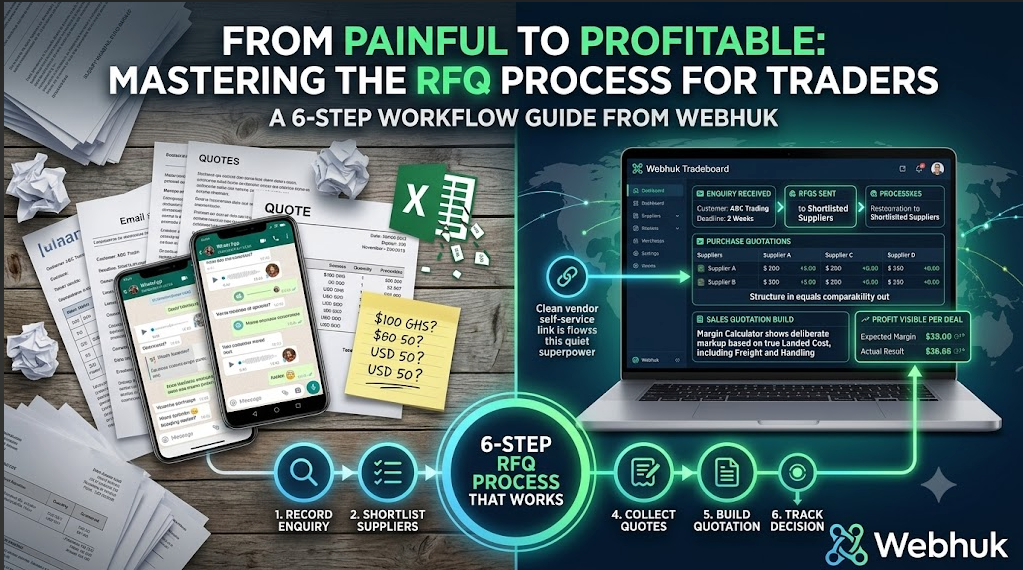
A customer sends your trading company a list: 12 items, mixed categories, needed within two weeks, "send us your best price." Now the real work starts. You email four suppliers for pricing. Two reply the next day — in different formats. One quotes in dollars, another in cedis. The third replies to the wrong thread, and the fourth calls with prices you scribble on a notepad. By the time you've assembled a quote, five days have passed, you've retyped every line twice, and you're honestly not sure whether your 15% markup survives the freight cost you estimated at the last minute.
This is the daily reality of the RFQ process in most trading businesses — and it is where trading companies win or lose. Traders don't manufacture anything; the entire business is buying well, quoting fast, and protecting the spread between the two. This guide lays out a clean six-step RFQ workflow, the reasons the manual version breaks down, and how to run the whole thing in one system.
What Is an RFQ?
An RFQ (Request for Quotation) is a document a buyer sends to suppliers asking them to quote prices for specific items and quantities. In a trading business, RFQs sit at the center of a two-sided workflow:
- A customer enquiry comes in (they want to buy from you)
- You send RFQs to your suppliers (you need prices to build your offer)
- Suppliers return purchase quotations (their prices to you)
- You select the best options, add your markup and freight, and issue one sales quotation to the customer
Your profit lives entirely in step 4 — in the gap between what suppliers quoted you and what you quoted the customer. Which is exactly why a sloppy RFQ process doesn't just waste time; it makes your margins a guess.
Why the Manual RFQ Process Breaks Down
If you run RFQs through email, WhatsApp, and Excel, you will recognise most of these failure points:
Supplier replies live everywhere and nowhere. One quote is a PDF attachment, one is text in an email body, one is a voice note. Assembling them into a comparison means retyping — and retyping means errors in the exact numbers your profit depends on.
Quotes aren't comparable. One supplier includes delivery, another doesn't. One quotes per carton, another per piece. One quotes in USD, another in GHS. Comparing them "by eye" quietly favours whoever formatted their email best, not whoever offered the best real price.
Slow replies stall the whole deal. You can't quote the customer until the slowest supplier responds — and nobody is systematically chasing the stragglers, because there's no list of which RFQs are still open.
Markup is applied blind. Freight, handling, and currency conversion get estimated at the end, roughly. Deals that looked profitable at quoting time turn out marginal after delivery — and you only find out when you close your books, if at all.
There's no deal-level scoreboard. After the dust settles, can you say what you earned on that specific deal? Most trading SMEs can't. Without per-deal profit and loss, you keep repeating the unprofitable deals because they look identical to the good ones.
The 6-Step RFQ Process That Works
Here is the disciplined version of the workflow, whether you run it on software or on paper:
Step 1 — Record the enquiry in full. Customer, items, quantities, specifications, and the customer's deadline. An RFQ built on a half-recorded enquiry produces a quote the customer has to correct — which restarts the clock.
Step 2 — Shortlist the right suppliers. Don't blast every vendor. Maintain a categorised supplier list (electricals, packaging, hardware, and so on) and send each RFQ only to vendors who actually deal in those items. Three well-chosen suppliers beat ten random ones.
Step 3 — Send structured RFQs with a reply deadline. Every RFQ should carry the same item descriptions and quantities, ask for the same things (unit price, currency, validity, delivery terms), and state when you need the response. Structure in equals comparability out.
Step 4 — Collect purchase quotations into one comparison. All supplier prices, side by side, per item, in one currency. This is the moment you can see that Supplier A is cheapest on 8 items but Supplier B wins on the 4 heavy ones once delivery is counted.
Step 5 — Build the sales quotation with deliberate margin. Take the selected supplier prices, add freight and handling as explicit line costs — not a mental estimate — then apply your markup. If the goods are imported, the number you mark up should be the true landed cost of the goods, not the supplier's invoice price.
Step 6 — Track the quote to a decision, and record the outcome. Follow up before validity expires, convert wins into orders through your enquiry-to-invoice workflow, and record the final profit or loss on the deal so next quarter's pricing is smarter than this quarter's.
Running the Whole Thing in One System
Every step above can be done manually — the problem is doing all six, on every deal, every week, while the phones ring. This is the workflow Webhuk Tradeboard was built around, and it's worth walking through because it changes who does the typing:
- The enquiry goes in once. Items and quantities are recorded against the customer, and that single record drives everything downstream.
- RFQs are generated from the enquiry and sent to a shortlist of vendors — you can use labels to shortlist vendors by what they supply, so the packaging RFQ goes only to packaging suppliers.
- Vendors fill in their own quotes. Instead of emailing a PDF you'll have to retype, each supplier receives a link where they enter their prices directly. Their purchase quotation lands in your system already structured — no transcription, no transcription errors.
- You combine the best purchase quotations into one sales quotation, item by item, then apply your markup and add freight — explicitly, as part of the quote build, not as an afterthought.
- Profit and loss is visible per deal. Because the system holds both sides — what vendors quoted you and what you quoted the customer — it can show the expected margin on the deal before you send the quote, and the actual result after.
- Nothing ages silently. Open quotations, orders, and invoices appear in aging lists with printable PDF reports, so Monday morning's follow-up calls make themselves obvious.
The quiet superpower here is the vendor self-service link: it moves the data entry from your team to the supplier, which is both faster and more accurate. Your staff stop being typists and go back to being negotiators.
Measure Your RFQ Process Like It's the Business (Because It Is)
Once the workflow is structured, three numbers tell you almost everything:
- Enquiry-to-quote time. How many days from customer enquiry to sales quotation sent? In competitive trading markets across Ghana and West Africa, the first credible quote frequently wins — every day you cut here shows up in the win rate.
- Quote win rate. Of the quotations sent last quarter, how many became orders? A falling win rate with stable pricing usually means you're quoting too slowly or following up too little.
- Realised margin per deal. Planned margin versus actual, deal by deal. This is the number that tells you which customers, product categories, and suppliers actually make you money.
If you can't produce these three numbers in five minutes, the process — not the people — is the problem.
The Bottom Line
A trading company is an information business wearing a goods business's clothes: whoever assembles accurate supplier prices fastest, and prices with real costs instead of estimates, wins. Structure your RFQ process around the six steps above, get vendors entering their own quotes, and put a margin number on every deal before you send it. Webhuk's Tradeboard runs this entire loop — enquiry, RFQs, vendor self-service quotes, combined sales quotation with markup and freight, and per-deal profit tracking — with plans from 80 ghs per user per month and a 14-day free trial to run your next deal through it end to end.
Start a 14-day free trial
Frequently Asked Questions
What does RFQ mean in business? RFQ stands for Request for Quotation — a document a buyer sends to suppliers asking them to quote prices for specified items and quantities. Trading companies use RFQs to gather supplier pricing before building their own quotation for the end customer.
What is the difference between an RFQ and a quotation? An RFQ is the request you send to suppliers asking for prices. A quotation is the response — either the purchase quotation a supplier sends you, or the sales quotation you send your customer after adding your markup.
How do trading companies make money on RFQs? By buying well and selling with a controlled margin: they collect supplier quotes, select the best prices, add freight and handling, and apply a markup to produce the customer quotation. Profit is the gap between the combined supplier cost and the customer price, deal by deal.
How do I compare quotes from multiple suppliers fairly? Standardise the RFQ so every supplier quotes the same items, quantities, and terms; convert all quotes to one currency; include delivery costs; and compare per item rather than by grand total — different suppliers often win on different lines.
How long should a supplier take to respond to an RFQ? Set an explicit deadline on every RFQ — typically 2 to 5 working days for standard trading goods — and chase before it lapses. Your customer's deadline should drive the supplier's deadline, with buffer time for assembling your quotation.
What software can manage the RFQ process for a small trading company? Platforms like Webhuk include a Tradeboard that generates RFQs from customer enquiries, lets vendors submit quotes through a link, combines the best purchase quotations into one sales quotation with markup and freight, and tracks profit or loss per deal.