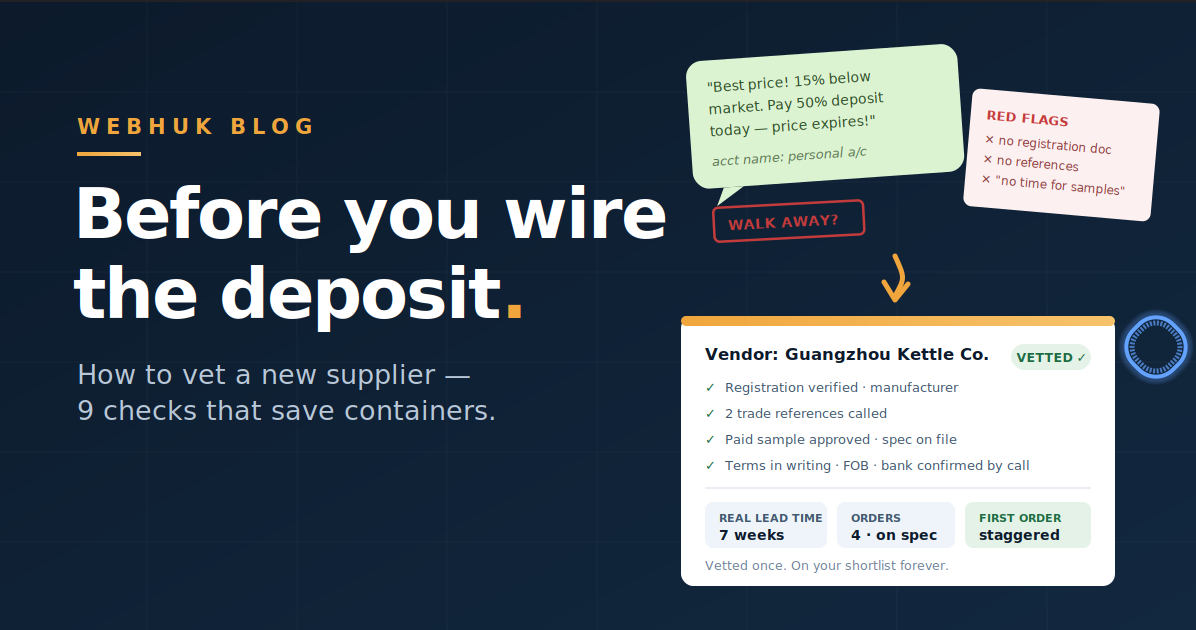
A new supplier appears — found on a sourcing platform, or recommended in a trade group — and the quote is remarkable. Fifteen percent below what you currently pay, same specification, faster lead time. They're responsive, professional, and they need a 50% deposit to begin production.
This is the moment that decides whether the next quarter is your best or your worst. Because the money you wire tomorrow leaves your jurisdiction, your legal reach, and often your ability to recover it — and the goods you've committed to might arrive perfect, arrive wrong, or never arrive at all.
Most importers learn supplier vetting the expensive way, once. This guide is the cheaper way: what to check before you commit, how to structure a first order so a bad supplier costs you little, the red flags that deserve real weight, and how to turn hard-won supplier knowledge into a vendor list your business keeps.
The Two Risks You're Actually Managing
Separate them, because they need different defenses:
Risk 1 — They don't exist (or won't deliver). Outright fraud, or a "trading company" that is one person with a website and no factory behind them. Defense: verification.
Risk 2 — They exist but disappoint. Real company, real goods — wrong quality, late shipments, specification drift on the second order, packaging that fails in transit. This is far more common than fraud, and it's the one that quietly ruins margins and customer relationships. Defense: samples, small first orders, and clear specifications.
A supplier can pass every verification check and still fail you on quality. Both defenses matter.
The 9-Point Vetting Checklist
1. Verify the company exists as claimed. Ask for registration or business licence documents and check the name matches the entity you'd be paying. For Chinese suppliers, that means the registered company name (often quite different from the trading name on the website). Cross-check the address, and — free and revealing — search the company name alongside words like "review," "complaint," and "scam."
2. Confirm they are what they claim to be. Manufacturer or trading company? Neither is disqualifying — trading companies can be excellent for consolidating mixed orders, manufacturers usually better on price and specification control for single products. What matters is knowing which you're dealing with, and pricing accordingly. Ask directly: "Do you own the factory?"
3. Get trade references — and actually call them. Ask for two or three existing customers, ideally in your region or a similar market. Most importers skip the calling part; the ten minutes it takes is the highest-return diligence available. Ask references about consistency on repeat orders, not just the first one.
4. Test their communication under pressure. Send a slightly complex technical question — specification tolerances, packaging details, certification. Speed matters less than quality: does the answer address what you asked, or deflect? A supplier who is vague before your money arrives will be vaguer afterwards.
5. Order a sample. Always. Pay for it yourself, and never accept "the sample is the same as the catalogue photo." Check the sample against the exact specification you'd order at scale — dimensions, materials, finish, power rating, packaging. Keep the approved sample; it becomes the reference standard for every future delivery dispute.
6. Write the specification down. Not "electric kettle 1.7L" but the full spec: capacity, material grade, wattage, voltage, cord length, packaging, carton quantity, markings, certifications. Ambiguity in a specification is always resolved in the supplier's favour — and any spec you can't write down is a spec you can't enforce.
7. Clarify commercial terms in writing. Incoterms (FOB, CIF, and who bears what — see landed cost of imported goods), unit price and its validity, lead time from deposit to shipment, payment schedule, packaging standard, and what happens if goods don't conform. Get it in an email thread at minimum; a signed purchase order or contract is better.
8. Understand the payment structure — and who you're paying. A deposit-plus-balance structure is normal in international trade. What isn't normal: pressure to pay to a personal account, an account in a different country from the company, or a bank name that changes at the last minute. Discuss payment mechanisms with your own bank — for larger first orders, banks can offer instruments that release funds against shipping documents rather than trust. Rules and options vary, so let your bank advise on what fits your transaction size and jurisdiction.
9. Consider inspection before shipment. For any order large enough to hurt, a third-party pre-shipment inspection — an inspector who checks the goods against your specification before the balance is paid and the container sails — costs a fraction of a wrong shipment. It's the single most underused protection available to SME importers.
Structure the First Order So Mistakes Stay Cheap
Even after vetting, treat the first order as a paid experiment:
- Order small. Enough to test the supplier, the shipping route, the clearing process, and the market's response to the product — not enough to threaten your cash if it fails.
- Stagger the money. Deposit, then balance against shipping documents or a passed inspection, rather than everything upfront.
- Test one variable. A new supplier and a new product and a new route on the same order means that when something goes wrong, you won't know which link broke.
- Price the risk in. Your first order's landed cost may be higher per unit than the scale quote suggests. Build that into your expectations; treat the difference as tuition.
- Watch the currency. Weeks between deposit and balance mean the rate moves — your multi-currency exposure on a first order deserves the same attention as the unit price.
Red Flags That Deserve Real Weight
Individually, some are innocent. In combination, walk away:
- A price far below every other quote. Sometimes it's genuine capacity or a different grade of materials; often it's a specification that quietly doesn't match, or a bait price that rises after your deposit. Ask why it's cheaper — and be unsatisfied with a vague answer.
- Urgency and pressure. "This price expires today." Legitimate suppliers with real factories rarely need to rush your due diligence.
- Reluctance to provide documents or references. A real company sends registration documents without drama.
- Payment redirection. Personal accounts, third-party accounts, last-minute changes to bank details. Any change to payment instructions should be verified by voice call to a number you already had — email accounts get compromised, and this specific fraud is common in trade.
- Specification vagueness that survives repeated questions. By the third clarifying email, ambiguity is a choice.
- Sample refusal or sample-versus-photo mismatch.
- No paper trail preference — a supplier who wants everything on chat and nothing in email.
Turn Supplier Knowledge Into an Asset
Here's the part most SMEs never do: everything you learn from vetting — the references, the sample results, the actual lead times, the disputes and how they resolved — is institutional knowledge, and it usually evaporates into one person's memory.
Instead, keep a scored vendor list: for each supplier, what they supply, the verification you completed, their real lead time (not the quoted one), quality history, payment terms, and a simple rating. Then when the next enquiry arrives, your RFQ process starts from a shortlist of vetted vendors rather than a fresh search — which is also how you stop repeat-buying from a supplier who disappointed you two years ago and whose name nobody remembers.
In Webhuk, this lives in your companies and contacts as vendors (some of whom are also customers), with labels for what they supply and how they rate, so shortlisting an RFQ takes seconds. Their purchase orders and purchase invoices thread onto the record — a real history of what was ordered, at what price, and when it actually arrived — with vendor SKUs mapped to your own item codes so supplier documents reconcile with your stock. Callsheets hold the conversations and commitments; Prepare for Arrival records what was actually received into your branches; and landed price calculation shows which supplier's "cheap" price stayed cheap once duties, freight, and clearing landed. From $7 per user per month, with a 14-day free trial.
The Bottom Line
The cheapest quote is often the most expensive lesson. Verify the company, confirm what they are, call the references, insist on a paid sample, write the specification down, agree terms in writing, take your bank's advice on payment structure, inspect before shipment when the order is large, and make your first order small and staggered. Then write down what you learned — because a vetted, scored vendor list is one of the few assets that makes every future order faster, cheaper, and safer.
Start a 14-day free trial
Frequently Asked Questions
How do I check if a supplier is legitimate? Request registration or licence documents and confirm the legal entity name matches who you'd be paying, cross-check the address, search the company name with terms like "review" and "complaint," ask for two or three trade references and call them, and order a paid sample before committing to a large order.
What are the biggest red flags with a new supplier? A price far below all other quotes without a credible explanation, pressure to decide immediately, reluctance to share documents or references, requests to pay a personal or third-party account, last-minute bank detail changes, persistent vagueness about specifications, and refusal to provide samples.
Should I pay a deposit to a new supplier? Deposits are normal in international trade, but structure matters: keep the first order small, stagger payment so the balance is released against shipping documents or a passed inspection, and verify payment details by voice call. Discuss suitable payment mechanisms with your bank for larger orders.
How large should a first order with a new supplier be? Small enough that failure doesn't threaten your cash flow, but large enough to genuinely test the supplier, the shipping route, and market demand. Change one variable at a time — a new supplier and a new product on the same order makes problems impossible to diagnose.
What is a pre-shipment inspection and is it worth it? A third-party inspector checks goods against your written specification before the balance is paid and the shipment sails. For any order large enough to hurt if it's wrong, the cost is small relative to a container of unusable stock.
How do I keep track of supplier performance over time? Maintain a vendor record with what they supply, verification completed, real lead times, quality history, and terms. Platforms like Webhuk hold vendors as company records with labels, threaded purchase orders and invoices, vendor SKUs, call notes, and arrival records — so supplier history stays with the business.