Ask any trader in Accra, Kumasi, or Takoradi which months carry the year, and the answer is the same: October to December. Gift buying, year-end corporate budgets being spent before they expire, families stocking up, weddings and homecomings — for many SMEs, a large share of annual profit lands in those twelve weeks.
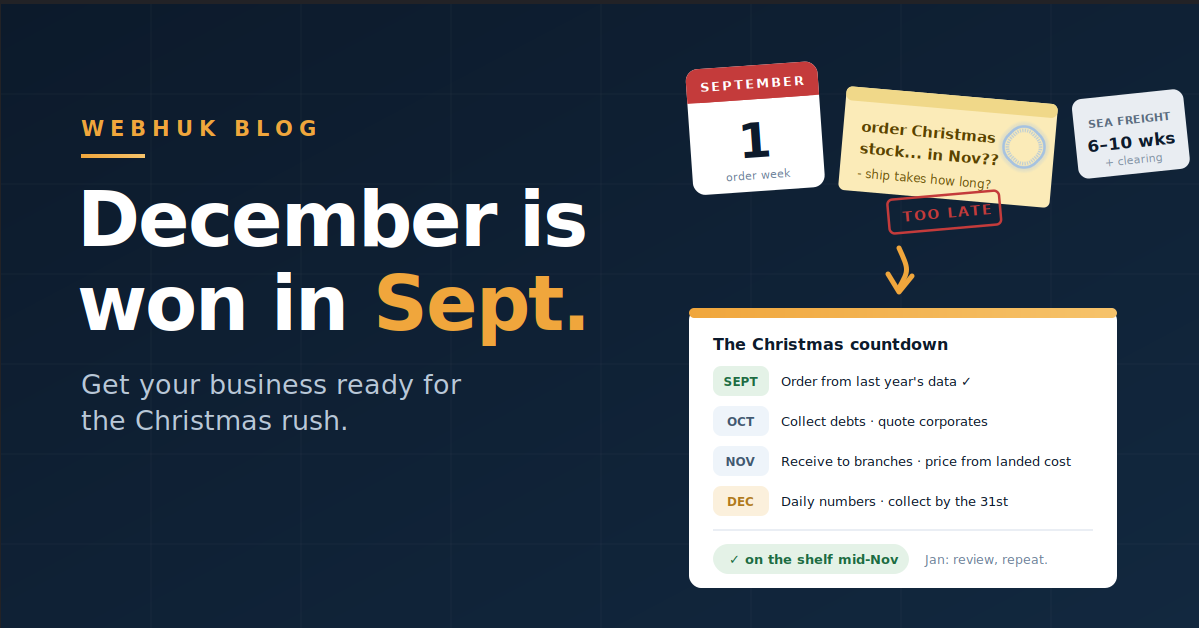
And here's what separates the businesses that have their best December from the ones that watch competitors have it: the December rush is won in September. A container ordered from a supplier this week, shipped by sea, cleared at Tema, and trucked to your shelf is a November arrival — if everything goes smoothly. Order in October and you're gambling on air freight prices or hoping the port isn't congested in the exact weeks everyone else's containers are landing.
This guide is the September plan to prepare your business for the Christmas season: an eight-week countdown covering stock, cash, corporate buyers, staff control, and how to actually run the peak without losing track of it.
Why September Is the Real Start of Christmas
Count backwards from a shelf date of mid-November — the point by which your Christmas stock should be sitting in the shop, priced and ready:
- Shipping and clearing: sea freight from Asian suppliers to Tema plus clearing typically runs several weeks door-to-shelf — roughly six to ten, depending on route, forwarder, and how busy the port is (confirm current transit times with your forwarder; peak season often adds delay).
- Production and supplier lead time: many suppliers need two to four weeks to produce or consolidate a sizeable order before it ships — and in Q4 they're busy too.
- Your own decision time: deciding what and how much to order well takes a week if you do it from data.
Add it up and mid-November on the shelf means orders placed in early-to-mid September. That's not a warning for next year — that's this week.
The 8-Week Countdown
Weeks 1–2 (early September): Decide from data, then order
Pull last December's numbers — per product, per branch. What actually sold, what ran out and when, what you were still holding in February. If your records are in a system, this is a fifteen-minute report; if they're in a memory, this is the year to change that.
Rank your range. Last year's stockouts are this year's biggest opportunities; last year's February leftovers are the items to order cautiously or not at all. Decide quantities by branch — the store in Kumasi and the store in Accra did not sell the same things in the same amounts.
Cost before you order. Price the order on true landed cost of imported goods — duties, freight, clearing, at a realistic exchange rate — so you know your December margins before committing, not after. If the cedi is moving, your multi-currency exposure between paying the supplier now and selling in December is a real number; put it in the calculation.
Place the orders. Confirm production and shipping dates in writing, and get the shipping documents into your purchasing records so arrivals can be tracked, not hoped for.
Weeks 3–4 (late September): Fix the cash, tighten the credit
The season eats cash before it pays: supplier deposits now, duties and clearing in November, extra staff in December — all before the December sales convert to money. Two moves:
Collect what's already owed. Every invoice in your 60+ days bucket is season funding sitting in someone else's business. Run the tracking customer debts rhythm hard in September and October: statements, calls, stop-supply lines — so the outstanding cedis come home before you need them.
Set the season's credit rules now. Decide, in advance and in writing: who gets credit in Q4, at what limits, and for which orders you'll require a proforma and deposit. A busy December is precisely when credit gets extended by whoever is on the counter, to whoever asks nicely — and January is when you discover what that cost.
Weeks 5–6 (October): Corporate buyers, staff, and systems
Quote corporate and institutional buyers early. Companies, banks, NGOs, and government offices spend year-end budgets in November and December — hampers, gifts, office supplies, end-of-year events. Their procurement moves slowly; a quotation sent in mid-October is in the running, one sent in December is too late. Build a corporate target list into your sales pipeline now, and make every quotation count: see how to write a quotation.
Staff up — and decide what temporary staff can do. Extra hands in December are normal; extra hands with full access to prices, discounts, stock adjustments, and cash records are how peak-season leakage happens. Define roles before anyone starts: what a seasonal sales assistant can see and do (record sales, check stock) versus what they can't (change prices, adjust stock, view margins). If your system has role-based access, set the roles now and train on them once.
Prepare the systems. Update price lists for the season, load new products with their SKUs before the stock lands, set reorder levels per branch, and — if you're still running on spreadsheets — recognize that a busy December is the worst possible month to discover the stock sheet is wrong.
Weeks 7–8 (November): Receive, price, distribute, push
Receive stock into named locations. Containers arrive into the warehouse, counted against the purchase documents, with landed costs attached — then distributed to branches as recorded transfers, so every location's stock across branches is known on day one of the season rather than reconstructed on day thirty.
Price from landed cost. Now the real numbers are in: set December prices from what the goods actually cost to land, not from what you estimated in September.
Push the pipeline. Follow up every corporate quotation before validity expires. This is the month year-end budgets get committed.
December: Operate by the numbers
Peak season isn't the time for planning — it's execution. Three daily habits:
- Sales and stock per branch, every evening — so a Kumasi stockout of a fast seller triggers a transfer from Accra tomorrow, not a lost week.
- Cash reconciled daily. High volumes and temporary staff make daily reconciliation the season's most important control.
- Collect before the year closes. Corporate customers pay from budgets that expire on 31 December — invoices delivered and followed up in the same week get paid; invoices that drift into January meet a new budget cycle and a new set of excuses.
Running the Season on One System
Every step above is a records problem in disguise — last year's per-branch sales, purchase orders with arrival tracking, receivables aging, quotations with validity, staff permissions, per-branch stock, daily cash. In Webhuk those are the same system: reports on last year's sales by SKU and branch; purchase orders and one-click purchase invoices with "Prepare for Arrival" receiving into specific branches and containers; landed price calculation for true December costs; multi-currency purchase records; built-in receivables aging for the September collection push; sales funnels and quotations on letterhead for the corporate pipeline; and role-based access so seasonal staff see exactly what their job needs. Plans start at 80 ghs per user per month with a 14-day free trial — and September is early enough that a trial started now has your Christmas stock flowing through it from order to shelf.
January: Close the Loop
The season's last task happens in the new year: sit down with the numbers — what sold, what ran out, what's left, what each corporate account paid and when — in your first monthly business review of the year. Write it down. Next September's plan is already half-finished if you do.
The Bottom Line
Christmas is not a December event for a trading business; it's a September decision, an October collection drive, a November arrival, and a December of execution. Order from data, cost at landed prices, collect early, quote corporates before their budgets close, control what temporary staff can touch, and run the peak on daily numbers. The calendar says you have twelve weeks. Your suppliers' lead times say you have this week.
Start a 14-day free trial
Frequently Asked Questions
When should a small business start preparing for the Christmas season? For businesses importing stock, September — sea freight, clearing, and supplier production lead times mean December stock must be ordered early-to-mid September to be on shelves by mid-November. Local sourcing allows a later start, but cash, credit rules, and corporate quotations still benefit from October at the latest.
How do I decide how much stock to order for Christmas? From last year's data per product and per branch: what sold, what ran out and when, and what was still unsold in February. Order up on last year's stockouts and cautiously on last year's leftovers, and cost the order at landed prices before committing.
How do I manage cash flow before the festive season? Collect overdue receivables in September and October, decide season credit rules and deposit requirements in advance, and budget for the costs that hit before December sales convert: supplier deposits, duties, clearing, and extra staff.
How can I win corporate Christmas orders in Ghana? Quote early — companies and institutions spend year-end budgets in November and December but their procurement moves slowly. Build a corporate target list into your pipeline in October, send professional quotations with clear validity, and follow up before expiry.
How do I control temporary staff during peak season? Define roles before anyone starts: what seasonal staff can do (record sales, check stock) and cannot (change prices, adjust stock, view margins), enforce it through system permissions, and reconcile cash daily.
What software helps run a busy sales season for a small business? Platforms like Webhuk combine last-year sales reports, purchase orders with arrival receiving into branches, landed cost calculation, receivables aging, quotations and sales funnels for corporate buyers, and role-based access for seasonal staff in one system. Plans start at 80 ghs per user per month with a 14-day free trial.