The business is doing well, so you open the second location. A shop in Accra, a store in Kumasi — or maybe a retail counter in front and a warehouse in Tema. And within a month you discover the strange truth every multi-branch owner learns: you now know less about your stock than when you had one shop.
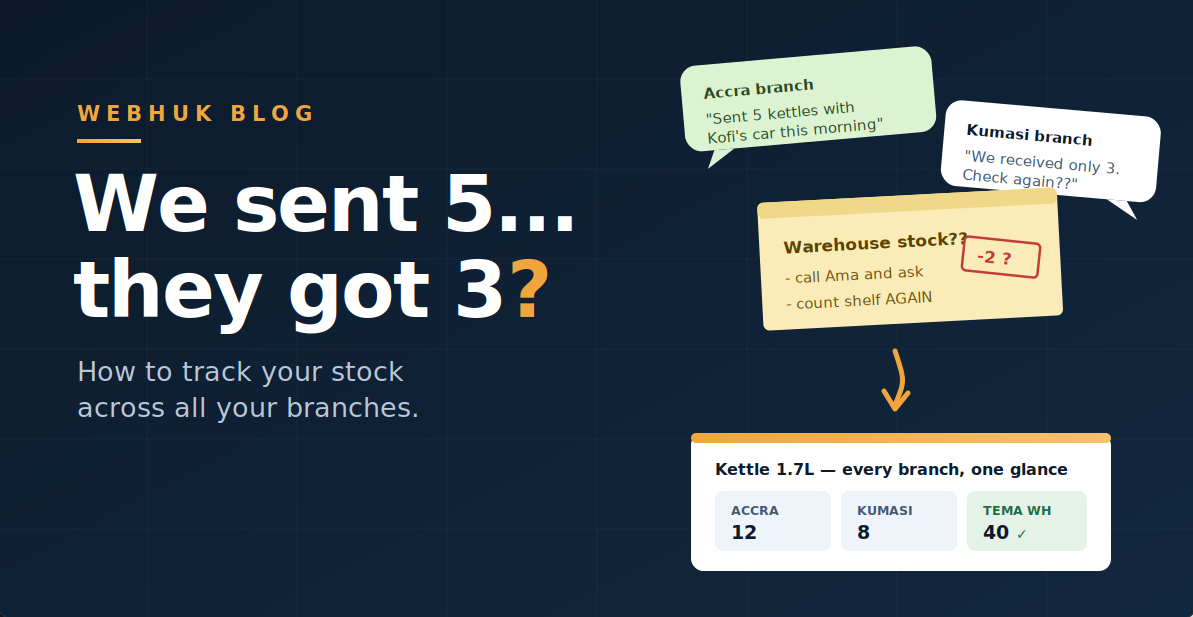
A customer in Kumasi asks for an item. The attendant thinks Accra has it — someone calls, someone counts, someone promises to "send it with the next car going." A week later, Accra swears they sent five, Kumasi insists they received three, and nobody can say where the other two are. Meanwhile the warehouse holds forty units of a product the shop keeps running out of, because stock decisions are made per branch by whoever is standing in it.
None of this is a discipline problem. It's a systems problem — and it has a systematic fix. This guide covers multi-location inventory management for SMEs: the foundations, the rules that keep multi-branch stock honest, and the numbers to watch per location.
Why Stock Goes Wrong the Day You Open Branch Two
With one shop, your eyes are the inventory system — you literally see the shelves daily. Branch two breaks that in four specific ways:
1. "Stock" becomes a meaningless number. Knowing you have 60 units total is useless when the customer is standing in the branch that has zero. Multi-location stock only means something per location.
2. Visibility becomes a phone call. Every "do we have it?" costs a call, an interruption, and a walk to the shelf — and the answer expires the moment the next customer buys one.
3. Movements go unrecorded. Goods travel between branches in car boots and with trotro drivers, tracked by memory and WhatsApp messages. Every untracked movement is a discrepancy waiting to be discovered — and an argument waiting to happen.
4. Shrinkage finds the shadows. Theft, damage, and miscounts hide easily when no one is sure what each location was supposed to have. You can't spot what's missing if you never knew what was there.
The Foundations: SKUs, Locations, and One Source of Truth
Before rules and software, three foundations:
Give every product one identity. A consistent SKU (stock-keeping unit) code per product — the same code in every branch, on every document. If Accra calls it "Kettle 1.7L Silver" and Kumasi calls it "Silver Kettle Big," you don't have one product in two places; you have two products and no truth. If your suppliers use their own codes, keep those as vendor SKUs mapped to yours, so purchase documents still reconcile.
Model your real locations — including inside them. Not just "Accra branch" and "Kumasi branch," but the structure within: the shop floor versus the back store, Warehouse Bay 1 versus Bay 3. When a location's stock is subdivided into the containers where goods physically sit, finding items stops being an expedition and counting stops being a guess.
Keep one live record, not one per branch. The moment each branch keeps its own book — or its own spreadsheet — you've guaranteed the books will disagree. One system, holding stock levels per location, that everyone reads from and writes to. (If you've recently moved your records off spreadsheets, this is the exact reason why.)
The 6 Rules of Multi-Location Stock Control
Rule 1 — Every movement is recorded, no exceptions. Goods enter a location (purchase received, transfer in) or leave it (sale, transfer out, damage write-off). If a physical movement has no record, your system is now fiction. The rule must survive busy Saturdays, which is why the best systems create the stock movement automatically from the sale or purchase document rather than trusting anyone to remember.
Rule 2 — The sale deducts the stock, instantly, from the right branch. When an invoice is raised in Kumasi, Kumasi's count drops — not a "total" number, and not at month-end when someone updates a sheet. This single automation removes the largest source of drift between shelf and record.
Rule 3 — Receive goods into a specific location. A shipment doesn't arrive "into the business"; it arrives into Tema Warehouse, Bay 3. Receiving against the purchase document, into the named branch and container, is also the moment to attach the landed cost of imported goods so every location's stock carries its true value.
Rule 4 — Transfers are documents, not favours. Moving 10 units from Accra to Kumasi is recorded as stock out of Accra and stock into Kumasi — dated, quantified, and signed for on receipt. The branch that sent and the branch that received must both acknowledge the same numbers. This is the rule that ends the "we sent five, we got three" wars, because the discrepancy surfaces the same day, not at Christmas stocktaking.
Rule 5 — Count small, count often. Replace the dreaded annual full stocktake with cycle counts: each week, each branch counts a small slice of its items and reconciles against the system. Twenty items a week per branch finds discrepancies while they're fresh, keeps staff honest, and keeps trust in the numbers high — because a system nobody trusts stops being updated.
Rule 6 — Set reorder levels per branch, not per business. The Kumasi shop selling 20 kettles a month and the Accra shop selling 5 should not share a reorder point. Minimum levels per location turn restocking from opinion ("I think we're low") into signal — and they're also how you spot that the warehouse is hoarding what a shop is starving for.
Running It in One System
Here's how this assembles in Webhuk, where multi-location tracking is structural rather than bolted on:
- Branches and Containers model your real geography — each branch subdivided into the containers where stock physically sits — and every SKU's quantity is visible per branch and container, from anywhere, without a phone call.
- Sales and purchases create the stock movements automatically. Raise an invoice and the outgoing logistics record is generated with it; record a purchase and the incoming side is handled — Rule 1 and Rule 2 enforced by the software, not by memory.
- "Prepare for Arrival" receives shipments into named locations, distributing the goods to the branch and container where they'll live, with landed price calculation rolling duties and shipment costs into per-unit values as stock is received.
- SKUs and Vendor SKUs keep your product identities consistent across branches and reconciled with supplier documents; your existing item list imports from CSV to get started.
- Role-based access gives each branch team exactly the visibility and permissions their job needs — the Kumasi attendant checks Accra's stock without being able to edit it.
- And because inventory lives beside your enquiry-to-invoice workflow and payment records, the answer to "can we supply this order, from where, at what margin?" sits in one screen instead of three phone calls.
Three Numbers That Tell You It's Working
- Stockouts per branch per month. How often did a customer want something a branch didn't have — especially while another location held it? This number falling is the clearest sign the system is paying for itself.
- Shrinkage rate. The gap between counted and recorded stock, per branch, per cycle count — as a percentage of stock value. Multi-branch retail always has some; what matters is that it's measured, trending down, and traceable to a location.
- Stock turn per location. How many times per year each branch sells through its stock. A branch turning 8× and another turning 2× on the same products is a redistribution decision hiding in plain sight.
Review all three monthly, per branch, side by side. Fifteen minutes — and you'll be managing locations by numbers instead of by whoever calls loudest for more stock.
The Bottom Line
Opening a second location shouldn't mean losing sight of your stock — but it will, unless stock levels live per location, every movement becomes a record, and counting happens little and often. Build on the three foundations, hold the six rules, and watch three numbers monthly. Webhuk gives you the machinery: branch-and-container stock visibility, movements created automatically by your sales and purchases, location-specific receiving with landed costs, and role-based access for branch teams — from 80 ghs per user per month, with a 14-day free trial and CSV import to bring your item list in. The next time a customer asks "do you have it?", the answer should be on the screen — for every branch at once.
Start a 14-day free trial
Frequently Asked Questions
How do I manage inventory across multiple locations? Track stock levels per location (not one business-wide total), record every movement — sales, purchases, transfers, write-offs — against the specific branch, and keep it all in one live system that every location reads and writes. Automating stock deduction at the point of sale removes the biggest source of errors.
What is the best way to track stock between a shop and a warehouse? Treat them as separate locations in one system, subdivided into the physical spots where goods sit (shelf, back store, warehouse bay). Receive purchases into the warehouse location, transfer to the shop with a recorded, acknowledged document, and let sales deduct from the shop's count automatically.
How should stock transfers between branches be handled? As formal documents: quantity out of the sending branch and quantity into the receiving branch, dated and confirmed by both sides. Any difference between sent and received surfaces immediately as a discrepancy to investigate — the same day, not at annual stocktaking.
What is a cycle count and why is it better than an annual stocktake? A cycle count checks a small portion of items regularly — for example, twenty items per branch per week — instead of counting everything once a year. Discrepancies are found while they're recent and traceable, disruption is minimal, and trust in the numbers stays high year-round.
How do I reduce stock shrinkage across branches? Measure it first: regular cycle counts per location against recorded levels. Then close the causes — record all movements including damage, require acknowledged transfer documents, restrict stock adjustments to specific roles, and track shrinkage percentage per branch so patterns become visible.
What software can track inventory across branches for a small business? Platforms like Webhuk track every SKU per branch and container, create stock movements automatically from invoices and purchases, receive shipments into named locations with landed cost calculation, and give branch staff role-based access. Plans start at 80 Ghs per user per month with a 14-day free trial.