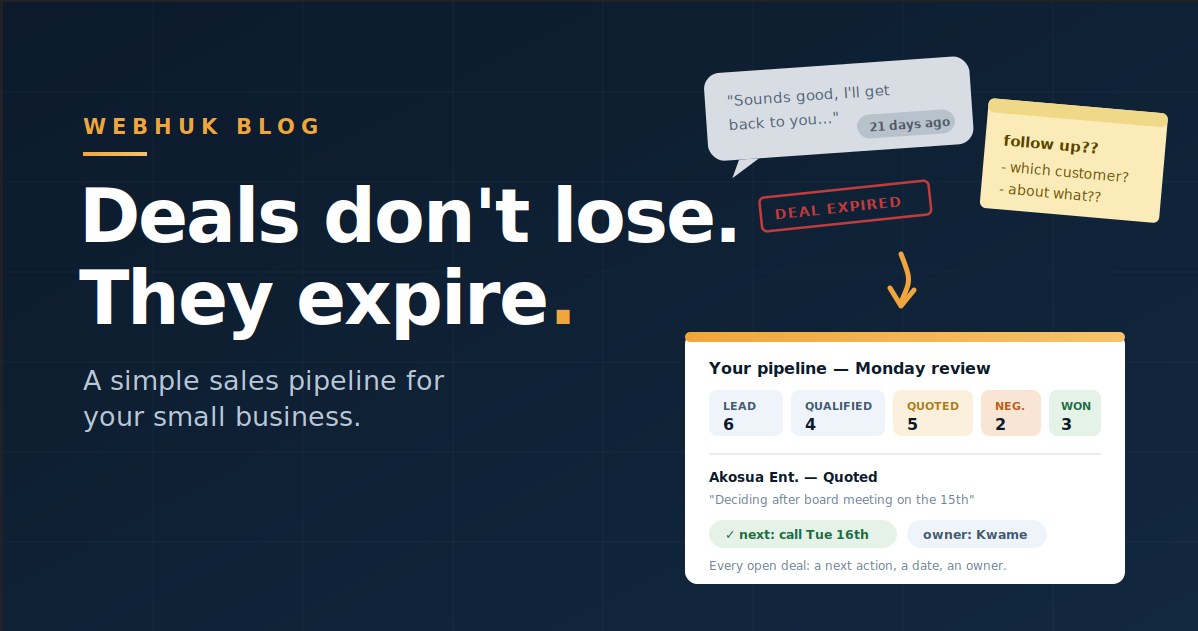
Think about the last ten potential customers who told you some version of "sounds good, I'll get back to you." How many did you follow up with? Not "meant to" — actually called, on a planned day, with notes from the last conversation in front of you?
For most small businesses, the honest answer is one or two. The rest joined the graveyard where most SME sales actually go to die — not lost to a competitor, not lost on price, just… never followed up. The prospect got busy, you got busy, and a deal that needed two more phone calls quietly expired.
The fix is not a complicated CRM with forty fields per contact that your team will abandon in three weeks. The fix is a sales pipeline for small business reality: five clear stages, one rule about next actions, a habit of logging calls, and a fifteen-minute weekly review. This guide builds it.
What a Sales Pipeline Actually Is
A sales pipeline is just an honest list of every potential deal, sorted by how far along it is. Nothing more mystical than that. Its power comes from what it forces you to admit: how many real opportunities you have, where each one stands, and — most importantly — what happens next for each.
The owner's head is where most SME pipelines currently live. That works until it doesn't: the week you travel, the month sales gets busy, the day a good salesperson resigns and takes the entire pipeline with them in memory.
Why Deals Die (It's Rarely the Price)
Watch where deals actually fall apart in a small business and a pattern emerges:
No next action. The quotation went out and now everyone is "waiting to hear back." Waiting is not a sales activity. Every live deal needs a concrete next step with a date — and a deal with no next action isn't in your pipeline, it's in your imagination.
No owner. Two people each assumed the other was following up with the customer. The customer, hearing from neither, concluded you weren't serious.
No memory of the last conversation. The customer mentioned they'd decide after their board meeting on the 15th. Nobody wrote it down, so nobody called on the 16th. When follow-up depends on remembering, follow-up loses to whatever is louder that day.
No record of why deals were lost. Without lost-reasons, you can't tell whether you're losing on price, speed, stock availability, or silence — so you fix nothing.
Every one of these is a system gap, not a talent gap. Which is good news: systems are buildable.
The 5-Stage Pipeline for SMEs
Keep it to five stages, each with a clear meaning, so nobody debates where a deal sits:
1. Lead — someone who might buy: a walk-in who asked questions, a referral, a company that requested your profile. Exit: you've had a real conversation about a real need.
2. Contacted / Qualified — you've spoken, and there's a genuine need, a budget, and a rough timeline. Exit: they've asked for prices.
3. Quoted — your quotation is in their hands (see how to write a quotation for making that document count). Exit: they respond — questions, negotiation, or a decision.
4. Negotiating — terms, prices, or delivery under discussion; the deal is live and warm. Exit: yes or no.
5. Won / Lost — won deals flow into your enquiry-to-invoice workflow; lost deals get a one-line reason recorded before they're closed.
Resist the urge to add stages. Every extra stage is another debate about definitions and another place for deals to hide.
The Follow-Up Engine: Call Logs and Next Actions
The pipeline tells you where deals are. What moves them is a simple engine with two parts:
Part one — log every meaningful contact. After each call or visit, write three lines against the deal: what was discussed, what they said (especially objections and dates — "deciding after the 15th"), and what you promised. Salespeople resist this until the first time it saves a deal — the customer who's amazed you remembered their exact concern from three weeks ago. A deal's call history is also how a colleague can pick up seamlessly when the usual person is away, and how the pipeline survives staff changes.
Part two — every open deal has a next action with a date. No exceptions. "Call Akosua Tuesday about the revised quantities." "Visit site Friday before requoting." The moment a call ends, the next action gets set — while the conversation is fresh. Your working day then starts from a simple list: today's actions, ordered. Not "who should I chase?" but "here's who I'm chasing, and here's why."
Between those two parts sits the discipline that separates businesses that convert from businesses that hope: the follow-up happens on the planned day whether or not you feel like it, referencing the last conversation. Persistent and informed beats frequent and vague.
The 15-Minute Weekly Pipeline Review
Once a week — Monday morning works — walk the pipeline with whoever sells:
- Stuck deals first. Anything sitting in a stage past its normal time (a quote unanswered for two weeks, a negotiation silent for ten days): decide the reviving action or close it honestly as lost.
- Check every open deal has a next action and an owner. Any deal without one gets one, on the spot.
- Read the lost reasons. Three losses in a month to "no stock" is an inventory conversation, not a sales problem. Three to "too slow with the quote" points straight at your quoting speed.
Fifteen minutes. The businesses that do this stop being surprised by their own months.
Running It in Webhuk
Everything above works on a whiteboard — until the deals number more than a dozen and the whiteboard meets a busy week. In Webhuk, the same system runs as part of the platform your quotes and invoices already live in:
- Sales Funnels hold your deals by stage, so the pipeline is a living view rather than a Monday reconstruction — each deal tied to the actual customer record.
- Callsheets are the call log built in: every conversation recorded against the deal as a running thread, so the full history — who said what, when, and what was promised — travels with the deal, not with one person's memory.
- Tasks with reminders carry the next actions: "call Akosua Tuesday" becomes something the system surfaces on Tuesday, integrated with the funnel so working the day's list is working the pipeline.
- Labels on companies and contacts let you slice the pipeline — by customer type, region, or product interest — when you want to see where deals cluster.
- And because it's one platform, the handoffs are seamless: a qualified deal's quotation is generated in the same system, a won deal becomes an order and invoice without retyping, and the money side flows into tracking customer debts. The pipeline isn't beside your operations — it's the front end of them.
From 80 ghs per user per month, with a 14-day free trial — enough time to load your current live deals and run two weekly reviews before deciding.
Three Numbers That Tell You It's Working
- Win rate — of deals that reached Quoted, how many became Won? Track it monthly; it's the single best measure of your selling.
- Average days in stage — especially Quoted. If quotes sit unanswered for 20 days on average, your follow-up rhythm (or your quotes) needs work.
- Lost reasons, tallied — the free consulting your lost deals are trying to give you. Read the tally monthly and fix the biggest one.
The Bottom Line
Your next month's revenue is sitting in your pipeline right now — in the deals that will get a planned, informed follow-up and the deals that will die of silence. Five stages, a call log, a next action on everything, and fifteen minutes on Mondays: that's the whole system. Webhuk gives it a home — funnels, callsheets, task reminders — inside the same platform that sends the quotation and raises the invoice when the answer is yes. "I'll get back to you" should trigger a plan, not a hope.
Start a 14-day free trial
Frequently Asked Questions
What is a sales pipeline for a small business? An organized list of every potential deal, sorted by stage — typically Lead, Qualified, Quoted, Negotiating, and Won/Lost — with a next action and owner on each. It replaces memory-based selling with a visible, workable process.
How many stages should a small business sales pipeline have? Five is usually right: Lead, Contacted/Qualified, Quoted, Negotiating, Won/Lost. Fewer loses useful distinction; more creates debates about definitions and places for deals to hide.
How do I follow up with customers without annoying them? Follow up on a planned date with a reason: reference the last conversation, answer an open question, or check against a date they mentioned. Informed, purposeful follow-up reads as professionalism; only vague, repeated "just checking in" calls annoy.
What should I record after each sales call? Three lines: what was discussed, what the customer said (objections, concerns, and any dates they mentioned), and what you promised — plus the next action with its date. Logged against the deal, this history lets anyone on the team continue the conversation seamlessly.
Do I need a CRM or is a spreadsheet enough for pipeline tracking? A spreadsheet can hold stages, but it can't remind you of Tuesday's calls, thread call histories to deals, or connect a won deal to the quotation and invoice. Lightweight platforms give you those without big-CRM complexity — the test is whether your team still updates it in month three.
What software combines a sales pipeline with quotations and invoicing? Platforms like Webhuk include sales funnels with threaded callsheets and task reminders in the same system that generates quotations, orders, and invoices — so won deals flow straight into fulfillment without retyping. Plans start at 80 ghs per user per month with a 14-day free trial.