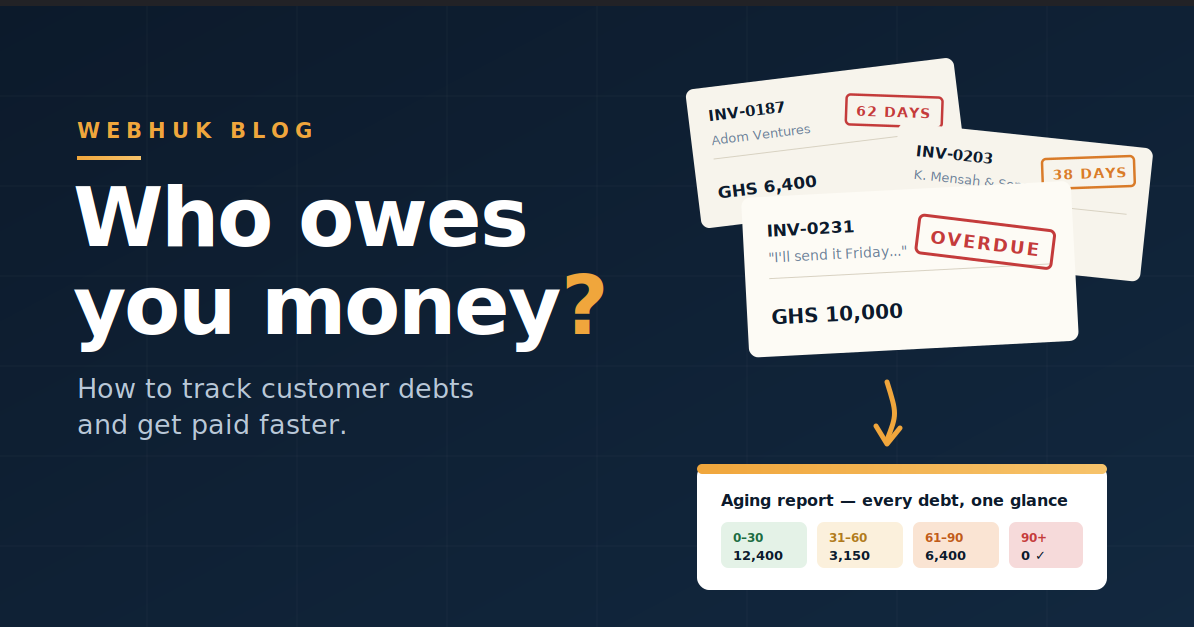
In most trading businesses in Ghana, refusing to sell on credit means refusing to sell. Your regular customers expect 30 days. The corporate client pays "after processing." The long-time customer takes goods today and says, sincerely, "I'll send it Friday." Credit is how commerce runs — and it's also how profitable businesses quietly run out of cash.
Here's the uncomfortable pattern: the sale was won, the goods delivered, the margin earned on paper. But the money is sitting in other people's businesses, recorded — if at all — in a notebook, a memory, and a WhatsApp thread. Ask many SME owners "who owes you money right now, and how much?" and the honest answer is a guess.
This guide is about replacing that guess with a system: how to track customer debts properly, age them, follow up without damaging relationships, and measure whether your collections are getting better or worse.
Unpaid Invoices Kill More SMEs Than Poor Sales
A business doesn't close because profit is low on paper. It closes the week it can't pay a supplier, a rent demand, or salaries — in cash. Every cedi sitting in overdue invoices is a cedi you've already worked for but cannot use, and worse, you're effectively financing your customers' businesses interest-free while possibly borrowing for your own.
The math is brutal in one direction: if your margin is 15%, a single unpaid invoice of GHS 10,000 wipes out the entire profit of roughly GHS 67,000 in sales. Collections are not admin. Collections are profit protection.
Decide Your Credit Rules Before the Sale, Not After
Most debt problems are created at the moment of sale, not at collection time. Three rules to set in advance:
1. Who qualifies for credit — and how much. New customers pay upfront or a deposit; credit is earned by payment history. Set a credit limit per customer, even informally: the moment their outstanding balance would exceed it, the next sale is cash. A limit you never check is not a limit, which is why the balance must be visible at the moment of sale.
2. Terms in writing, on the invoice. "Payment within 30 days" printed on a professional invoice — with your bank details right there — outperforms any verbal agreement. If you followed our enquiry-to-invoice workflow guide, your terms are already standardised on every document.
3. Deposits for large or custom orders. For big orders, issue a proforma invoice and collect an advance before goods move. A customer unwilling to pay a deposit is telling you something about how they'll treat the balance.
The 6-Practice Receivables System
Practice 1 — Invoice the same day, every time. The payment clock starts when the invoice lands, not when the goods do. A business that invoices "when we get time" has voluntarily added a week to its collection cycle.
Practice 2 — Record every payment against a specific invoice. Not "Kwame paid 5,000" in a notebook — GHS 5,000 against invoice #INV-0231, leaving GHS 3,200 outstanding. Part payments are normal in our market; untracked part payments are how disputes are born. When you record payments against invoices, every customer has a clean running balance you can both agree on.
Practice 3 — Keep one live debtors list. One list, showing every customer, their total outstanding, and their oldest unpaid invoice — visible to you any day, not rebuilt from receipts at month-end. If you've moved your records off spreadsheets, this list should simply exist in your system, always current, without anyone compiling it.
Practice 4 — Age your receivables. Sort every unpaid invoice into buckets: 0–30 days (normal), 31–60 (attention), 61–90 (problem), 90+ (crisis, possible bad debt). Aging turns a flat list of debts into a priority queue — because a 75-day-old invoice needs a different conversation than a 20-day-old one, and research on receivables consistently shows the odds of collecting fall sharply as invoices age.
Practice 5 — Run a fixed follow-up rhythm. Collections fail from inconsistency, not rudeness. A workable rhythm for Ghanaian business relationships:
- A few days before due date: a friendly message — "Invoice #231 is due Friday; here are the bank details again."
- Due date passed: a polite call, assume good faith, ask for a payment date. Log what they promised.
- Broken promise: a firmer call referencing the promise, and a customer statement sent in writing.
- 60+ days: an owner-to-owner conversation, and new sales switch to cash-only until the account clears.
The critical habit is logging every call and every promise. "You said Friday the 12th" is a very different conversation than "you've been promising for a while."
Practice 6 — Enforce a stop-supply line. The kindest thing you can do for a customer drifting into deep debt is stop deepening it. A clear, consistently applied rule — "we pause credit at 60 days or at the credit limit" — is respected precisely because it isn't personal.
Running All of This in One System
Every practice above can be run on paper with enough discipline. The problem is that discipline is exactly what busy weeks destroy — which is why this works far better when the tracking is a by-product of normal work rather than a separate chore. In Webhuk, the receivables system assembles itself from things you're already doing:
- Every invoice is generated from the order (with your terms and bank details on the letterhead PDF), so same-day invoicing is one click, not a task.
- Every payment is recorded against the invoice and into a financial account — cash, bank, or customer site credit — so part payments and running balances are always current, per customer.
- Aging lists for invoices (and quotations and orders) are built in, with printable PDF reports — Monday morning's follow-up priorities are a glance, not a compilation job.
- Callsheets let your team log each follow-up call and what was promised against the customer, so the history travels with the account rather than living in one person's memory.
- Tasks with reminders turn "call Kwame Friday about the balance" into something the system remembers even when you don't.
- Role-based access means the salesperson can see a customer's balance before quietly extending more credit — without seeing anything else they shouldn't.
The pattern to notice: nobody "does receivables tracking" as extra work. The debtors list, the aging, and the balances fall out of invoicing and payment recording — work that was happening anyway.
Measure It: Three Numbers That Tell the Truth
- Days Sales Outstanding (DSO) — on average, how many days from invoice to payment? Formula: (receivables ÷ credit sales for the period) × days in the period. If your terms are 30 days and your DSO is 58, your real terms are 58.
- Percentage of receivables over 60 days. This is your risk gauge. Watch the trend monthly; a rising number means your credit rules or follow-up rhythm are slipping.
- Collection effectiveness — of what was due this month, how much actually arrived? Consistently below ~80% means the problem is systemic, not one difficult customer.
Review these monthly, right after the aging report. Twenty minutes, once a month, and you'll know whether the profit you calculated on the deal is actually becoming cash.
The Bottom Line
You can't avoid selling on credit — but you can stop credit sales from being a leap of faith. Set the rules before the sale, invoice the same day, record every payment against its invoice, age the book, follow up on a rhythm, and watch three numbers monthly. Webhuk gives you the machinery for all of it — one-click invoices with your terms, payments tracked to customer accounts, built-in aging reports, callsheets and reminders for follow-up — from 80 ghs per user per month with a 14-day free trial. Your next collection call should start with "according to our records" — and your records should be right.
Start a 14-day free trial
Frequently Asked Questions
What is the best way to keep track of customer debts in a small business? Record every credit sale as an invoice, record every payment against a specific invoice (including part payments), and maintain one live debtors list showing each customer's outstanding balance and oldest unpaid invoice. Business software does this automatically as a by-product of invoicing.
What is an aging report for invoices? An aging report sorts unpaid invoices into time buckets — typically 0–30, 31–60, 61–90, and 90+ days overdue. It turns your debtors list into a priority queue, since older invoices are progressively harder to collect and need firmer follow-up.
How do I get customers to pay invoices on time without spoiling the relationship? Consistency beats aggression: state terms in writing on the invoice, remind politely before the due date, call the day after it passes, log every promise, and follow up on broken promises by referencing them specifically. Clear, predictable rules are respected because they're not personal.
Should I stop supplying a customer who owes money? Set a clear line in advance — for example, credit pauses when a balance passes 60 days or exceeds the customer's credit limit — and apply it to everyone. New sales can continue on cash terms while the old balance is settled.
How are part payments handled in receivables tracking? Each part payment is recorded against the specific invoice it settles, reducing that invoice's outstanding amount and the customer's running balance. This keeps a clean, agreed history and prevents the classic "but I paid you something" dispute.
What software can track customer debts for SMEs in Ghana? Platforms like Webhuk record payments against invoices and customer accounts, maintain live balances (including part payments and site credit), and produce built-in aging reports for invoices — plus callsheets and task reminders for follow-up. Plans start at 80 ghs per user per month with a 14-day free trial.