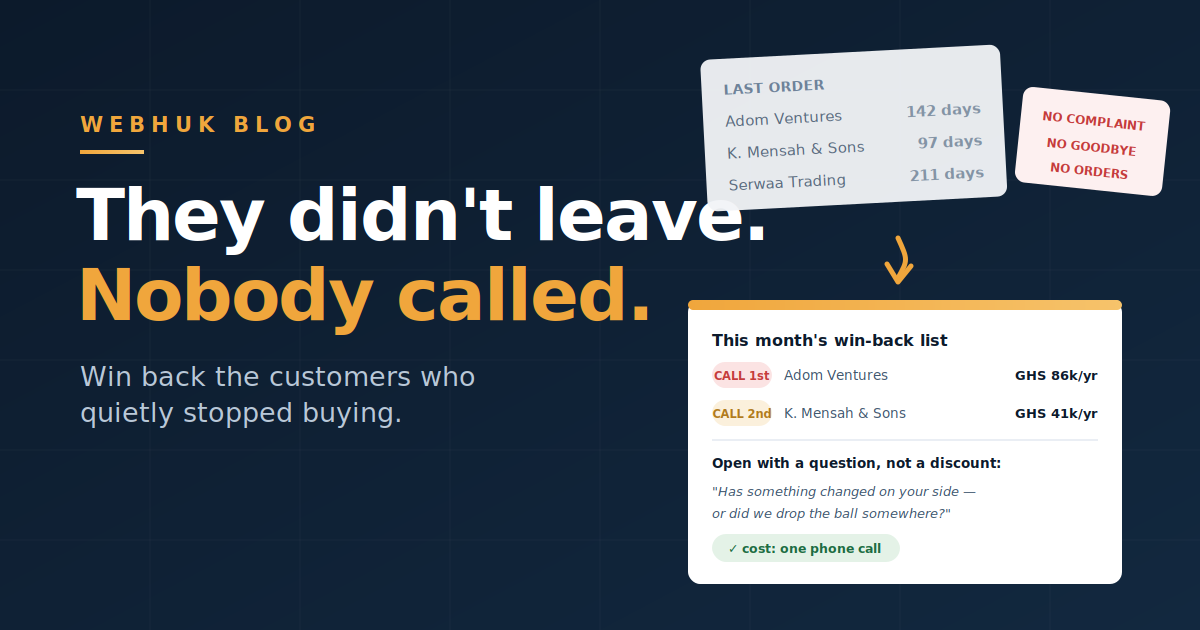
Think of a customer who used to buy from you every few weeks. Reliable, familiar, no drama. Now ask yourself: when did they last place an order?
For most SME owners, the honest answer is "actually… I'm not sure. It's been a while." And that's the whole problem — because that customer didn't storm out, didn't complain, didn't announce anything. They just stopped. Quietly. And because nothing dramatic happened, nothing in your business registered that anything had changed.
Meanwhile you're spending money and energy chasing new customers who don't know you, don't trust you yet, and will take weeks of effort to convert. The customer who already trusts you, already knows your stock, and already has an account with you is sitting one phone call away — and that call is free.
This guide covers how to win back lost customers: finding who's gone quiet, understanding why they actually left, what to say when you call, and how to make reactivation a monthly routine instead of a once-a-year panic.
Why Dormant Customers Are Your Cheapest Revenue
Three reasons this list outperforms almost any other sales activity available to a small business:
The trust already exists. The hardest part of any sale — convincing someone you're legitimate, reliable, and worth paying — is done. You're not building a relationship; you're resuming one.
You already know what they buy. No discovery needed. If their history shows they bought cables and fittings every month for two years, your call writes itself: you know what to mention and what's back in stock.
The cost is a phone call. No advertising spend, no commission, no new customer acquisition cost. For an SME watching cash flow, this is the highest-return hour in the week.
And the quiet bonus: a reactivation call often surfaces a problem you didn't know existed — a late delivery, a rude exchange, a price that drifted above a competitor's. One call can fix something that's been silently costing you other customers too.
Why Customers Actually Stop Buying
Owners usually assume price. The reality is more varied, and more fixable:
- They were disappointed once — a late delivery, a wrong item, a dispute handled badly — and rather than complain, they simply went elsewhere. Common, and the most recoverable.
- You ran out of stock when they needed you. They found another supplier who had it, and inertia kept them there. This is why repeated stockouts cost far more than the single lost sale.
- Their contact person changed. The person who knew you left their company, and the new one brought their own suppliers. Nothing personal — just nobody maintained the relationship.
- Their business changed — different products, different scale, or they're struggling.
- Price. Real, but less often the whole story than owners assume.
- No reason at all. They drifted. You stopped being top of mind, and nobody called. This is the largest category, and the easiest to reverse.
Notice how many of these are not rejections. Most dormant customers aren't lost — they're unattended.
Step 1: Find Them (Define "Dormant" for Your Business)
"Dormant" depends on your buying cycle. A customer who buys weekly and hasn't bought in six weeks is a warning; a customer who buys twice a year isn't dormant at four months. Set a threshold per customer type — for many trading businesses, 90 days without a purchase is a sensible starting line.
Then produce the list. This is where your customer database stops being admin and starts being money: for each customer, their last purchase date, what they typically buy, their lifetime value, and any outstanding balance. If that list exists, you have a campaign. If it doesn't, you have — at best — the handful of names you happen to remember, which is exactly why most SMEs never run this play.
Step 2: Prioritize (Don't Call Everyone)
Rank the list so your limited hours go where the return is:
- High value, recently dormant — your best customers who've been quiet 90–180 days. Call these first, this week. They're the most recoverable and worth the most.
- High value, long dormant — valuable customers gone 6–12 months. Worth a call, but expect that something happened; be ready to listen.
- Low value, any period — a message or a seasonal mailing is enough.
- Customers with unpaid balances — handle with care. This is a relationship call, not a collection call; mixing the two usually loses both. If a balance exists, deal with it as part of your receivables rhythm, separately.
Step 3: Make the Call (What Actually Works)
The instinct is to open with a discount. Resist it — you'll train customers to wait for discounts, and you'll never learn why they left.
Lead with the question, not the pitch. Something like: "Mr. Mensah, it's Kwame from [business]. I noticed we haven't supplied you in a while and I wanted to check in — has something changed on your side, or did we drop the ball somewhere?"
That last clause is the magic. It gives permission to tell you the truth, and the truth is the point of the call.
Then shut up and listen. Whatever comes back — a complaint, a stockout story, a new supplier — let it come out fully without defending. You're gathering intelligence that's worth more than the single order.
Respond to what they actually said:
- Disappointed? Acknowledge it plainly, say what's changed, and ask for one more chance on a specific order. No elaborate apologies — just ownership and a concrete next step.
- You were out of stock? Tell them what you now hold and offer to reserve it. This is where accurate stock information turns a call into an order.
- New contact person? Ask for an introduction and treat it as a fresh relationship — because it is.
- Price? Don't discount reflexively. Ask what they're paying, then decide deliberately whether you can match, whether you compete on service, or whether that business isn't worth having at that price. Sometimes the right answer is to let it go — and a quotation with clear terms often wins back more than a lower number would.
- Just drifted? Easiest of all. Tell them what's new, what's in stock, and ask if you can quote their next requirement.
Always end with a next action. A quote to send, a sample to deliver, a date to call back — logged against their record, exactly like any deal in your sales pipeline.
Step 4: Make It a Routine, Not a Rescue
The businesses that get real money out of this don't run a dramatic campaign once a year. They run a small, boring routine:
- Monthly: pull the dormant list as part of your monthly business review. Ten to twenty calls, assigned to someone by name, with a date.
- Log everything. Every reason given goes onto the customer's record. After three months, patterns emerge — "out of stock" appearing repeatedly is an inventory decision, not a sales one.
- Watch the leading indicator. Don't wait for 90 days of silence. A customer whose buying frequency is slowing is drifting now — a call at that point prevents the dormancy entirely.
- Time it to the calendar. Before a busy season is the strongest moment to reactivate — which is exactly why the Christmas season plan starts with the customers you already have.
Running It in Webhuk
This play lives or dies on having customer history you can sort. In Webhuk, that's structural: companies and contacts hold every customer with their full thread of quotations, orders, invoices, and payments — so last purchase date, typical items, and lifetime value are visible rather than remembered. Labels let you slice the list by customer type, region, or product interest, so a win-back round can target precisely ("all wholesale electricals customers in Kumasi, quiet 90+ days"). Callsheets capture every conversation and the reason given, building the pattern data that tells you what's really driving customers away. Tasks with reminders carry the callbacks, and sales funnels hold the revived deals so they're worked like any other opportunity. From 80 ghs per user per month, with a 14-day free trial.
The Bottom Line
Your next month's easiest revenue isn't hiding in a new market — it's sitting in your own records, in the names of people who already trusted you once and were never asked why they stopped. Define dormant for your business, pull the list, call the valuable ones first, open by asking rather than selling, listen properly, log the reason, and do it again next month.
Most of them didn't leave. Nobody called.
Start a 14-day free trial
Frequently Asked Questions
How do I know which customers have stopped buying? Set a threshold based on your normal buying cycle — 90 days without a purchase works for many trading businesses — then list customers whose last purchase predates it, along with what they typically bought and their value to you. This requires purchase history held per customer, not just a contact list.
Why do customers stop buying without complaining? Most don't leave angrily; they drift. A single disappointment, a stockout, a change of contact person at their company, or simply no contact from you is usually enough. Complaining takes effort — switching suppliers is easier.
What should I say when calling a customer who stopped buying? Ask rather than sell: acknowledge they haven't ordered in a while and ask directly whether something changed on their side or whether you dropped the ball. Then listen without defending, respond to the actual reason, and end with a concrete next step.
Should I offer a discount to win back a customer? Not as an opening move. Discounting first teaches customers to wait for discounts and hides the real reason they left. Find out the reason first — often it's stock availability or a service failure, which costs nothing to fix.
How often should I run a win-back campaign? Monthly, as a small routine of ten to twenty calls, rather than one large annual campaign. Regular small rounds catch customers while they're recoverable and surface recurring problems early.
What software helps track customers who stopped buying? Platforms like Webhuk hold each customer's full history — quotations, invoices, payments, and call notes — so last purchase date and buying patterns are visible, with labels to segment the list and task reminders for follow-up calls.