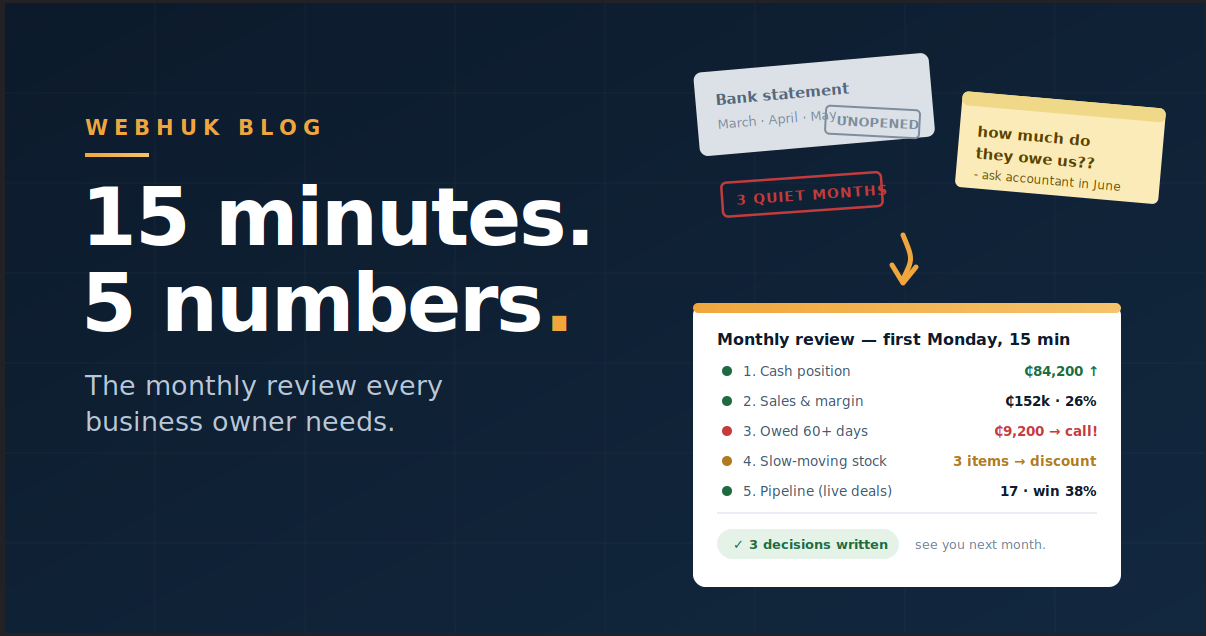
There's a particular conversation most SME owners have once a year, usually with an accountant, usually months after it could have mattered. It goes: "Did you know your margins dropped in March?" — and no, you didn't know, because March was busy, and April was busier, and the numbers that could have told you were scattered across a sales book, a stock sheet, a debtors list, and a bank statement nobody read side by side.
Businesses rarely fail from one bad decision. They fail from three quiet months nobody examined. The antidote is not more reports, more meetings, or an MBA — it's a monthly business review: fifteen minutes, once a month, five numbers, each with a decision attached. This guide gives you the exact ritual.
Why Monthly Is the Magic Frequency
Daily numbers are noise — one big sale or one slow Tuesday tells you nothing. Yearly numbers are archaeology — true, but too late to act on. Monthly is where signal lives: long enough for patterns to be real, short enough that you can still change the quarter.
The other reason monthly works is honesty about your attention. A ritual that takes an afternoon dies by the third month. Fifteen minutes on the first Monday of the month, coffee in hand, survives — and a review that happens beats a perfect review that doesn't.
One rule before the numbers: this is a decision meeting, not a viewing. Every number below comes with the decision it exists to drive. If you look at a number and no decision could ever follow from it, stop looking at it.
Number 1: Cash — Position and Direction
The question: how much money do we actually have, and did it go up or down this month?
Not profit — cash: the balances across your cash and bank accounts today, versus the same day last month. Profitable businesses die of empty accounts all the time (usually because the profit is parked in stock and unpaid invoices — which is exactly what Numbers 3 and 4 will reveal).
The decision attached: if cash fell while sales held steady, the next ten minutes of this review will tell you where it went — and whether the response is collecting harder, buying slower, or pricing better.
Number 2: Sales and Margin — Together, Never Apart
The question: what did we sell this month, and what did we actually keep?
Sales alone is the vanity number; a record sales month at eroded margins can leave you poorer. Put the two side by side: total sales versus last month (and versus the same month last year, if seasonality matters in your trade), and gross margin — what remained after the true cost of the goods. For importers, "true cost" means landed cost, not the supplier invoice; if the cedi moved this month, your multi-currency exposure belongs in this glance too.
The decision attached: margin slipping two months running is a price-list review, this week — not a hope that next month fixes itself.
Number 3: Receivables — Who Owes You, and How Old Is It
The question: how much of our money is sitting in other people's businesses — and is any of it going stale?
Two figures: total outstanding, and the portion older than 60 days. The total tells you how much of your cash-flow problem is actually a collection problem; the 60+ bucket is your risk gauge, because debts collect worse the older they get — the whole discipline of tracking customer debts hangs on catching them young.
The decision attached: every account in the 60+ bucket gets a named action before this meeting ends — a call, a statement, a stop-supply. Not "we should follow up." A name, an action, a date.
Number 4: Stock — Value, Movers, and Gaps
The question: how much money is sitting on our shelves, and is it the right stock?
Three glances: total stock value (this is usually where the "missing" cash from Number 1 is hiding), your slowest movers (stock that hasn't sold in 60–90 days is cash in prison), and your stockouts — items customers wanted that you didn't have, especially if another branch was holding them. If you run multiple locations, this is a per-branch look; the redistribution decisions practically make themselves once stock across branches is visible on one screen.
The decision attached: slow movers get a decision — discount, bundle, return, or transfer — and repeated stockouts adjust a reorder level. Stock reviews that end without either are just inventory tourism.
Number 5: Pipeline — Next Month, Visible Today
The question: where will next month's revenue come from?
The four numbers above describe the month behind you. This one looks forward: how many live deals sit in your sales pipeline, what's stuck in Quoted, and what your win rate did. A thin pipeline today is a quiet sales problem in six weeks — visible now, while there's time to act.
The decision attached: stuck quotes get follow-up owners; a thinning Lead stage triggers whatever fills your funnel — calls, visits, the dormant-customer list.
The 15-Minute Agenda
Here's the running order, timed:
- Minutes 1–2 — Cash. Position, direction. Write the two figures down.
- Minutes 3–5 — Sales & margin. Versus last month. Circle anything moving two months in the same bad direction.
- Minutes 6–9 — Receivables. Total and 60+ bucket. Assign the actions, with names.
- Minutes 10–12 — Stock. Value, slow movers, stockouts. One decision per problem item.
- Minutes 13–14 — Pipeline. Deal counts by stage, stuck quotes, win rate.
- Minute 15 — Write the three decisions. Not ten. The three that matter most, each with an owner and a date. That page is the meeting's output — and next month's review starts by checking whether they happened.
Do it with your manager or accountant if you have one; alone with coffee if you don't. The ritual matters more than the audience.
The One-Page Rule
Here's the honest catch: this review takes fifteen minutes only if the numbers are already sitting there. If "check receivables" means building a debtors list from receipts, and "stock value" means calling two branches, your fifteen-minute review has a two-day compilation problem in front of it — which is why it never happens.
That's the real test of your record-keeping, and the practical payoff of moving off spreadsheets onto one system. In Webhuk, the five numbers are by-products of work already done: the dashboard and reports show sales and payments from the invoices you raised; receivables aging comes built-in (with printable PDFs for the follow-up list); stock value and levels sit per branch and container, updated by every sale and arrival; and the sales funnels hold the pipeline by stage. The review becomes literally that — a review — fifteen minutes of reading and deciding, rather than a compilation project. From 80 GHS per user per month, with a 14-day free trial that spans at least one real month-end.
The Bottom Line
You don't need more data. You need five numbers, once a month, each welded to a decision: cash and its direction, sales with margin, receivables with the 60+ bucket, stock with its slow movers, and the pipeline that funds next month. Fifteen minutes, first Monday, three written decisions. Run it for three months and the June conversation with your accountant changes from "did you know?" to "as expected." That's the whole difference between owning a business and being surprised by one.
Start a 14-day free trial
Frequently Asked Questions
What should a small business review every month? Five numbers: cash position and its direction, sales alongside gross margin, receivables total with the over-60-days portion, stock value with slow movers and stockouts, and the sales pipeline by stage. Each should drive a specific decision, not just be observed.
How long should a monthly business review take? Fifteen minutes, if the numbers are already available in one place. If compiling the figures takes hours, the review problem is actually a record-keeping problem — the fix is a system where the numbers are by-products of daily work.
What is the most important number for a small business owner? Cash position and its month-on-month direction — because businesses close when cash runs out, not when profit dips. But cash only becomes actionable alongside receivables and stock, which is usually where missing cash is hiding.
What is the difference between sales and margin, and why review both? Sales is what customers paid; margin is what remained after the true cost of the goods sold. Reviewed alone, sales can grow while the business gets poorer — rising costs or discounting can erode margin invisibly unless the two sit side by side.
How do I know if my stock levels are healthy? Watch three things monthly: total stock value (against your cash position), items unsold for 60–90 days (cash trapped in slow movers), and stockouts of items customers wanted. Healthy stock turns over; unhealthy stock accumulates quietly.
What software gives small businesses monthly reports automatically? Platforms like Webhuk produce the review numbers as by-products of normal work: dashboards and reports from invoices and payments, built-in receivables aging with printable PDFs, stock value per branch, and a sales funnel view of the pipeline. Plans start at 80 GHS per user per month with a 14-day free trial.