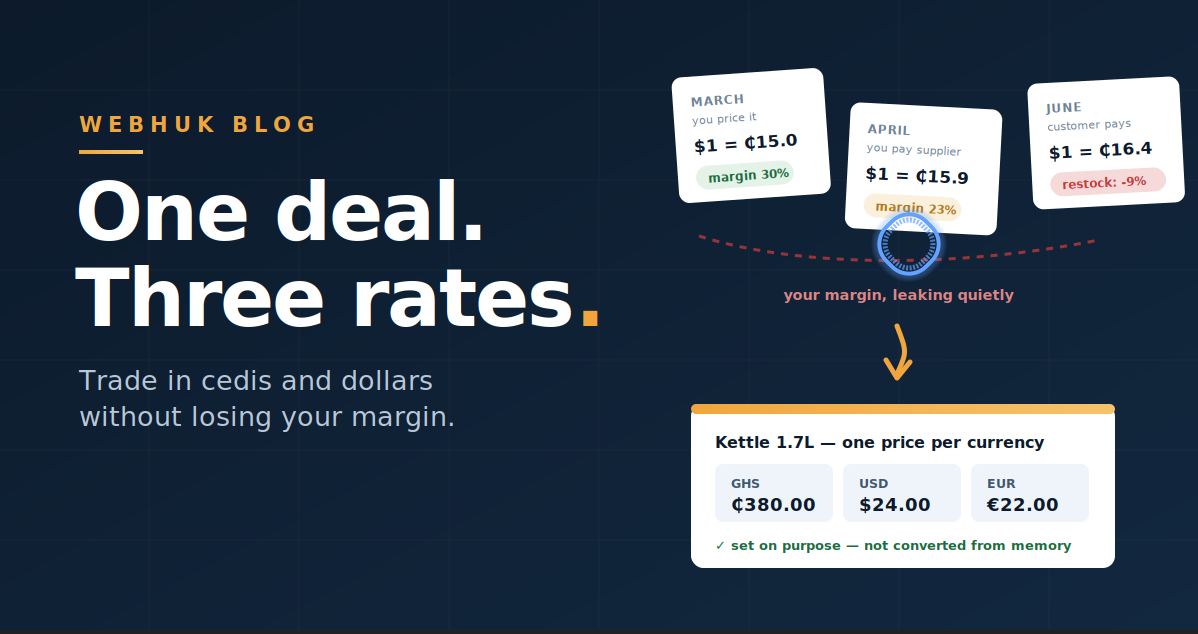
Here's a story every importer in Ghana has lived. In March, you price a container of goods using the exchange rate of the day. In April, you pay your supplier — but the cedi has slipped, so the dollars cost you more than you planned. In May, the goods arrive and you sell them at the March price list, because that's the list your shop has. In June, your accountant tells you the "profitable" container barely broke even.
Nobody stole anything. No supplier cheated you. The margin didn't disappear in one place — it leaked through three different exchange rates that your records treated as one. This is the core challenge of multi-currency accounting for SMEs: your costs live in dollars (or yuan, or euros), your sales live in cedis, and the bridge between them moves every week.
This guide covers the three-rates problem, the working rules that protect your margin, where foreign-currency invoicing does and doesn't apply, and how to run all of it without a spreadsheet full of stale conversions.
The Three-Rates Problem
Most SMEs operate as if there's one exchange rate — "the rate" — usually whatever was true when someone last checked. In reality, every imported product passes through at least three rates:
- The rate when you quoted or priced. Your price list, or the quotation you sent a customer, was built on this rate.
- The rate when you actually paid. The supplier invoice, the freight, the duties — each converted at the rate on its payment day, which is your only real cost.
- The rate when your customer finally pays you. If you sold on credit and the customer pays 45 days later, the cedis you receive buy fewer of the dollars you'll need for the next order.
When the cedi is stable, the gaps between these rates are noise. In a depreciation year, the gaps are the story: a business can sell everything it imports, at the prices it planned, and still find itself unable to afford the next container. That's not bad luck — that's rate exposure, unmeasured.
A Worked Example (illustrative figures)
Say you order goods worth $10,000:
- March (pricing): rate 15.0 — you plan on a cost of GHS 150,000 and build your price list for GHS 195,000 total revenue: a 30% markup.
- April (payment): rate 15.9 — the goods actually cost GHS 159,000. Your real markup, at the March price list, just fell to about 22.6%.
- June (customer pays): you collect the GHS 195,000 — but the rate is now 16.4, so your revenue converts to about $11,890 of buying power for the next order, instead of the $13,000 you planned.
Same deal, same prices, no mistakes anyone can point to — and roughly a third of the planned margin gone, purely to timing. Every rule below exists to make this visible before it happens instead of after.
The 6 Working Rules of Multi-Currency Trading
Rule 1 — Record the actual rate paid, per transaction. Not the interbank rate, not "the rate," but the rate at which you actually bought the currency for that payment — supplier, freight, duties, each on its own day. This is the foundation: your landed cost of imported goods is only true if it's built on real rates.
Rule 2 — Price from today's replacement cost, not last quarter's purchase. The question isn't "what did this stock cost me?" but "what will it cost me to replace it?" When the currency is sliding, pricing off old costs quietly liquidates your business one sale at a time — you're converting inventory into cedis that can't buy the same inventory back.
Rule 3 — Keep a price column per currency, and maintain them together. If you serve both local customers (in cedis) and foreign or regional buyers (in dollars), each product needs a deliberate price in each currency — not a mental conversion at whatever rate someone remembers. And when you review prices, review all columns in the same sitting, or they drift apart.
Rule 4 — State the currency, and the basis, on every document. Every quotation and invoice: explicit currency, never a bare number. For quotations on imported goods, two protections belong in your standard terms: a short validity period, and where appropriate a stated rate basis (e.g., "prices based on USD/GHS at X; quotations revalidated after expiry"). This is the multi-currency reason quotation validity exists — see how to write a quotation.
Rule 5 — Know the legal lines. In Ghana, Bank of Ghana rules restrict pricing, advertising, and receiving payment in foreign currency for domestic transactions unless authorized — the cedi is the legal tender for local business. In practice this means: invoice local customers in cedis (whatever currency thinking sits behind the price), and reserve foreign-currency invoicing for the cases it's meant for — export sales and foreign clients — or where you hold the relevant authorization. Rules and their enforcement evolve, so confirm the current position with your bank or advisor before setting policy.
Rule 6 — Review your exposure monthly. Three numbers, once a month: how much you owe suppliers in foreign currency, how much customers owe you in cedis (see tracking customer debts — slow collection is a currency loss, not just a cash-flow one), and what rate movement since your last price review has done to your replacement costs. Fifteen minutes that regularly triggers the price-list update most SMEs make six months too late.
Where Foreign-Currency Invoicing Belongs
To be precise about the two directions:
- Buying side: your purchase orders and supplier invoices will naturally be in the supplier's currency — record them in that currency, at the actual rates paid, and let the landed cost calculation bring them into cedis truthfully.
- Selling side: local customers are invoiced in cedis (Rule 5). Foreign customers — an export order, a client in Abidjan or London — are quoted and invoiced in the agreed currency, with the rate exposure now on the collection side, which is one more reason short payment terms matter on foreign invoices.
The failure mode to avoid is the middle ground: "dollar prices" quoted informally to local customers, converted at an undocumented rate at payment time. It's legally grey and commercially messy — the disputes write themselves.
Running Multi-Currency in One System
The spreadsheet version of all this — one tab of rates, one tab per currency, VLOOKUPs bridging them — fails exactly when it matters most: in a fast-moving month. Here's how it runs in Webhuk instead:
- Add the currencies you trade in — cedis alongside USD, GBP, EUR, CNY, or any others — and each SKU carries its own price per currency, maintained deliberately rather than converted on the fly.
- Choose the currency per document: a quotation or invoice to a foreign customer goes out in their currency; local documents go out in cedis — same items, same letterhead, correct column applied.
- Purchases feed landed cost: supplier invoices in foreign currency flow into the built-in landed price calculation, so duties, freight, and the shipment's real costs land in a true per-unit cedi cost — the number Rule 2's pricing decisions come from.
- Payments land in your financial accounts against the right invoices, keeping customer balances honest while the rate moves.
The system holds the structure — per-currency prices, per-document currency, real landed costs — so the monthly review in Rule 6 becomes reading numbers rather than reconstructing them. From 80 GHS per user per month, with a 14-day free trial: long enough to run one real shipment and one real foreign quotation through it.
The Bottom Line
You can't control the exchange rate. You can control whether it surprises you. Record real rates per transaction, price from replacement cost, keep deliberate per-currency price lists, put currency and validity on every document, respect the legal lines on domestic invoicing, and look at your exposure monthly. Do that, and depreciation becomes a number you manage — instead of a mystery your accountant explains in June.
Start a 14-day free trial
Frequently Asked Questions
What is multi-currency accounting for a small business? It's keeping your records so that each transaction is captured in its actual currency at the actual exchange rate paid or received — supplier invoices in dollars, sales in cedis — so costs, prices, and margins stay true even as rates move.
How should I price imported goods when the cedi is falling? Price from replacement cost — what it will cost to bring the goods in again at today's rate — rather than from what the current stock cost historically. Review price lists on a fixed schedule, and keep quotation validity short so old rates can't be accepted late.
Can I invoice customers in Ghana in US dollars? For domestic transactions, Bank of Ghana rules restrict pricing and receiving payment in foreign currency unless authorized — local customers are invoiced in cedis. Foreign-currency invoicing is for export sales and foreign clients, or authorized entities. Confirm the current rules with your bank or advisor.
What exchange rate should I use in my records? The rate you actually transacted at, per payment — the rate at which you bought the dollars for that supplier payment, on that day. Averages and "official" rates are fine for analysis, but real costs come from real rates.
Why does slow customer payment cost more when currency is depreciating? Because the cedis you collect later buy fewer dollars for your next import. A 60-day collection during a depreciation isn't just delayed cash — it's a real reduction in your restocking power, which is why receivables discipline matters doubly for importers.
What software supports multi-currency invoicing for SMEs? Platforms like Webhuk let you add any currencies you trade in, hold a price per currency on each product, issue each quotation or invoice in the chosen currency, and feed foreign-currency purchases into landed cost calculations. Plans start at 80 GHS per user per month with a 14-day free trial.