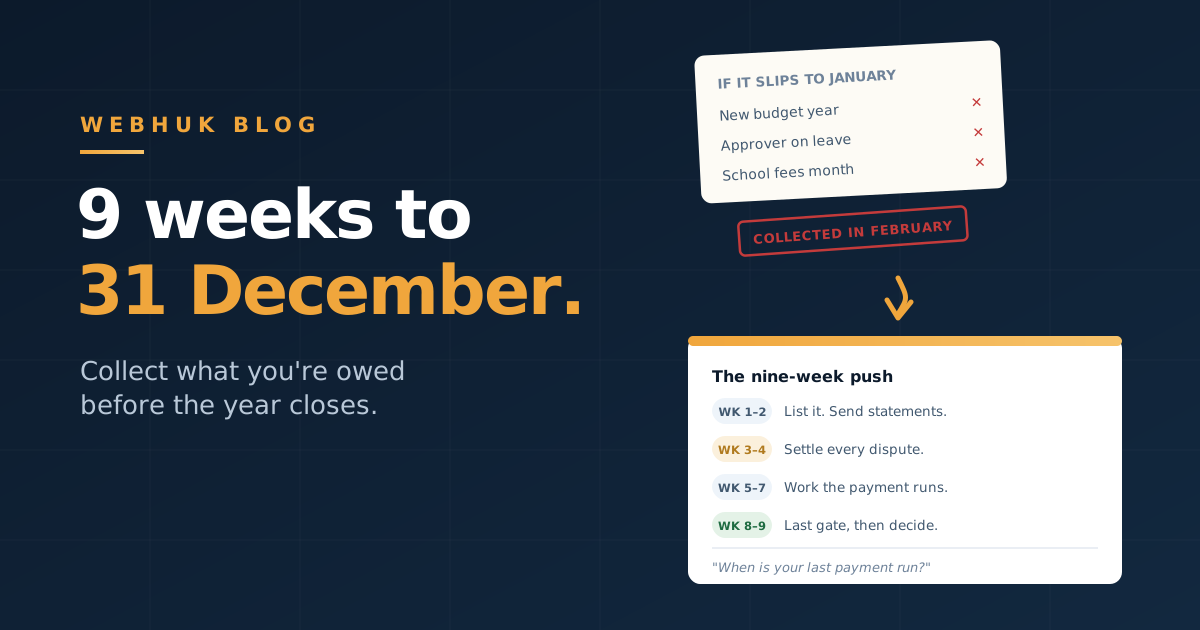
There are about nine weeks left in the year — fewer once you remove the holidays, the days when your customer's accounts officer is on leave, and the week between Christmas and New Year when nothing moves at all.
Here's why that matters more than it sounds. The invoice sitting unpaid on a corporate customer's desk right now has a deadline you can't see: 31 December, when their budget year closes. Cross that line and your invoice doesn't just get later — it enters a different world. New budget, possibly a new approver, a finance team buried in year-end closing, and a payment run that won't look at anything until February.
Meanwhile January in Ghana is the single hardest month to collect money from anyone. School fees land. December spending has emptied everything. Customers who would have paid you in early December will genuinely not have it in late January.
This guide is the plan: how to collect outstanding invoices before year end, week by week, starting now.
Why Year-End Collection Is a Different Job
Normal collection is a rhythm — statements, calls, follow-ups, repeat. Year-end collection is a deadline, and it changes the tactics:
Budget expiry works in your favour, briefly. Institutional and corporate customers often have funds allocated that must be spent before the year closes. An invoice in front of the right person in November is something they may be motivated to pay now rather than lose the budget line. The same invoice in January is a cost against a fresh, tighter budget.
Approval chains get slower, then stop. Every corporate payment passes through people — and in December, those people take leave. The chain doesn't just slow; it breaks in places and nobody tells you.
Everyone else is chasing too. Your customer's accounts office is receiving year-end pressure from every supplier they have. Whoever is clearest, earliest, and easiest to pay gets paid; whoever calls on 20 December joins a queue that's already closed.
January is a dead month. This is the part SMEs underestimate. Money not collected by 31 December is often not collected in January either — it slips to February or March, which means your December stock purchases were financed out of your own pocket for an extra quarter.
The Nine-Week Plan
Weeks 1–2 (now, late October): Know exactly what you're owed
You cannot chase what you can't list. Start with an accurate aging report — every unpaid invoice, by customer, sorted by how overdue it is. If producing that takes you two days of digging through receipt books, that's the first problem to fix, and the rest of this plan depends on it.
Then split the list into three:
- Clean and current — invoices that are simply awaiting their due date or the next payment run. These need visibility, not pressure.
- Disputed or unclear — the customer says the quantity was wrong, the price differs from the quote, they never got the invoice, or they claim they already paid part of it. These are your priority. Every disputed invoice is one that will absolutely not be paid before year end unless the dispute is resolved first, and disputes take weeks to settle.
- Old and quiet — 90+ days, no recent contact. Work these too, but expect that the conversation is different.
Send statements to everyone this fortnight. Not a chasing letter — a clean statement of what's outstanding, with invoice numbers and dates. A surprising share of unpaid invoices in SME trade are unpaid because nobody on the customer's side has a complete picture.
Weeks 3–4 (early November): Clear the obstacles
This is reconciliation fortnight. For every disputed or unclear item, get on the phone and settle it — issue the credit note, resend the lost invoice, correct the price, agree the balance in writing. Nothing ages worse than a disagreement nobody addresses.
At the same time, ask every significant customer three practical questions:
- "Do you have everything you need to pay this?" — invoice, delivery note, purchase order number, your bank details. Institutions often can't pay because a reference number is missing, and nobody told you.
- "When is your last payment run before year end?" — this single question is the most valuable one in the whole plan. It converts "sometime before December" into a date you can work backwards from.
- "Who approves it, and are they travelling in December?" — so you know whether to push now or route around someone's leave.
Write the answers down against the customer record. By mid-November you should have a payment-run calendar for your top customers — and your follow-up order writes itself.
Weeks 5–7 (mid-November to mid-December): Work the calendar
Now it's execution, and it's unglamorous: call ahead of each customer's payment-run date, confirm your invoice is on the list, and follow up the day after it runs to confirm the payment went out.
A few things that measurably help:
- Make yourself easy to pay. Bank details on every document, correct invoice numbers quoted, a copy resent instantly on request.
- Ask for a specific amount by a specific date, not "some payment." Vague requests get vague outcomes.
- Offer part payment as a landing place. For a customer who genuinely can't clear the full balance, agreeing GHS 8,000 of a GHS 20,000 balance before year end — in writing, with dates for the rest — is far better than an un-negotiated nothing.
- Escalate by relationship, not by volume. An owner-to-owner call in late November is worth more than ten messages from a junior.
- Log every promise with its date. "You said the 8th" is the whole conversation on the 9th.
Weeks 8–9 (mid-to-late December): Last gate
By now you're closing, not opening. Two jobs:
Push the final payment runs. Most corporate runs happen well before the 31st — mid-December is often the real deadline. Anything not on those runs is a January conversation.
Decide what you're doing about the rest. Before the year closes, for each uncollected balance: agree a written January payment plan, place the account on credit hold for new supply, or — for the genuinely dead ones — recognise it and stop spending energy on it. Carrying an imaginary receivable into the new year distorts every number you'll look at in the monthly business review.
Don't Undo the Work in December
December is also your busiest selling month, and here's the trap: a frantic season is exactly when new credit gets extended casually at the counter, to whoever asks nicely. Collecting GHS 100,000 in November while handing out GHS 80,000 of unmanaged new credit in December is running hard to stand still.
Set the rules before the rush: who gets credit in December, what limit, and which orders require a deposit or a proforma invoice before goods move. Then make sure whoever is on the counter on a busy Saturday knows them.
Running It in Webhuk
The plan above is mostly organisation, and organisation is what a system gives you. In Webhuk, the aging lists for invoices are built in with printable reports — so week one is a report, not an archaeology project. Payments are recorded against specific invoices and into financial accounts, so part payments reduce the right balance and every customer's position stays true as money comes in. Callsheets hold the conversations and the promises, so "when is your last payment run?" and "you said the 8th" live on the customer's record rather than in somebody's memory. Tasks with reminders carry the callbacks to the right day, and role-based access keeps December's credit decisions with the people who should be making them.
Webhuk plans start at 80 GHS per user per month with a 14-day free trial — enough to run this entire nine-week push through it before you pay anything.
The Bottom Line
The money you are owed right now is at its most collectable today and gets harder every week from here. List it accurately, settle the disputes first, ask every customer when their final payment run is, work backwards from those dates, and take part payments in writing rather than promises.
A business that enters January having collected hard is a business that can buy stock while competitors are waiting on February. That difference is decided in the next nine weeks.
Frequently Asked Questions
When should I start chasing invoices for year-end payment? By late October. Disputes take weeks to resolve, corporate payment runs are often scheduled well before 31 December, and approvers take leave through the month. Starting in December usually means collecting in February.
Why is it harder to collect payment in January? Corporate customers start a new budget year with fresh allocations and a finance team closing the previous one, so old invoices queue behind new priorities. For individual and small-business customers, January brings school fees and post-December cash shortages.
What should I do about a disputed invoice at year end? Resolve it first, before chasing payment. A disputed invoice will not be paid regardless of how often you follow up — issue the credit note, resend the document, or agree the corrected balance in writing, then put it back in the payment queue.
Should I accept part payment of an overdue invoice? Usually yes. An agreed part payment before year end, recorded against the invoice and with written dates for the balance, is materially better than an unpaid full balance that rolls into a dead month. Record it against the specific invoice so the remaining balance stays accurate.
What's the single most useful question to ask a corporate customer? "When is your last payment run before year end?" It converts a vague promise into a date, tells you how long you have to clear any obstacles, and lets you confirm your invoice is on that run.
How do I stop December sales from recreating the debt I just collected? Set December credit rules in advance — who qualifies, what limit, and which orders need a deposit or proforma invoice before goods move — and make sure counter staff know them before the rush starts.