You send a customer your quotation. They like it. Then comes the reply every supplier in Ghana knows: "Okay, send me a proforma so we can process payment."
If you've ever paused at that message — wondering what exactly a proforma is, how it differs from the invoice you were about to send anyway, and whether it changes anything in your books — this guide settles it in plain language. Because while the two documents can look nearly identical on the page, they do completely different jobs, and mixing them up creates real problems: sales recorded that never happened, deposits floating unattached to any document, and month-end numbers nobody can explain.
What Is a Proforma Invoice?
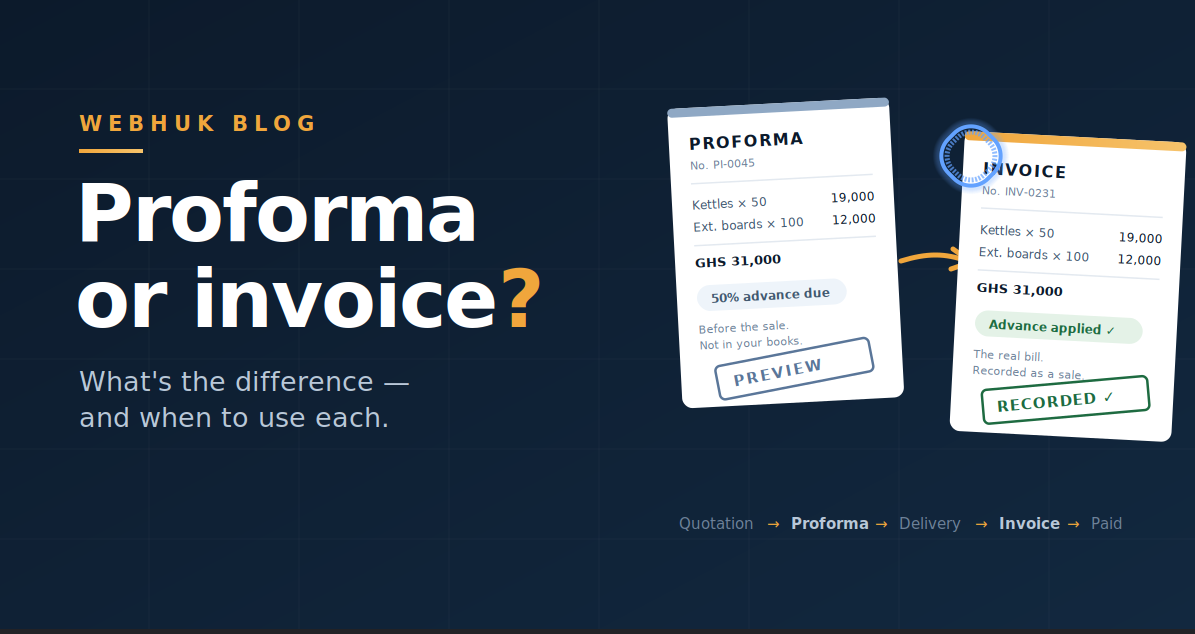
A proforma invoice is a preliminary bill sent before a sale is finalized. It shows the customer exactly what they will pay — items, quantities, prices, taxes, total — but it is not a demand for payment against a completed sale, and it does not enter your sales records. Think of it as a formal preview of the invoice to come: "this is what the real bill will say."
The word proforma comes from Latin, meaning "for the sake of form" — a document produced for formality, not for the books.
What Is an Invoice?
An invoice (sometimes called a tax invoice or final invoice) is the real bill: a formal demand for payment issued when the sale actually happens — goods delivered or work done. It enters your sales records, creates a receivable owed by the customer, and is the document your accounting, taxes, and debt collection all hang on.
One sale, one invoice. Every payment the customer makes — including any advance they paid earlier against the proforma — is ultimately recorded against it.
Proforma vs Invoice: The Key Differences
| Proforma invoice | Invoice | |
|---|---|---|
| When it's sent | Before the sale is finalized | When the sale happens (goods delivered / work done) |
| What it is | A preview: "this is what you will pay" | A demand: "this is what you now owe" |
| Effect on your books | None — not recorded as a sale | Recorded as a sale; creates a receivable |
| Accounting & tax role | Not an accounting document | The core accounting and tax document |
| Can the customer pay against it? | Yes — typically an advance/deposit | Yes — full or part payment of the debt |
| Binding? | Generally not a binding demand; prices usually honoured like a quotation within a stated period | Represents a real debt owed |
| Numbering | Its own reference (e.g., PI-0045) | Your official invoice sequence |
(On tax specifics: treatment of documents varies by jurisdiction and changes with regulation — confirm the current requirements for tax invoices with your accountant or the revenue authority. The principle that a proforma is not the tax document, and the final invoice is, holds broadly.)
When a Proforma Is Exactly the Right Document
1. Requesting advance payment. The most common use in Ghana. You won't release goods or start work without a deposit — but there's no completed sale to invoice yet. The proforma bridges the gap: it gives the customer a formal document showing precisely what to pay, without you recording a sale that hasn't happened.
2. The customer's internal process needs it. Companies and institutions often need a document to raise a purchase order, get management approval, or justify a payment requisition. "Send a proforma" frequently means "give my accounts office something official to act on."
3. Bank and payment processes. Banks commonly ask for a proforma to support payment processing — especially for transfers and trade-related payments — as evidence of what the funds are for.
4. Confirming a complex order before committing. For large or customized orders, a proforma lets the customer verify every line — specifications, quantities, delivery charges, taxes — and formally accept, before you procure stock or start production. (If they haven't agreed to buy at all yet, the right document is earlier in the chain: see how to write a quotation.)
When It Must Become an Invoice
The moment the sale is real — goods handed over or delivered, service performed — the proforma's job is done and the invoice takes over. Issue the final invoice, record any advance already received against it, and the balance becomes the customer's outstanding debt, visible in your receivables and subject to your normal follow-up rhythm for tracking customer debts.
A useful rule for your team: the proforma opens the door; the invoice closes the sale. No delivery should ever leave against a proforma alone, and no month should end with payments sitting against proformas that were never converted.
The Document Chain, In Order
For a typical B2B sale, the sequence looks like this:
- Quotation — your priced offer, sent while the customer is deciding
- (Customer accepts — often with a purchase order)
- Proforma invoice — if an advance payment or the customer's process requires it
- Advance payment received — recorded, linked to the deal
- Delivery of goods / completion of work
- Invoice — the real bill; the advance is applied, the balance falls due
- Final payment — recorded against the invoice; the sale is closed
Not every sale needs every step — a simple cash sale can jump straight to invoice — but when a customer says "send me a proforma," this chain is the map of where you are and what comes next.
4 Proforma Mistakes That Corrupt Your Numbers
1. Recording proformas as sales. The classic error. Ten proformas sent in March get counted as March sales; three customers never proceed; now your revenue, stock plans, and tax position are all built on sales that don't exist. A proforma is a maybe — it belongs in your pipeline, not your sales ledger.
2. Leaving deposits floating. A customer pays 50% against a proforma, the cash goes into the drawer or account, and nothing links it to the deal. Months later: "I already paid something" — and nobody can prove how much against what. Every advance must be recorded the day it arrives, tied to the customer and the transaction, and applied to the final invoice when issued.
3. Never converting. Goods get delivered against the proforma, everyone moves on, and no invoice is ever raised. There's now a real debt with no document behind it — invisible to your receivables, un-chaseable, and a hole in your accounts.
4. Using proformas to avoid invoicing. Deliberately trading on proformas alone to keep sales out of the official records isn't a clever shortcut — it's a compliance risk that also destroys your own visibility into what you're owed. The invoice protects you first.
How This Works in One System
The reason these mistakes are so common is that in a Word-and-Excel setup, the proforma and the invoice are two separate documents someone must remember to create, reconcile, and link. In Webhuk, they're stages of one flow: from the customer's accepted quotation or order, you can generate a proforma invoice with one click — same letterhead PDF, same line items, emailed to the customer directly from the system — and when the sale completes, generate the final invoice from the same order, so nothing is retyped and nothing gets lost between documents. Advance and final payments are recorded against the invoice and the customer's account, so balances stay true, and your sales records only ever contain real sales. It's the full enquiry-to-invoice workflow with the proforma step built in where you need it — from 80 GHS per user per month, with a 14-day free trial.
Next time a customer says "send me a proforma," you'll know exactly what they're asking for — and your books will too.
Start a 14-day free trial
Frequently Asked Questions
What is a proforma invoice in simple terms? It's a preliminary bill sent before a sale is finalized, showing the customer exactly what they will pay — items, prices, taxes, and total. It is not recorded as a sale and is commonly used to request advance payment or support the customer's approval process.
What is the main difference between a proforma invoice and an invoice? Timing and effect: a proforma comes before the sale and doesn't enter your accounts; an invoice is issued when the sale happens, is recorded as a sale, and creates a debt the customer owes.
Is a proforma invoice legally binding? Generally, no — it is not a demand for payment on a completed sale. Like a quotation, the prices on it are typically honoured within a stated validity period, but the binding accounting document is the final invoice. For jurisdiction-specific questions, confirm with a professional.
Can a customer pay against a proforma invoice? Yes — that's one of its main uses, especially for advance payments or deposits. Record the payment immediately, linked to the customer and the deal, and apply it to the final invoice when the sale completes.
Is a proforma invoice valid for tax purposes? A proforma is not a tax invoice; the final invoice is the document your accounting and tax reporting rest on. Requirements for tax invoices vary by jurisdiction, so confirm specifics with your accountant or revenue authority.
When should I send a proforma instead of a quotation? A quotation is for a customer still deciding; a proforma is for a customer who has agreed to buy and now needs a formal document to pay an advance or process the purchase internally. In a typical sale, the quotation comes first and the proforma follows acceptance.