It is the badge of honor for every modern business owner. But being busy is not the same as being productive. In fact, if you are constantly putting out fires, chasing down information, or correcting mistakes, you aren't running a business—the business is running you.
The secret to scaling isn't hiring more people to do the same inefficient work. It’s about streamlining.
But what does that actually mean?
Learning how to streamline business operations is the art of removing friction. It’s about taking a complex, messy process and straightening it out so that work flows from A to Z without stopping. It’s the difference between a dirt road and a highway.
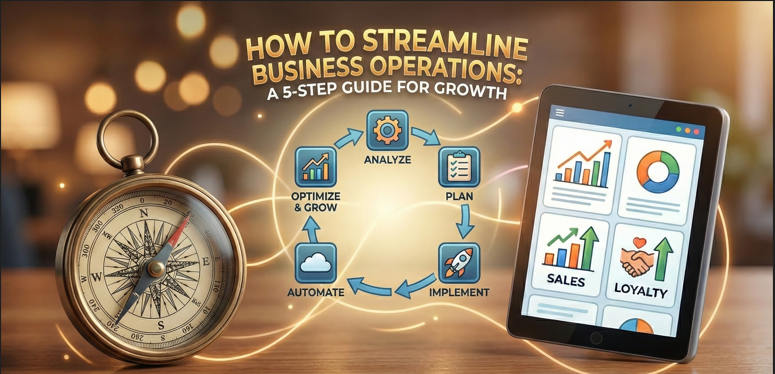
In this guide, we will move beyond the buzzwords and give you a practical, 5-step framework to cut the fat, speed up your delivery, and reclaim your sanity.
Step 1: Map Your "As-Is" Processes (Be Honest)
You cannot fix what you cannot see. The first step is to pick one core process—say, "Order Fulfillment" or "Client Onboarding"—and map it out.
Don't map how you think it works. Map how it actually works.
- "Sales rep gets an order via email."
- "Sales rep walks to the warehouse to check stock."
- "Warehouse manager is at lunch, so sales rep leaves a sticky note."
- "Sticky note falls off..."
See the friction? Visualizing this workflow often reveals that a 10-minute task is taking 3 days. This mapping exercise is crucial for identifying where you are losing time and money, and it’s the foundation for any meaningful business process improvement.
Step 2: Identify and Kill the Bottlenecks
Once you have your map, look for the "red lights." Where does the work pile up?
- The Approval Bottleneck: Does every single purchase order need your personal signature? If you are away, does the whole company stop? This is a classic sign you need to automate your purchase orders with software that sets pre-approved limits.
- The Information Silo: Does your finance team have to ask the sales team for data that should already be in the system?
- The Manual Re-entry: Are you typing data from an email into Excel, and then from Excel into an invoice?
These bottlenecks are not just annoying; they are expensive. They delay revenue and frustrate customers.
Step 3: Automate the Repetitive (and Boring)
Humans are great at strategy and relationships. We are terrible at repetitive data entry. We get tired, we get bored, and we make typos.
Technology should handle the robotic work.
- Inventory: Instead of counting boxes every week, use a system that updates stock levels automatically with every sale. This aligns with inventory management best practices and ensures you never sell what you don't have.
- Invoicing: Automate your billing. If you are a service agency, use software that converts tracked time directly into invoices to reduce unbilled hours. You should never have to "remember" to bill a client.
Step 4: Centralize Your Data (The Single Source of Truth)
Chaos thrives in separation. When your data lives in five different places, you spend half your day just looking for answers.
To truly learn how to streamline business operations, you must move toward a centralized system. Whether you call it an ERP or a "Business OS," the goal is the same: one place where Sales, Operations, and Finance meet.
When everyone looks at the same numbers, arguments stop. You can see clearly if a project is profitable or if it's draining resources. You begin to understand the real story behind your cash flow vs profit, allowing you to make decisions based on facts, not guesses.
Step 5: The "Kaizen" Approach (Continuous Improvement)
Streamlining isn't a one-time event. It is a culture.
Adopt the "Kaizen" mindset—the Japanese philosophy of continuous improvement. Once a quarter, revisit your processes.
- "Is this report still necessary?"
- "Can we shave 2 days off our delivery time?"
- "Is there a new tool that can handle this better?"
As your business grows, your processes will break. That is normal. The goal isn't to be perfect; the goal is to be slightly better today than you were yesterday.
Conclusion: Efficiency is a Competitive Advantage
In a slow market, the most efficient business wins. By lowering your operational costs and speeding up your delivery, you can outprice and outperform competitors who are still stuck in "spreadsheet hell."
Don't let the fear of change paralyze you. Start small. Fix one process. Then another. Before you know it, you won't just be busy—you will be unstoppable.
Ready to start your streamlining journey? Explore how Webhuk’s integrated tools can help you simplify your workflow, from streamlining production to mastering your cash flow.
Frequently Asked Questions (FAQs)
1. What is the first thing I should streamline in my business?
Start with the "low-hanging fruit"—usually the process that causes the most complaints or consumes the most time. For many businesses, this is either Invoicing (to get paid faster) or Inventory Management (to stop stockouts).
2. Does streamlining always mean firing employees?
No. This is a common myth. Streamlining is about removing waste, not people. By automating boring, repetitive tasks, you free up your employees to focus on higher-value work like customer service, sales, or product innovation.
3. How much money can I save by streamlining?
The savings can be massive. Studies show that inefficient processes can cost businesses 20-30% of their revenue annually. This comes from lost time, errors, rework, and missed opportunities.
4. Do I need expensive consultants to streamline my operations?
Not necessarily. While consultants can help, you know your business best. Start by mapping your own workflows and asking your team, "What prevents you from doing your job fast?" Their answers will guide you to the right solutions.
5. What tools do I need to streamline operations?
At a minimum, you need a centralized system to manage your core data (Sales, Inventory, Finance). Moving from disconnected spreadsheets to a unified cloud-based platform is the single biggest technology step you can take toward efficiency.