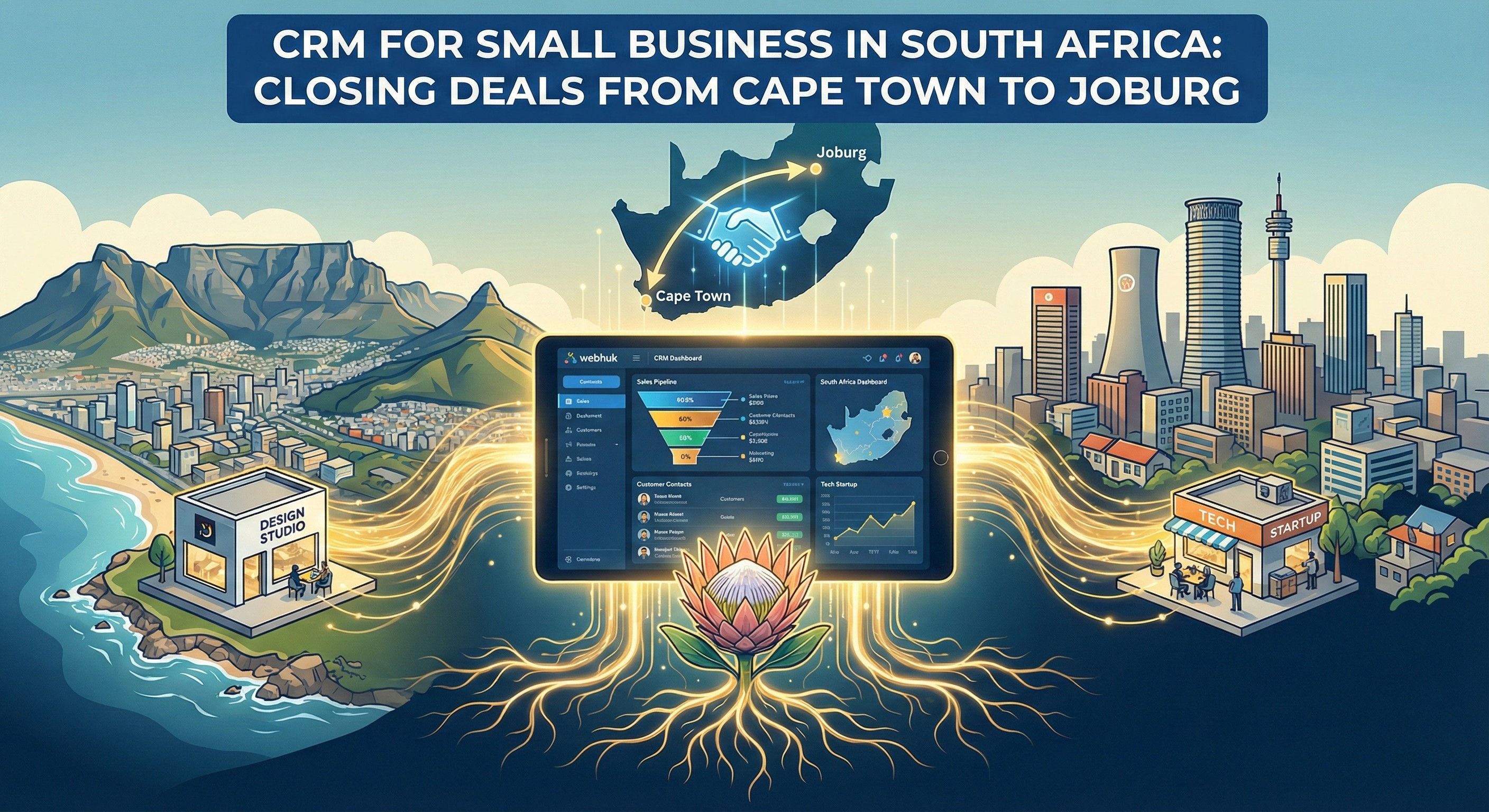
In the high-pressure business environments of Sandton, Umhlanga, and Cape Town, the difference between closing a deal and losing it is often speed.
South African SMEs are incredibly competitive. If a potential client sends an enquiry and you don't respond within the hour, your competitor will.
Yet, many small businesses still manage their sales on spreadsheets. They have a database of "Leads" in Excel, a list of "Current Clients" in Pastel/Sage, and critical deal details locked away in WhatsApp chats on a sales rep's personal phone.
This fragmented data is a ticking time bomb.
- What happens if your top sales rep leaves and takes their phone with them?
- How do you ensure you aren't emailing a client who just unsubscribed (a major POPIA violation)?
The solution is a CRM (Customer Relationship Management) system. For a long time, CRMs were seen as expensive tools for big banks or insurers. Today, CRM for small business is the secret weapon agile South African companies use to punch above their weight.
In this guide, we will explore why adopting a CRM is critical for South African SMEs and how it protects your most valuable asset: your customer data.
The "Excel Ceiling" in Sales
You can run a business on Excel when you have 10 clients. But when you have 100 leads and 5 sales reps, Excel breaks.
1. No "Single View" of the Customer Imagine a client calls your office in Durban. They are angry because a delivery is late. Your sales rep picks up, sees "New Deal" in the spreadsheet, and tries to sell them an upgrade. The rep doesn't know about the service complaint because that data is in a different file. The result? You look unprofessional, and you likely lose the client.
2. The "Follow-Up" Failure Research shows that 80% of sales require 5 follow-ups. Most salespeople stop after 2. Without a system to nag you ("Hey, call John Smith today"), leads slip through the cracks. A CRM automates this persistence.
Why South African Businesses Need a CRM Now
Beyond simple organization, the South African landscape presents unique reasons to upgrade.
1. The POPIA Compliance Minefield
The Protection of Personal Information Act (POPIA) changed the game. You can no longer hoard customer data carelessly.
- You need to know exactly where your data is stored.
- You need to record when a customer gave consent to be contacted.
- If a customer says "Delete me," you must be able to do it instantly across all records.
Spreadsheets are not POPIA compliant. They are easily copied, emailed, or stolen. A secure CRM for small business centralizes data in an encrypted vault, allowing you to manage consents and deletions lawfully.
2. Managing the "Semigration" Workforce
South Africa is seeing a massive trend of "Semigration"—families moving to the coast while keeping their jobs in Gauteng. Your sales team might be scattered across the country. You can't shout across the office to ask, "Did you email that prospect?" A cloud CRM gives you a virtual sales floor. The Sales Manager in Joburg can see exactly what the Rep in Cape Town did today—how many calls were made, how many demos were booked, and what the pipeline value is—in real-time.
3. Surviving the Economic Squeeze
The economy is tough. You cannot afford to waste marketing budget on leads that get ignored. A CRM ensures Lead Accountability. Every lead that comes from your website is automatically assigned to a human. If that human doesn't action it in 24 hours, the system alerts the manager. No lead is left behind.
Key Features to Look For
Don't buy a Ferrari when you need a Bakkie. Small businesses don't need complex enterprise features. You need tools that work.
- WhatsApp Integration: Let’s be honest—business in SA happens on WhatsApp. Look for a CRM that can log WhatsApp chats into the client’s profile so the conversation history isn't lost if a phone is lost.
- Mobile App: Your reps are on the road. They need to log a meeting note via voice-to-text immediately after leaving a client’s office, not wait until they get back to their laptop during Load Shedding.
- Pipeline Visualization: You need a "Kanban Board" (drag-and-drop view). Moving a deal from "Qualified" to "Quote Sent" gives you a visual sense of progress and helps you forecast revenue for the month.
Transforming "Sales" into "Relationships"
A CRM isn't just about policing your sales team; it's about delighting your customers.
Scenario: It’s a client’s birthday.
- Without CRM: You forget.
- With CRM: The system alerts you 2 days before. You send a personalized WhatsApp.
Scenario: A client hasn't ordered in 3 months.
- Without CRM: You don't notice until end-of-year accounts.
- With CRM: The system flags them as "At Risk" and prompts you to call.
This is how small businesses win. You use technology to simulate the intimacy of a "mom and pop" shop, but at scale.
Conclusion: Data is Your New Gold
In the past, a business's value was its building or its stock. Today, your value is your customer list.
If that list is messy, duplicated, and insecure, your business is fragile. Implementing a CRM for small business is the best way to secure your future revenue. It professionalizes your sales process, keeps the Information Regulator happy, and ensures that every lead is treated like gold.
Ready to stop losing leads? Webhuk offers an intuitive, South African-friendly CRM that helps you track, manage, and close deals from anywhere in the country.
Frequently Asked Questions (FAQs)
1. Is a CRM difficult to set up for a small team?
Not anymore. Modern cloud CRMs are "plug and play." You can import your existing contacts from Excel or Google Contacts in minutes. The learning curve is usually just a few hours, especially for systems designed with a simple user interface.
2. How does a CRM help with POPIA compliance?
It provides a secure, auditable environment for data. You can tag contacts who have "Opted In" and easily filter out those who have "Opted Out." It also controls who in your team can see sensitive data (like ID numbers), which is a key requirement of the Act.
3. Can I track my sales team's activity without micromanaging?
Yes. A CRM records activities (calls, emails, meetings) automatically. You don't need to hover over your team; you just check the weekly dashboard. This focuses the conversation on results rather than activity.
4. What happens if I have bad internet connection?
Most robust CRMs have mobile apps with offline capabilities. You can view client details and log notes while offline, and the app will sync everything to the cloud once you reconnect to Wi-Fi or 4G.
5. Can I integrate CRM with my accounting software?
Yes. This is the "Holy Grail" of efficiency. Integrating CRM with your invoicing software means that when a deal is won, the quote is automatically converted into an invoice in your accounts, saving you from typing the same data twice.