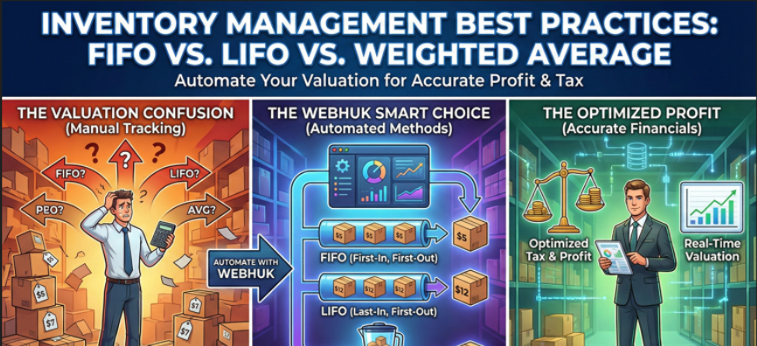
Introduction: The "Silent Killer" of Profitability
If you walk into your warehouse and see shelves full of boxes, you might see "assets." But if those boxes have been sitting there for six months, an accountant sees something very different: Liability.
Inventory is cash tied up in physical form. Every day an item sits unsold, it costs you money in storage fees, insurance, and the risk of becoming obsolete. Yet, surprisingly, many small business owners manage this massive asset based on "gut feeling" or messy spreadsheets.
They buy stock when it "looks low." They calculate profit based on what they think they paid for the item.
This lack of precision leads to two major problems:
- Phantom Profits: You think you made money, but inflation on your replacement stock ate your margin.
- Tax Nightmares: You cannot tell the taxman exactly what your "Cost of Goods Sold" (COGS) was.
In this guide to Inventory Management Best Practices, we are going to tackle the most confusing part of the supply chain: Inventory Valuation. We will break down the "Big Three" methods—FIFO, LIFO, and Weighted Average—and help you decide which one is right for your business.
The Core Dilemma: Prices Always Change
To understand why this matters, you have to accept one truth: Your supplier changes prices.
Imagine you sell coffee mugs.
- In January, you bought 100 mugs at $5 each.
- In June, you bought 100 mugs at $7 each (because inflation happened).
- In December, you sell a mug for $15.
Here is the million-dollar question: What was your profit?
- If you sold the January mug, your cost was $5, so profit is $10.
- If you sold the June mug, your cost was $7, so profit is $8.
Physically, the mugs look identical. But financially, they are different. The method you choose to "pick" which mug you sold (FIFO or LIFO) determines your reported profit and your tax bill.
Method 1: FIFO (First-In, First-Out)
The Global Standard for Most Businesses.
The Concept: Imagine a grocery store shelf. You always sell the milk that expires soonest (the oldest stock) before you sell the fresh milk that just arrived. In accounting terms, FIFO assumes that the first items you bought are the first items you sold.
Who is it for?
- Perishable Goods: Food, medicine, cosmetics (anything with an expiry date).
- Trend Products: Fashion and electronics (where old stock loses value fast).
- Global Businesses: Critical Note: FIFO is the standard required by IFRS (International Financial Reporting Standards). If you are outside the USA (e.g., UK, India, Europe, Australia), you likely must use FIFO.
The Pros:
- Accurate Value: Your remaining inventory on the balance sheet reflects current market prices (since you kept the new, expensive stuff).
- Higher Reported Profit: Since you are "selling" the cheaper, older stock first, your Cost of Goods Sold (COGS) is lower, making your profit look higher. (Great for impressing investors).
The Cons:
- Higher Taxes: Higher reported profit means a higher tax bill at the end of the year.
Method 2: LIFO (Last-In, First-Out)
The "Tax Saver" (Mostly US-Only).
The Concept: Imagine a pile of sand. When you scoop sand off the top, you are taking the sand you added last. The sand at the bottom (the first sand) stays there forever. LIFO assumes that the last items you bought (the most expensive ones) are the first ones you sold.
Who is it for?
- US-Based Businesses: LIFO is permitted under US GAAP rules but banned in most other countries.
- High Inflation Industries: If your supplier prices are skyrocketing, LIFO helps you protect cash.
The Pros:
- Lower Taxes: Since you are "selling" the expensive new stock first, your Costs (COGS) are higher. This lowers your reported profit, which lowers your tax bill.
The Cons:
- Obsolete Inventory: Your balance sheet shows old, cheap inventory value (from years ago) which might not reflect reality.
- Restricted Use: You cannot use this if you want to follow international accounting standards.
Method 3: Weighted Average Cost (WAC)
The "Keep It Simple" Approach.
The Concept: Why worry about which specific mug you sold? Just take an average. Formula: (Total Cost of Goods Available for Sale) / (Total Units Available for Sale).
If you bought some at $5 and some at $7, your average cost is $6. Every sale uses this $6 cost.
Who is it for?
- Commodities: Gas stations, chemical plants, or hardware stores selling nails/screws where individual tracking is impossible.
- Small Businesses: It is the easiest method to calculate if you don't have powerful software.
The Pros:
- Smooths Out Fluctuations: You don't see wild swings in profit margins just because a supplier changed prices for one month.
- Simplicity: Easy to track.
Beyond Valuation: 3 Operational Best Practices
Deciding on FIFO vs. LIFO is just the math. To actually manage your warehouse efficiently, you need to implement these three operational habits.
1. Set "Reorder Points" (Min/Max Levels)
The worst thing in retail is the "Stockout." A customer wants to buy, but you have nothing to sell.
- Best Practice: Determine a "Safety Stock" level for every item.
- The Webhuk Fix: In Webhuk ERP, you can set a rule: "If Stock < 10 units, Alert Purchase Manager." You never have to guess when to reorder.
2. Implement Cycle Counting
Most businesses do a "Physical Inventory Count" once a year. They shut down the warehouse for 3 days and count everything. It is a nightmare.
- Best Practice: Do "Cycle Counting." Count 10% of your high-value items every week. By the end of the quarter, you have counted everything without shutting down operations.
3. Batch and Expiry Tracking
If you sell anything that can expire (food, chemicals, or even batteries), you must track "Batch Numbers."
- Best Practice: When a customer complains about a defective product, you need to know exactly which shipment it came from so you can recall only that batch, not your whole stock.
The Role of ERP: Stop Calculating Manually
If you are reading this and thinking, "How on earth am I going to calculate the Weighted Average for 500 different products?"—relax.
You aren't supposed to do this by hand.
In the age of Cloud ERP, the software handles the logic.
- You configure it once: When you set up Webhuk, you select your method (e.g., "FIFO").
- The System tracks the layers: Every time you receive goods, Webhuk records the date and price.
- The System automates the sale: When you sell an item, Webhuk automatically "picks" the correct cost layer based on your rule.
You just see the final profit number. The complex math happens in the background.
Conclusion: Control Your Stock, Control Your Cash
Inventory management is a balancing act. Have too much stock? You are burning cash on storage. Have too little? You are losing sales. Use the wrong valuation method? You might be overpaying taxes.
Moving from "Chaos" to "Best Practices" doesn't require a Ph.D. in accounting. It just requires the right tool.
Whether you choose FIFO (for freshness) or Weighted Average (for simplicity), the key is Consistency. Pick a method, stick to it, and let a system like Webhuk do the heavy lifting.
Optimize Your Inventory with Webhuk
Stop guessing your profit margins. Webhuk.io offers enterprise-grade inventory tracking for SMEs.
- Real-Time Stock Updates across multiple warehouses.
- Automated FIFO/Average Costing.
- Batch & Expiry Management.
Start Your 7-Day Free Trial – See exactly what is sitting on your shelves right now.
Frequently Asked Questions
1. Why does the inventory method I choose change my profit? I sold the same item!
It feels counterintuitive, right? You sold a mug for $15, so why does the profit change? It changes because the cost of replacing that mug changes over time. If you use FIFO, you are telling the taxman you sold the old, cheaper mug (higher profit). If you use LIFO, you are saying you sold the new, expensive mug (lower profit). The physical sale is the same, but the accounting story—and the tax bill—is different.
2. I run a small retail store. Which method is safest for me?
For most small businesses, especially those outside the US, FIFO (First-In, First-Out) is the safest bet. It mirrors what actually happens physically (you usually try to sell old stock first), and it is the standard requirement for international accounting. However, if you sell identical items where age doesn't matter (like screws or gravel), Weighted Average is much simpler to manage and keeps your margins steady.
3. Why is LIFO banned in so many countries?
LIFO is popular in the US because it can lower taxes during inflation. However, international standards (IFRS) ban it because it can distort a company's value. If you use LIFO for 20 years, your balance sheet might claim your inventory is worth 1990s prices, which is totally inaccurate today. Regulators prefer FIFO because it ensures the asset value on your books matches current market reality.
4. How do I handle items that have expiration dates?
If you sell food, medicine, or cosmetics, you must use a system that supports Batch and Expiry Tracking. Standard inventory counting isn't enough. You need an ERP that can identify exactly which batch a specific item came from. This ensures that you are shipping the items that expire soonest (FEFO - First Expired, First Out), which is a crucial variation of FIFO for perishable goods.
5. Do I need to be a math wiz to calculate Weighted Average?
Absolutely not. In the past, accountants had to do complex spreadsheets to figure this out. Today, modern cloud ERPs like Webhuk do this automatically. You just enter the supplier invoice when goods arrive, and the software instantly recalculates the average cost of that item in the background. You don't need to do the math; you just need to trust the system.