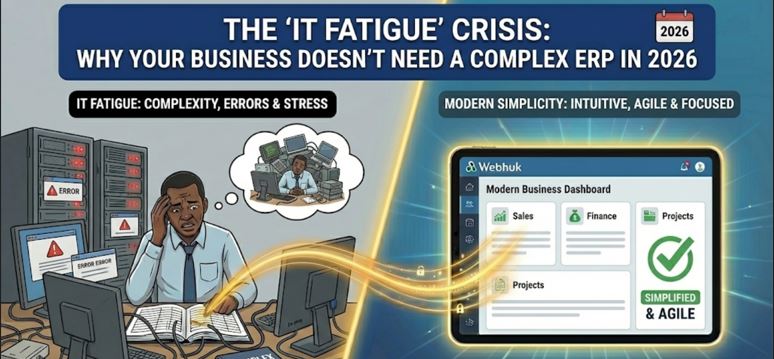
In the boardrooms of Accra and the office parks of Sandton, a new frustration is boiling over. Business owners, eager to digitize, have spent thousands of Dollars and Rands on world-class ERP systems like Odoo or SAP, only to find that their staff are still using paper notebooks.
This is "IT Fatigue." It happens when the software meant to simplify your business becomes so complex that it requires a dedicated consultant just to issue a basic invoice. By 2026, the trend has shifted: SMEs are abandoning "feature-heavy" monsters in favor of Zero-Bloat ERP solutions that actually get used.
The Trap of "Infinite Features"
Generic ERPs market themselves on having "thousands of modules." While this sounds good on a sales pitch, for a growing SME in Africa, it often leads to:
- The Complexity Tax: You pay for 100 features but only use 5. The other 95 just clutter your screen and confuse your employees.
- Long Implementation Deaths: It takes 6 months to "configure" the system. In that time, your market has changed, and your team has lost interest.
- Hidden Consultant Costs: Every time you want to change a tax setting for the GRA or a reporting format for SARS, you have to pay an expensive external expert.
Why "Simple" is the New "Powerful"
At Webhuk, we believe that software should be invisible. It should work in the background, allowing you to focus on your customers. Here is why a "Zero-Bloat" approach is winning in 2026:
1. The 10-Minute Onboarding
A simple ERP should be as intuitive as a social media app. Webhuk is designed so that a new hire in your Sales department can start generating quotes within 10 minutes of logging in—no 3-day training workshops required.
2. Lightning-Fast Performance
Complex ERPs are heavy. They require high-speed fiber and high-end computers. In a "Mobile-First" environment (as we discussed in our Mobile ERP guide), Webhuk’s lean code ensures it runs smoothly on a basic smartphone or a laptop during a power outage.
3. Purpose-Built for Africa
Instead of trying to serve a Fortune 500 company in New York, Webhuk is optimized for the local hero:
- Localized Accounting: Built-in templates for Ghanaian VAT and South African tax laws.
- Integrated Tradeboards: A focused Tradeboard that handles the specific Sales-to-Procurement workflow of African traders.
How to Identify if You Have IT Fatigue
If you recognize these signs, it's time to simplify:
- Your team keeps "shadow records" in Excel because the ERP is too hard to use.
- You are afraid to click certain buttons for fear of "breaking the system."
- Your monthly software bill is higher than your office rent.
Conclusion: Reclaim Your Time
Technology should be a tailwind, not an anchor. By choosing a Simple ERP for small teams, you remove the digital friction that slows down your growth. Scale your business, empower your staff, and leave the complexity to the competition.
Frequently Asked Questions (FAQs)
1. Does "Simple" mean Webhuk has fewer features than Odoo? It means Webhuk has better-organized features. While Odoo tries to do everything for everyone, Webhuk focuses on the core pillars of an African SME: [Inventory], [Accounting], and [CRM]. We give you 100% of what you need and 0% of the "bloat" you don't.
2. Can I migrate my data from a complex ERP to Webhuk? Yes. Most complex systems allow for a CSV/Excel export. Our onboarding team specializes in cleaning that data and importing it into Webhuk’s streamlined architecture, often in less than 48 hours.
3. Is a simple ERP secure enough for my financial data? Simplicity in the user interface does not mean simplicity in security. Webhuk uses the same AWS-powered security infrastructure as the world's leading banks. In fact, simpler systems are often more secure because there are fewer "moving parts" for hackers to exploit.
Tired of fighting your software? It’s time to move to an ERP that works for you, not the other way around. Experience the power of "Zero-Bloat" management with Webhuk.