Ghana’s trading sector is built on speed. A distributor in Accra might process dozens of orders in a day. An importer in Tema coordinates shipments from three continents. A wholesaler in Kumasi supplies hundreds of small retailers who expect quick turnaround and accurate documentation.
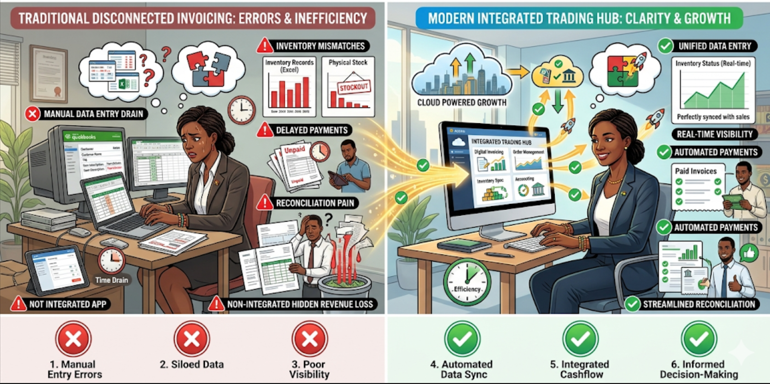
But behind that speed sits a fragile operational reality. For most trading companies in Ghana, the invoicing process is disconnected from everything that comes before it — the enquiry, the quotation, the stock check, the delivery. Each step happens in a different tool, managed by a different person, with no automated link between them.
The result is an invoicing workflow that is slow, error-prone, and quietly draining money from the business every single week.
Where Businesses Go Wrong: Invoicing as an Afterthought
In most Ghanaian trading businesses, invoicing happens at the end of the process — almost as an administrative task rather than a core operational step. A salesperson agrees on terms with a customer over the phone or in person. Someone writes up the sale. Then, separately, someone in finance or admin creates the invoice, often re-entering details from scratch.
This creates multiple points of failure. The price on the invoice might not match the price that was quoted, because the quotation was verbal or buried in a WhatsApp message. The quantities might differ from what was actually delivered. Tax calculations might be inconsistent. And if the customer has multiple orders or partial deliveries, tracking which invoice covers which delivery becomes a manual puzzle.
For businesses operating across multiple branches — which is common in Ghana’s trading landscape — the problem multiplies. Each branch may generate invoices independently, using different templates, different price lists, and sometimes different terms. Head office discovers discrepancies only at month-end, when reconciliation reveals the gaps.
A Scenario You Might Recognise
Esi runs a wholesale provisions business with outlets in Accra and Cape Coast. Her Accra branch handles walk-in retailers and phone orders. Her Cape Coast branch serves the western corridor. Both branches create invoices using a basic invoicing app, but neither branch can see the other’s transactions in real time.
Last month, a large retailer placed a split order across both branches. The Accra branch invoiced at the standard wholesale price. The Cape Coast branch, working from an outdated price list, invoiced ten percent lower. The customer noticed and demanded the lower price on both shipments. Esi had to honour it — losing margin because her two branches were not operating from the same data.
The same week, a customer in Cape Coast claimed he had already paid for an invoice that Esi’s Accra office was still showing as overdue. The payment had been made to the Cape Coast branch but never communicated to head office. Esi spent two days tracing the transaction.
What This Is Costing You
Margin Erosion From Inconsistent Pricing
When branches or salespeople invoice from different price lists, customers inevitably discover the inconsistency and demand the lowest price. Every pricing discrepancy is a negotiation you lose before it starts. For trading businesses operating on margins of 15 to 25 percent, even a few percentage points lost per transaction adds up to significant revenue leakage over a quarter.
Payment Delays From Invoice Errors
Incorrect invoices trigger disputes. Disputes delay payment. In a market where late payment is already a chronic challenge for SMEs, adding self-inflicted delays through invoicing errors makes cashflow management even harder. Every day an invoice sits unpaid because of an error is a day your cash is stuck.
Hours Lost to Manual Reconciliation
When invoicing is disconnected from sales and inventory, reconciliation becomes a manual, time-consuming exercise. Finance teams in trading businesses regularly spend entire days at month-end matching invoices to deliveries, tracing payments, and resolving discrepancies between branches. This is time that should be spent on analysis and forecasting, not detective work.
Customer Trust Eroded
Repeated invoicing errors — wrong prices, missing items, duplicate charges — damage your reputation with customers. In Ghana’s trading community, where relationships and word-of-mouth matter enormously, a reputation for unreliable documentation can cost you business faster than a competitor’s lower price.
A Better Way to Operate: Invoicing That Is Connected to the Full Transaction
The solution is not better invoicing software in isolation. It is connecting invoicing to the operational workflow that precedes it. When a quotation, once approved, flows into a sales order that automatically generates an invoice with the correct prices, quantities, and terms, the errors disappear. When every branch works from the same price list and the same SKU master, consistency is built in rather than policed after the fact.
A connected system also means payment tracking is part of the same flow. When a customer pays, the system records it against the specific invoice, updates the receivables dashboard, and flags any outstanding balances. No more chasing payments that have already been received at a different branch. No more manual aging spreadsheets that are outdated the moment they are printed.
How Webhuk Connects the Full Workflow for Ghanaian Trading Businesses
Webhuk is built for exactly this operational context. It is a cloud-native platform headquartered in Ghana, designed specifically for trading, distribution, and multi-branch businesses in the region.
With Webhuk, every invoice traces back to a quotation and sales order. Pricing is controlled centrally, so all branches work from the same data. Multi-branch inventory is tracked in real time, meaning invoices always reflect what was actually available and delivered. Payment reconciliation happens within the same system, giving finance a live view of receivables across all locations.
For trading companies handling cross-border transactions, Webhuk supports multi-currency invoicing with automatic exchange rate management — essential for businesses importing from China, India, Europe, or elsewhere and invoicing in Ghana Cedis.
The platform is designed for rapid deployment. Most businesses are operational within 30 days, with no need for external consultants or IT specialists. It is built for business owners and operations managers who need results, not complexity.
Trading in Ghana and tired of invoicing headaches? Try Webhuk free for 7 days and connect your entire workflow from quote to payment.
Learn more: How Enquiries, Quotations, Orders and Invoices Work in Webhuk
Explore: Multi-Currency Invoicing for Cross-Border Trade
Frequently Asked Questions
Why is invoicing a common problem for trading companies in Ghana?
Most trading businesses in Ghana manage invoicing separately from quotations, orders, and inventory. This disconnect causes pricing inconsistencies, documentation errors, and payment tracking gaps — especially for multi-branch operations where each location may invoice independently.
How does disconnected invoicing affect cashflow?
Invoice errors lead to customer disputes, which delay payments. When payment tracking is manual, overdue invoices are missed or followed up late. Both problems slow cash collection and create uncertainty about the business’s real financial position.
Can Webhuk handle Ghana Cedi and foreign currency invoicing?
Yes. Webhuk supports multi-currency invoicing with automatic exchange rate management. You can invoice in Ghana Cedis for local customers and in USD, EUR, or CNY for international transactions, with all conversions tracked and reconciled.
Is Webhuk suitable for businesses with branches in different cities?
Absolutely. Webhuk is designed for multi-branch operations. All locations share the same price lists, SKU data, and customer records, while inventory and transactions are tracked per branch with full visibility at head office level.
How quickly can a trading company in Ghana get started with Webhuk?
Most trading businesses go live within 30 days. Webhuk’s onboarding is designed for speed — no consultants, no custom development. Your team can start processing real transactions within weeks of signing up.