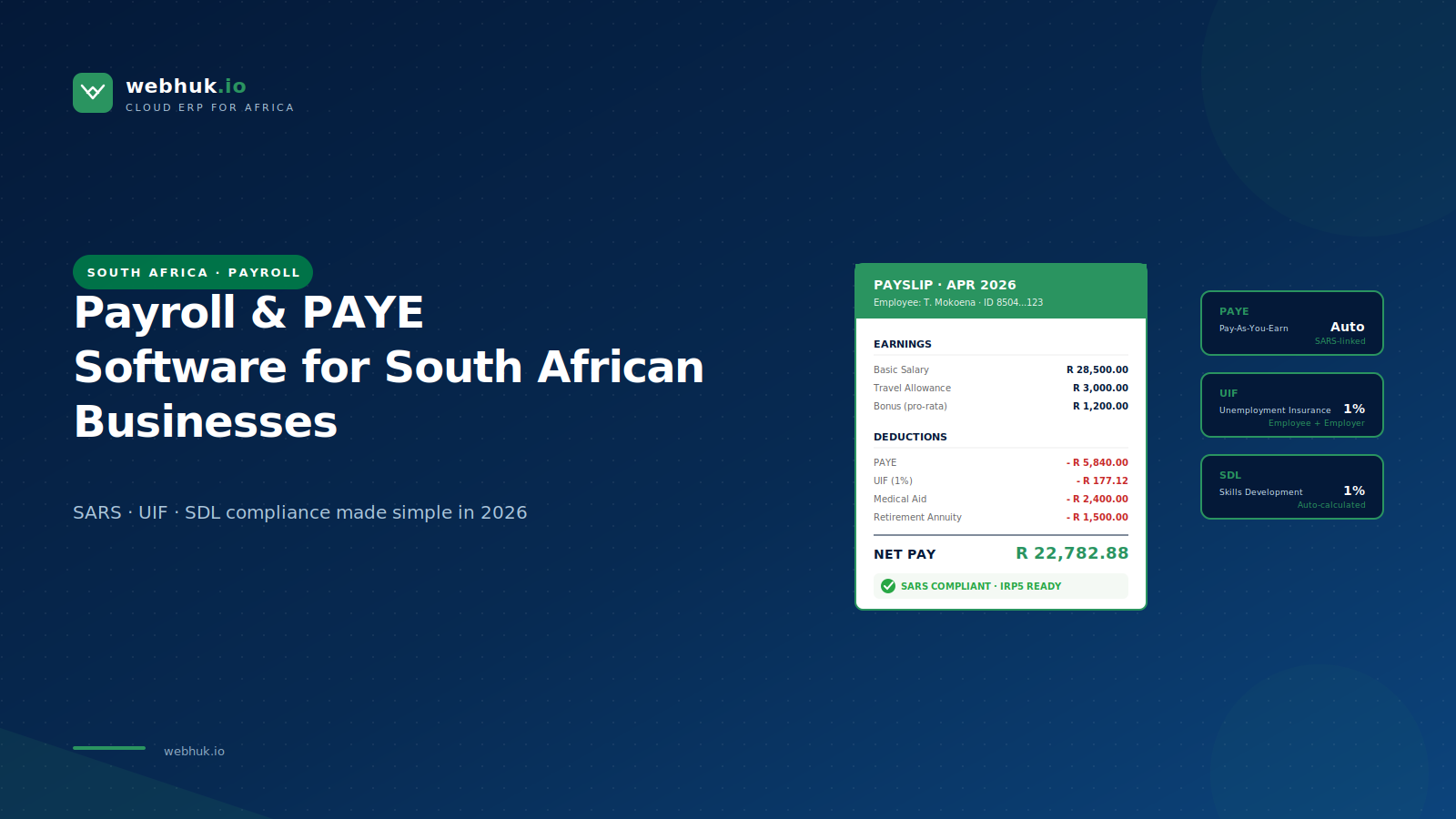
Payroll is the part of running a South African business that nobody wants to talk about until it goes wrong. PAYE miscalculated. UIF underpaid. SDL forgotten. EMP201 late. EMP501 reconciliation mismatching against the IRP5s by a few cents per employee that compound into a SARS query nobody anticipated.
The cost of getting payroll wrong in South Africa is high. Penalties from SARS for late or incorrect submissions. Frustration and legal exposure from staff who feel underpaid or misclassified. Audit risk that escalates when payroll records do not reconcile to the general ledger.
The good news is that payroll software in SA in 2026 is mature, well-priced, and integrates with the rest of your business stack more easily than ever before. The bad news is that not all platforms handle the SARS-specific requirements equally well, and the difference between "compliant" and "really compliant" is the difference between an audit you pass and an audit that costs you.
What South African payroll software must actually do in 2026
PAYE calculation that handles every legitimate edge case. Tax tables, rebates, age-based thresholds, medical aid credits, retirement annuity contributions, travel allowances, fringe benefits, bonuses, leave pay, additional payments. The software must apply the SARS rules correctly without manual override.
UIF and SDL handled automatically. Unemployment Insurance Fund contributions, Skills Development Levy, both calculated and deducted correctly every month.
EMP201 monthly submission. The combined declaration of PAYE, UIF and SDL. Generated automatically from the payroll run, ready for submission via eFiling. The better platforms support direct submission.
EMP501 reconciliation. Twice a year — interim in October-November, final in April-May. The reconciliation between EMP201 submissions across the period and the IRP5/IT3(a) certificates issued to employees. Mismatches here are where many businesses get into trouble.
IRP5 and IT3(a) generation at year end. Tax certificates for every employee, ready to issue and submit to SARS. The data must reconcile cleanly with both EMP201 history and EMP501.
Leave management. Annual leave, sick leave, family responsibility leave, parental leave. Tracking accrual, usage, balances, payouts at termination.
Statutory deduction handling. Garnishee orders, maintenance orders, any court-ordered deductions handled correctly with proper sequencing.
Multiple pay frequencies. Monthly, weekly, fortnightly, daily. Some businesses run multiple frequencies for different staff categories.
Multiple companies or branches. Group structures with multiple legal entities, or single companies with multiple branches needing separate reporting.
General ledger integration. The payroll journal must post correctly to your accounting system every pay run. Without this, your books and your payroll will never agree at month-end.
ESS and self-service portal. Employees viewing payslips, claiming leave, updating personal details, downloading IRP5s. Removes a significant administrative load from HR or finance.
Compliance with the latest SARS tax tables and legislation. Updated automatically as SARS changes rules. Manual updates are a recipe for errors.
The platforms competing for SA payroll in 2026
1. Sage Payroll (Sage Business Cloud Payroll, Sage 200 Evolution Payroll, Sage VIP)
Sage's payroll suite is the most established in South Africa. Multiple products at different scale tiers. Tight integration with Sage accounting, deep SARS compliance, a vast network of trained payroll administrators and consultants.
Best for: Established SA businesses already on Sage accounting infrastructure, and businesses valuing the deepest compliance pedigree.
2. SimplePay
Cloud-native, modern UX, growing SA user base. Strong PAYE, UIF, SDL handling. Direct EMP201 and EMP501 generation. Integrates with Xero, Sage and other accounting platforms. Pricing is competitive for SMEs.
Best for: SA SMEs wanting a modern, cloud-native payroll experience with strong accountant network coverage.
3. PaySpace
Cloud payroll with strong reputation for compliance and broader payroll-into-HR functionality. Used widely from mid-market into larger enterprises. Strong African multi-country capability for SA-headquartered businesses.
Best for: Mid-market and larger SA businesses, especially those operating across multiple African countries.
4. Webhuk.io Payroll
Payroll within a full ERP, with native SA SARS compliance and additional African multi-country support. Strong fit for SA businesses operating across SADC and broader Africa, and for SMEs wanting payroll connected to accounting, HR and time tracking in one platform. The Webhuk team can run a payroll-fit assessment for your specific business, particularly useful if you operate across multiple African countries and need consolidated payroll administration.
Best for: SA-headquartered businesses with cross-border operations and SMEs wanting integrated payroll without separate vendor relationships.
5. Pastel Payroll (legacy)
The Pastel Payroll product line has largely been absorbed into the Sage suite. Some legacy installations remain, particularly desktop versions.
Best for: Existing users planning a migration to Sage Cloud or alternatives.
6. CRS Payroll, Sage 300 People, and other enterprise platforms
Larger enterprise payroll platforms used by listed and large private SA companies.
Best for: Large SA enterprises with complex multi-country, multi-entity, multi-currency payroll needs.
7. QuickBooks Payroll, Xero with payroll integrations
Xero does not have a native SA payroll product but integrates well with SimplePay and similar partners. QuickBooks payroll has had limited SA presence.
Best for: SMEs already on Xero who pair it with SimplePay or Sage Payroll, depending on preference.
How to choose between Sage, SimplePay, PaySpace and others
Choose Sage Payroll if: You are already on Sage accounting, you value the deepest compliance pedigree, you have access to Sage-trained payroll administrators, and your business is purely or primarily SA.
Choose SimplePay if: You want a modern, cloud-native experience, your business is SA-only or SA-primary, and you value reasonable subscription pricing with strong support.
Choose PaySpace if: You are mid-market or larger, you need African multi-country payroll, and you value a mature platform with deep payroll-into-HR functionality.
Choose Webhuk Payroll if: You want payroll inside a full ERP, particularly with cross-border African operations, and value a modern integrated platform.
Choose enterprise platforms if: You are above mid-market and need complex multi-entity, multi-country, multi-currency payroll at scale.
For sector-specific guidance — manufacturing payroll with shift premiums and piece rates, retail payroll with commission complexity, services payroll with project-based time tracking — the Webhuk blog has dedicated articles on payroll considerations by industry.
What payroll compliance looks like in practice
Every month, in this order:
Pay run preparation. Inputs gathered: time and attendance, leave taken, overtime, bonuses, terminations, new hires.
Pay run processing. Software calculates gross pay, statutory deductions (PAYE, UIF, SDL), voluntary deductions (medical aid, retirement annuity, garnishee orders), and net pay.
Payslip distribution. Electronic payslips to all employees via email or self-service portal.
Bank file generation. Payment file uploaded to corporate banking for direct credit to employees.
EMP201 preparation. Combined declaration of PAYE, UIF, SDL aggregated for the month.
EMP201 submission. Filed via SARS eFiling by the 7th of the following month.
EMP201 payment. Paid to SARS by the 7th of the following month.
General ledger journal. Payroll cost posted to accounting system. Accruals for leave, bonuses, year-end provisions.
Filing and retention. Source documents, payslips, EMP201s, all retained for the statutory period.
Twice a year, in addition:
EMP501 reconciliation. Aggregating EMP201 history against IRP5/IT3(a) certificates for the period. Reconciling differences. Filing with SARS.
At year end:
IRP5 and IT3(a) issuance. Tax certificates for every employee. Submission to SARS.
The right payroll software handles 90% of this automatically. The wrong payroll software, or the right software badly used, requires significant manual work and creates compliance risk.
Common Payroll Mistakes SA Businesses Make
Treating contractors as employees, or vice versa, incorrectly. SARS scrutinises this. The definition of an employee for tax purposes is specific and software cannot fix a misclassification.
Forgetting to update tax tables when SARS publishes new ones. Manual systems forget. Cloud systems update automatically. Old desktop systems may be running outdated tables, leading to under or over deduction.
Mishandling fringe benefits and travel allowances. Company cars, home office allowances, travel reimbursements — all have specific tax treatments. Software that does not handle these natively forces manual workarounds.
Inconsistent leave accrual. Different rules applied to different staff inconsistently. Audit risk and staff trust risk.
Late EMP201 submissions. Penalty risk and interest exposure. Cloud platforms with automated reminders and direct submission largely eliminate this.
EMP501 mismatches. Where the EMP201 history does not reconcile with IRP5 totals. Difficult to fix retrospectively. Easy to prevent with good software.
Payroll journal not reconciling to the general ledger. Where the payroll cost in books does not match the payroll run. Common source of audit issues.
What it costs to get this right
Payroll software subscription costs in SA, indicative for 2026:
• Very small (under 10 employees): ZAR 200-500 per month
• Small (10-50 employees): ZAR 500-2,000 per month
• Mid-market (50-500 employees): ZAR 2,000-15,000 per month
• Larger (500+ employees): typically priced per employee, ZAR 30-100 per employee per month
Implementation cost varies. SimplePay and similar can be self-implemented for small operations. Sage 200 Evolution Payroll for a mid-market business with complex pay structures might cost ZAR 50,000-200,000 to implement. Larger enterprise systems run higher.
Compared to the cost of getting payroll wrong — penalties, staff disputes, audit findings, time lost to firefighting — the cost of good payroll software is one of the easiest economic decisions a SA business owner makes.
The bottom line
Payroll in South Africa in 2026 is not the place to economise on software. Get a credible platform — Sage Payroll, SimplePay, PaySpace, Webhuk Payroll, depending on your size and needs — implement it properly, train your administrator, integrate it with your accounting, and trust it to do what it does well.
The businesses that take payroll seriously sleep better at night, pay less in penalties, retain staff better because the basics are right every month, and free their HR and finance teams to focus on growth rather than firefighting. That is the actual benefit of getting payroll software right. Everything else is detail.
Frequently Asked Questions
Q1. What is the best payroll software for small businesses in South Africa?
The best payroll software for SA small businesses in 2026 depends on size and existing systems. SimplePay offers a modern cloud-native experience for SMEs. Sage Payroll is the most established choice, particularly for businesses already on Sage accounting. PaySpace fits mid-market and larger operations, especially with African multi-country needs. Webhuk Payroll suits businesses wanting payroll inside a full ERP.
Q2. Does payroll software handle PAYE, UIF and SDL automatically?
Yes, all credible South African payroll platforms handle PAYE, UIF and SDL automatically based on current SARS tax tables. The software calculates the correct deductions every pay run, generates the EMP201 monthly submission ready for eFiling, and produces the EMP501 reconciliation twice a year. Always confirm that tax table updates happen automatically as SARS publishes them.
Q3. How does payroll software help with EMP201 and EMP501 submissions?
Capable payroll software generates the EMP201 monthly declaration automatically from each pay run, with the correct PAYE, UIF and SDL totals aggregated. Some platforms support direct submission to SARS via eFiling integration; others produce the schedules for manual upload. EMP501 reconciliation is generated twice a year and reconciles EMP201 history with IRP5 totals — software-driven reconciliation prevents the mismatches that create SARS queries.
Q4. Can payroll software handle multiple branches or companies in South Africa?
Yes, mid-tier and enterprise payroll platforms handle multiple branches and multiple legal entities. Each entity can run its own payroll with separate EMP201 submissions while consolidating into group reporting. Smaller payroll platforms may require separate subscriptions per company. Always confirm multi-entity capability if you operate a group structure.
Q5. How much does payroll software cost in South Africa per month?
Payroll software in South Africa ranges from around ZAR 200-500 per month for very small businesses (under 10 employees), ZAR 500-2,000 for small businesses (10-50 employees), and ZAR 2,000-15,000 for mid-market businesses (50-500 employees). Larger enterprises typically pay per employee at ZAR 30-100 per employee per month. Implementation cost varies by complexity from self-service for small operations to ZAR 50,000-200,000 for mid-market deployments.