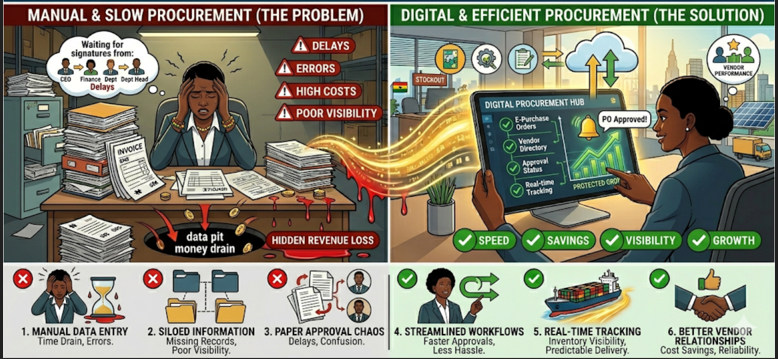
The letters E-R-P carry a lot of baggage. For decades, Enterprise Resource Planning meant SAP, Oracle, or NetSuite — massive systems built for corporations with dedicated IT departments, consultant budgets, and implementation timelines measured in months or years.
When a growing SME starts experiencing operational pain — inventory discrepancies, invoicing errors, procurement chaos — the conventional advice is to get an ERP. But for most small and medium businesses, that advice leads to one of two outcomes: either they invest in a system that is far too complex and expensive for their needs, or they hear the price tag and decide to stick with spreadsheets for another year.
Both outcomes are wrong. The real answer for most SMEs is not traditional ERP. It is a simpler, more focused concept: better operational flow.
Where Businesses Go Wrong: Confusing ERP With What They Actually Need
Traditional ERP systems are designed to cover everything. Human resources, manufacturing, supply chain, finance, customer relationship management, project management, compliance — the feature list runs into hundreds of modules. Most SMEs use perhaps ten percent of those features. The rest is complexity they pay for but never touch.
The implementation model compounds the problem. Industry studies consistently show that ERP projects overrun their budgets and timelines, with a significant percentage failing to deliver the expected business benefits. The primary reasons are over-customisation, poor change management, and data migration challenges — all problems that are amplified in smaller organisations where resources are thin.
So an SME owner who simply wants to stop losing money between quotation and payment, or wants to see real-time stock across three branches, ends up evaluating systems that require consultants, custom configuration, and months of setup. The problem is not that the business needs are complex. It is that the solution being offered is designed for a different scale of complexity.
A Scenario You Might Recognise
Nana runs a trading company in Tema that imports hardware and electrical supplies. His operations are straightforward: buy from suppliers overseas, store in two warehouses, sell to contractors and retailers. He looked into ERP systems last year after too many pricing errors and stockout incidents.
The first vendor he spoke to proposed a 16-week implementation with a consultant fee of $15,000, plus monthly licensing. The system covered manufacturing planning, HR, CRM, and financial consolidation — features Nana would never use. The second vendor offered an open-source option that was cheaper but required a developer to configure and maintain.
Nana went back to his spreadsheets. Not because he did not need a system, but because the systems on offer did not match his problem. He needed his quotes to become orders to become invoices without manual re-entry. He needed to see stock across both warehouses in real time. He needed landed costs to automatically flow into his pricing. He did not need a platform that could also run his payroll and manage his HR policies.
What This Is Costing You
The Cost of Doing Nothing
Many SMEs stay on spreadsheets because traditional ERP feels like the only alternative and it is too expensive or too complex. The cost of that inaction is ongoing: continued manual work, persistent errors, inventory they cannot trust, and cashflow visibility they do not have. These are not static costs. They compound as the business grows and transaction volume increases.
The Cost of Over-Buying
SMEs that do invest in traditional ERP often find themselves paying for features they do not use, locked into contracts with consulting firms, and dealing with systems that are harder to change than the spreadsheets they replaced. The implementation may eventually deliver value, but the time-to-value is measured in quarters or years rather than weeks.
The Real Cost: Lost Agility
The biggest cost is subtle. While an SME is stuck either on spreadsheets or in a slow ERP implementation, competitors who found the right-sized solution are moving faster — quoting faster, fulfilling faster, collecting faster. In competitive markets, operational speed is a genuine advantage, and anything that slows it down has a direct impact on revenue.
A Better Way to Operate: Operations-First, Not Everything-First
What most SMEs actually need is not enterprise resource planning. It is operational workflow management — a system that handles the core processes that drive revenue and cash: quoting, ordering, inventory, procurement, invoicing, and payment tracking.
This is a fundamentally different starting point from traditional ERP. Instead of asking what every department in the business might eventually need, it asks: what are the workflows that, if connected, would immediately reduce errors, save time, and improve cash collection?
For a distributor, that means connecting the quote to the order to the invoice to the payment, with inventory updating at every step. For an importer, it means landed cost allocation that feeds into pricing automatically. For a multi-branch retailer, it means stock visibility across all locations in real time.
These are not complex requirements. They do not need 16-week implementations. They need a focused platform that does these things well and can be live in weeks, not months.
How Webhuk Delivers Operational Flow Without ERP Complexity
Webhuk takes the operations-first approach. It is not an enterprise ERP repackaged for smaller businesses. It is a cloud-native operational platform designed from the ground up for SMEs — specifically distributors, traders, importers, and multi-branch retailers.
The platform covers the workflows that matter most: customer enquiries and quotations, sales orders, procurement and vendor management, multi-branch inventory with real-time tracking, invoicing, and receivables management. These are not modules bolted onto an accounting system. They are a single, connected flow where data moves from one step to the next without manual intervention.
Webhuk includes features like container-based landed cost allocation and multi-currency support because these are real operational needs for its target users — not because they are line items on a feature comparison spreadsheet. The platform skips the modules SMEs do not need — manufacturing planning, HR, complex financial consolidation — and focuses entirely on operational visibility and control.
Most businesses go live within 30 days. There are no consultant fees. No custom development. No six-month implementation projects. Just a clear, practical system that replaces the spreadsheet chaos with professional operational discipline.
If you have been told you need ERP but the options feel too complex or too expensive, the problem is not your business. It is the category. You do not need enterprise resource planning. You need better operational flow. And that is exactly what Webhuk delivers.
Skip the ERP complexity. Try Webhuk free for 7 days and get the operational control your business actually needs.
Learn more: See How Webhuk’s Operational Workflow Works
Frequently Asked Questions
What is the difference between ERP and an operational workflow platform?
Traditional ERP tries to manage every business function. An operational workflow platform focuses on the core revenue-driving processes: quoting, ordering, inventory, procurement, invoicing, and payments. This makes it simpler to deploy, faster to adopt, and more affordable for SMEs.
Is Webhuk an ERP system?
Webhuk is an operations-first cloud platform. It covers the operational workflows that SMEs need most, without the complexity of traditional ERP. It handles quote-to-cash, procurement, multi-branch inventory, and payment tracking in one connected system.
Why do ERP implementations fail for SMEs?
Common reasons include over-customisation, excessive scope, poor change management, and systems designed for enterprise-scale complexity. SMEs often end up paying for features they never use while struggling with long implementation timelines.
Can Webhuk grow with my business?
Yes. Webhuk is built on a scalable cloud-native architecture. As your branch count, transaction volume, and team size grow, the platform scales with you without requiring re-implementation or migration to a different system.
How is Webhuk different from Odoo or Zoho?
Odoo and Zoho are broad suites covering many functions. Webhuk is focused specifically on the operational workflows that matter most to distributors, traders, and multi-branch SMEs: quote-to-cash, procurement, inventory with container-based costing, and real-time payment visibility. This focus means faster deployment and less configuration overhead.