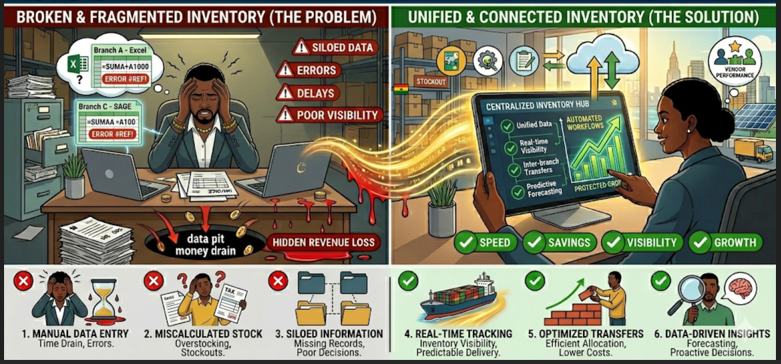
If you run a distribution or retail business with more than one location, you have almost certainly experienced the same frustrating pattern. Branch A reports that a product is out of stock. Branch B has 50 units sitting on the shelf. But nobody knew, because the inventory systems — if they exist at all — do not talk to each other.
Multi-branch inventory management is one of the most common operational failures in growing SMEs. It is also one of the most expensive. Stockouts cost you sales. Excess stock ties up your cash. And the time your team spends on manual cycle counts, phone calls between branches, and emergency stock transfers is time they are not spending on serving customers.
The problem is not that multi-branch inventory is inherently complex. The problem is that most businesses try to manage it with tools that were designed for a single location.
Where Businesses Go Wrong: One Spreadsheet Per Branch, Zero Shared Visibility
The typical multi-branch inventory setup looks like this: each branch maintains its own stock records, usually in a spreadsheet or a standalone point-of-sale system. Head office consolidates these records periodically — maybe weekly, maybe monthly. In between updates, nobody has a reliable picture of what is actually available across the business.
This creates three persistent problems. First, sales teams cannot confidently promise stock to customers because they do not know what is available at other branches. Second, purchasing decisions are made branch by branch rather than on a consolidated basis, leading to duplication and inefficiency. Third, inter-branch transfers happen reactively — only when a stockout is already causing problems — rather than proactively, based on demand signals.
For distributors handling hundreds or thousands of SKUs across three, five, or ten locations, the manual approach collapses quickly. Errors compound. Reconciliation becomes a full-time job. And the cost of holding too much inventory in one place while losing sales in another eats directly into margins.
A Scenario You Might Recognise
Yaw distributes fast-moving consumer goods across four branches in Greater Accra. Each branch manager sends a stock report every Monday morning via WhatsApp. Yaw’s operations assistant compiles these into a master spreadsheet. By Wednesday, the data is already stale — sales have moved stock, returns have come in, and one branch received a delivery that was not captured until the manager remembered to update his list.
Last month, Yaw turned down a large order from a hotel chain because his Accra Central branch showed zero stock of a premium cooking oil. It was only after the customer placed the order with a competitor that Yaw discovered his East Legon branch had 80 cartons. He lost the deal, the repeat business, and his team spent a full day figuring out how the discrepancy happened.
What This Is Costing You
Lost Sales From False Stockouts
When your sales team cannot see real-time inventory across all locations, they turn away orders for products that are actually available somewhere in your network. Every false stockout is a sale you could have made. For distributors with high order volumes, even a small percentage of missed sales due to poor visibility adds up to substantial lost revenue.
Excess Capital Tied in Inventory
Without a consolidated view, each branch tends to over-order independently to avoid running out. The result is excess stock sitting in multiple locations. Industry data suggests that excess inventory ties up 20 to 60 percent of working capital for small distributors and retailers — capital that could be deployed into faster-moving products or expansion.
Operational Friction From Reactive Transfers
Emergency inter-branch transfers are expensive and disruptive. A vehicle dispatched to move 30 cartons from one branch to another because stock was not allocated properly in the first place costs fuel, driver time, and management attention. These reactive transfers are symptoms of a visibility problem, not a logistics problem.
Reconciliation as a Full-Time Job
When inventory data arrives in different formats from different branches at different times, consolidating it into a reliable picture requires hours of manual effort every week. Many multi-branch businesses dedicate one or more staff members primarily to inventory reconciliation — a role that would be largely unnecessary with a real-time system.
A Better Way to Operate: One Inventory, Multiple Branches, Real-Time Updates
The solution is a single inventory system that tracks stock across all branches in real time. Every sale, receipt, return, and transfer updates the central record immediately. Every branch, and every salesperson, can see what is available across the entire network at any moment.
This is not a luxury. For any business operating more than one location, it is the operational baseline required to avoid the costs described above. Real-time multi-branch visibility enables proactive stock transfers before shortages occur, consolidated purchasing that leverages the full network’s buying power, and sales confidence that every quote is backed by actual available inventory.
The key is that inventory must be connected to the rest of the operational workflow. Stock data is only useful if it feeds into quotations, sales orders, invoicing, and procurement. A standalone inventory tracker that does not talk to your sales or purchasing process is just another data silo.
How Webhuk Delivers Real-Time Multi-Branch Inventory
Webhuk’s inventory module is designed from the ground up for multi-branch operations. Every SKU is tracked in real time across all locations. Incoming goods, outgoing sales, inter-branch transfers, and returns all update the central inventory immediately. There is no weekly spreadsheet. No WhatsApp stock reports. No stale data.
Sales teams can check availability across all branches when generating quotations. If Branch A is out of stock but Branch B has supply, the system shows it. Purchase orders are generated with visibility into the full network’s stock position, so procurement is consolidated rather than duplicated across branches.
Webhuk also includes reorder alerts and smart replenishment suggestions based on actual stock movement patterns. When a SKU falls below a defined threshold at any branch, the system flags it and can generate a purchase order with the associated vendor pre-populated. For distributors managing perishable goods, expiry tracking and batch management add another layer of control.
All of this connects seamlessly to the rest of Webhuk’s operational workflow — quotations, sales orders, invoicing, and payment tracking. Inventory is not a separate module. It is the backbone of the entire system.
Running multiple branches without real-time stock visibility? Start your free 7-day Webhuk trial and see your full inventory picture for the first time.
Explore: Webhuk Multi-Branch Inventory Management in Detail
Frequently Asked Questions
What causes inventory discrepancies between branches?
The most common cause is delayed or incomplete data entry. When stock movements are recorded manually or batch-updated, the gap between reality and records grows with every transaction. Sales, returns, transfers, and receipts that are not captured in real time create discrepancies that compound over time.
How does Webhuk handle inter-branch stock transfers?
Webhuk records inter-branch transfers as a single transaction that automatically adjusts inventory counts at both the sending and receiving branches. The transfer is logged with full traceability, so you always know what moved, when, and why.
Can I set different reorder levels for different branches?
Yes. Webhuk allows you to configure SKU-level reorder points and safety stock thresholds independently for each branch, reflecting the different demand patterns and storage capacities at each location.
Does Webhuk support perishable goods tracking?
Yes. Webhuk includes batch and expiry date management. Inventory nearing its expiry date is flagged automatically, and daily scheduled reports can alert your team to perishable stock that needs to be prioritised for sale or written off.
How many branches can Webhuk support?
Webhuk is built on a scalable cloud architecture and can support any number of branches. Whether you operate two locations or twenty, the platform handles multi-branch tracking, reporting, and consolidation without performance limitations.