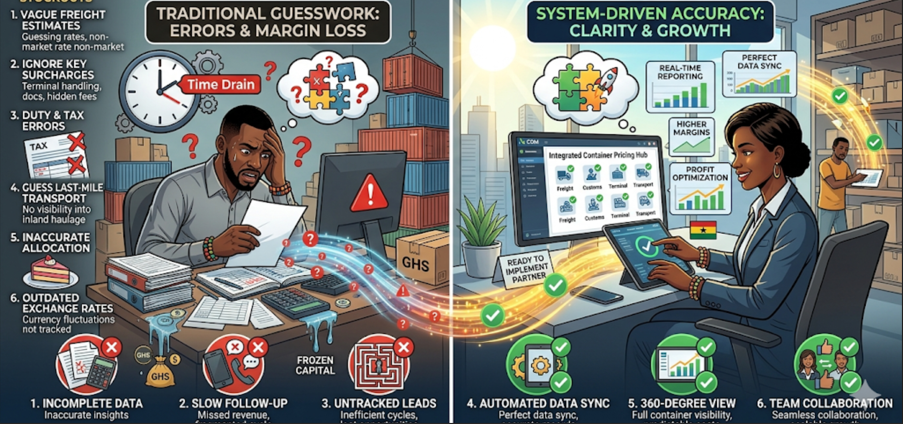
For businesses that import goods by sea container, the cost of each product is never a single number. It is a calculation that starts with the supplier’s price and accumulates layers of cost as the container moves from factory floor to your warehouse shelf: freight, marine insurance, customs duty, port handling, demurrage, clearing agent fees, inland transport, and sometimes warehousing.
Getting this calculation right is not optional. It is the foundation of your pricing, your margin analysis, and your profitability. Get it wrong, and every downstream number — your quotes, your invoices, your financial reports — is built on fiction.
Yet most importing SMEs still perform this calculation in spreadsheets, often weeks after the goods have already been sold. The error is not in the arithmetic. It is in the timing, the completeness, and the allocation method.
Where Businesses Go Wrong: The Spreadsheet COGS Trap
Container-based importing introduces a cost allocation challenge that spreadsheets handle poorly. A single 20-foot container might hold five different product lines with different weights, volumes, and duty classifications. The freight charge is a lump sum. The customs duty varies by product category. The clearing agent charges a flat fee. And the inland transport cost depends on the total weight, not the individual items.
Most importers handle this by waiting until all costs are in — which can be weeks after the container arrives — and then building a spreadsheet that divides costs across products using a rough method: sometimes by invoice value, sometimes by quantity, sometimes by weight, and sometimes by whatever feels right.
The problems are predictable. Costs that arrive late get missed. Allocation methods are inconsistent between shipments. And because the calculation happens after the fact, the prices at which goods were sold may not reflect the true cost. You discover margin erosion during a quarterly review, long after the opportunity to correct pricing has passed.
A Scenario You Might Recognise
Bright imports automotive spare parts from Guangzhou through Tema port. Each container typically holds brake pads, oil filters, wiper blades, and assorted fasteners. His supplier invoices are in USD. Freight is quoted in USD. Customs duty is calculated in GHS based on a CIF value. Clearing charges are in GHS. Inland transport to his Accra warehouse is a flat fee.
Bright’s process: he pays his supplier, records the FOB cost per item, and starts selling. Three to four weeks later, when all port and clearing charges have been finalised, his accountant builds a spreadsheet splitting total costs by product value. But by then, Bright has already quoted and invoiced 60 percent of the shipment based on estimated costs.
On his last container, the actual landed cost of his brake pads was 22 percent above the supplier price — not the 15 percent he had estimated. He had already committed to prices with three large garage chains. The margin he thought was 30 percent was actually 18 percent. He only knew this when his accountant finalised the numbers six weeks after the container arrived.
What This Is Costing You
Systematic Under-Pricing
When landed costs are estimated rather than calculated, businesses almost always underestimate. The forgotten demurrage charge, the unexpected duty rate adjustment, the fuel surcharge on inland transport — these costs are easy to miss in an estimate. The result is that your selling prices do not cover your true costs on a meaningful percentage of transactions.
Inconsistent Margins Across Products
Different products in the same container absorb costs differently depending on weight, duty classification, and volume. A flat percentage allocation hides this reality. You might think all your products carry a 25 percent margin, when in fact your high-duty items are at 10 percent and your low-duty items are at 40 percent. Without accurate per-product landed cost data, you cannot identify which products are genuinely profitable.
Delayed Financial Clarity
If your true COGS is only known weeks after the sale, your financial reports during that period are unreliable. Management decisions about purchasing, pricing, and product mix are based on incomplete data. By the time the numbers are corrected, the decisions have already been made.
A Better Way to Operate: Real-Time Container Cost Allocation
The solution is a system that captures container costs as they become available and allocates them to each product using defined rules — not one-off spreadsheet exercises. When the freight invoice arrives, it is allocated. When customs duty is assessed, it is allocated. When clearing and transport charges come in, they are allocated. Each cost layer updates the per-unit landed cost in real time.
This means your price lists always reflect the latest cost data. Your quotations are based on actual margins, not estimates. And your financial reports show true profitability from the moment goods are received, not weeks later.
How Webhuk Automates Container Pricing for Importers
Webhuk’s container-based pricing module is designed specifically for this use case. When you receive a container, you define the products it contains and their quantities. As costs are captured — supplier invoice, freight, duty, clearing, transport — Webhuk allocates them across SKUs using rules you configure: by weight, by value, by volume, or by quantity.
The per-unit landed cost updates automatically as each cost layer is added. Your inventory valuation reflects true costs immediately. Price lists and quotation engines pull from the latest landed cost data, so every quote your sales team generates carries a real margin.
Webhuk also handles the multi-currency dimension. Supplier costs in USD or CNY, port charges in GHS, and selling prices in any currency are all tracked with automatic exchange rate management, so currency movements are captured in your cost calculations rather than becoming a surprise.
The result is pricing confidence. You know your margins. Your quotes reflect reality. And you never again discover six weeks later that a shipment was sold at half the margin you expected.
Importing by container without accurate cost allocation? Start your free 7-day Webhuk trial and see your true per-unit landed costs.
Explore: Container-Based Inventory and Cost Tracking in Webhuk
Learn more: Multi-Currency Management for Cross-Border Trade
Frequently Asked Questions
What is container-based pricing?
Container-based pricing is a cost allocation method where all expenses associated with a shipment container — freight, duty, clearing, transport — are distributed across the individual products in that container to calculate the true landed cost per unit.
Why is spreadsheet-based COGS calculation risky for importers?
Spreadsheets are updated after the fact, often weeks after goods are sold. This means pricing decisions are based on estimates rather than actual costs. Late-arriving charges are frequently missed, and allocation methods are inconsistent between shipments.
How does Webhuk allocate shared container costs?
Webhuk allows you to define allocation rules per container: by product weight, value, volume, or quantity. Costs are allocated as they are captured, updating per-unit landed costs in real time.
Can Webhuk handle different duty rates for different products in the same container?
Yes. Each SKU can have its own duty classification. When customs charges are captured, Webhuk allocates duty costs according to each product’s specific rate rather than applying a flat percentage across the container.
Does this work with multiple currencies?
Yes. Webhuk tracks supplier costs, freight, duty, and selling prices in their respective currencies with automatic exchange rate management, ensuring currency fluctuations are captured in your cost calculations.