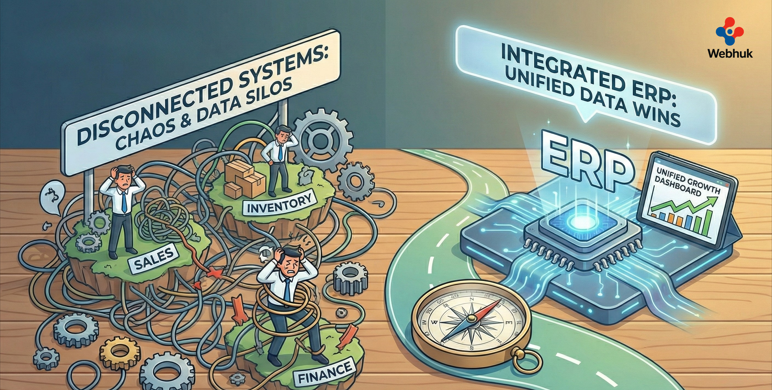
Imagine trying to drive a car where the speedometer is on your phone, the gas gauge is written in a notebook in the back seat, and the GPS is being shouted at you by a passenger in another vehicle.
It sounds ridiculous, yet this is exactly how thousands of small businesses operate every day.
They have accounting software for finance, a spreadsheet for inventory, a separate tool for sales, and maybe a whiteboard for production. None of these systems talk to each other. The result? "Data Silos." Information gets trapped, errors multiply, and you spend half your week just trying to figure out what is actually happening.
The solution to this madness is an Integrated ERP (Enterprise Resource Planning) system.
Unlike standalone apps, an integrated ERP connects every department—Finance, Sales, Inventory, Operations—into one single heartbeat. In this guide, we will explore the tangible benefits of integrated ERP and why it is the prerequisite for scaling a modern business.
The "Single Source of Truth" (Data Accuracy)
The biggest enemy of decision-making is conflicting data.
- Sales Team says: "We sold 100 units!"
- Warehouse Team says: "We only have 50 in stock."
- Finance Team says: "We haven't been paid for any of them."
Who is right? In a disconnected system, you have to hold a meeting to find out.
With an integrated ERP, there is only one database. When a salesperson closes a deal, the inventory count drops instantly. This real-time synchronization is critical for inventory management best practices. You never have to guess if your valuation is correct or if you are promising stock you don't have.
Total Visibility into Financial Health
Many business owners confuse "Money in Bank" with "Profit." They are not the same. Without integration, your financial reports are always lagging. You might think you are profitable this month, only to realize two weeks later that you overspent massively on raw materials.
An integrated ERP links your purchasing directly to your accounting. It helps you understand the nuances of cash flow vs profit by giving you a live P&L statement. You can see costs accruing as they happen, not 30 days later when the accountant finally gets the receipts.
Automation of Mundane Tasks
Efficiency isn't about working faster; it's about not doing the work at all. One of the top benefits of integrated ERP is workflow automation.
Example: The Purchase Order Chain In a manual system, a stockout triggers a panic. Someone calls a vendor, then manually types a PO, then emails it... In an integrated system, you can automate your purchase orders. The system sees stock is low, drafts the PO, sends it to the manager for one-click approval, and emails the vendor. No typing, no errors, no uncontrolled spending.
Streamlined Production and Operations
For manufacturers, disconnected systems are a disaster waiting to happen. If your production team doesn't know what the sales team is promising, you get bottlenecks.
Integration aligns the "Demand" (Sales) with the "Supply" (Production). The moment an order comes in, the ERP schedules the production run and allocates the raw materials. This is the core of streamlining production. It minimizes downtime because your shop floor knows exactly what to build and when.
Better Customer Service (and Retention)
Customers hate repeating themselves. "I already told the sales guy my address!" "Why didn't you know I have a pending support ticket?"
When your CRM is integrated with your ERP, your support team becomes superheroes. They can see everything: the customer's order history, their current invoice status, and their shipping details.
For service agencies, this integration ensures that the work promised by sales is actually what gets delivered and billed. It helps reduce unbilled hours because the time-tracking module feeds directly into the invoicing module. Nothing falls through the cracks.
Conclusion: Integration is an Investment, Not a Cost
It is easy to look at the price tag of an ERP and think, "I can save money by using cheap, separate apps." But you pay for that "savings" with your time. You pay for it with errors. You pay for it with lost customers.
The benefits of integrated ERP go far beyond software. It gives you a business that runs smoothly, scales without breaking, and lets you sleep at night knowing your data is accurate.
Stop fighting with disconnected spreadsheets. Experience the power of Webhuk’s all-in-one platform and start running your business with clarity and control today.
Frequently Asked Questions (FAQs)
1. What is the main difference between "Integrated ERP" and "Standalone Software"?
Standalone software (like Quickbooks or Trello) handles one specific function efficiently but doesn't talk to other tools. Integrated ERP is a suite of applications (Accounting, CRM, Inventory) that share a single database, so data entered once is available everywhere instantly.
2. Is integrated ERP too complex for small businesses?
Not anymore. Years ago, ERP was only for large corporations. Today, cloud-based ERP solutions for SMEs are designed to be user-friendly and modular. You can start with just the features you need and turn on more "integrated" modules as you grow.
3. How does integration save money?
It saves money primarily by reducing labor costs. You no longer need to pay staff to re-type data from one system to another. It also reduces costly errors—like over-ordering inventory or under-billing clients—that naturally happen in manual systems.
4. How long does it take to see the ROI from an ERP?
Most businesses see ROI within 6 to 12 months. The immediate impact is usually "time saved" (efficiency). The financial impact (higher profit margins, better cash flow management) typically becomes visible after a few quarters of disciplined use.
5. Can I integrate my existing software with a new ERP?
Yes, usually via APIs (Application Programming Interfaces). However, the goal of an Integrated ERP is to replace as many disparate systems as possible to create a "Single Source of Truth," rather than trying to duct-tape old systems together.