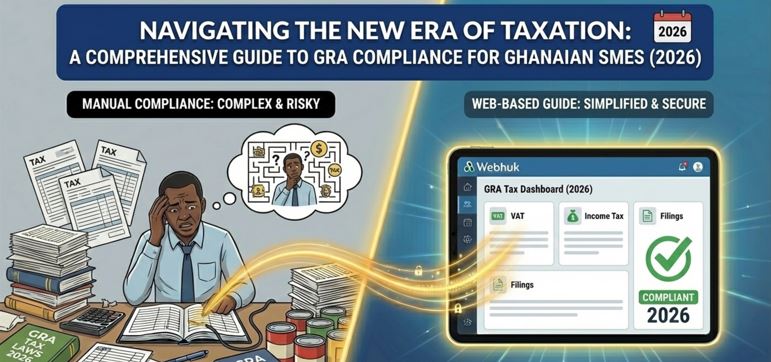
For small and medium-sized enterprises (SMEs) in Ghana, 2026 is the year of the "Digital Tax Revolution." The Ghana Revenue Authority (GRA) has officially moved from a manual, paper-based system to a high-tech clearance model. With the passage of the Value Added Tax Act, 2025 (Act 1151), the way you record sales, claim input credits, and issue invoices has fundamentally changed.
In this guide, we break down exactly what you need to do to stay on the right side of the law while using automation to grow your business.
1. The 2026 VAT Landscape: What Has Changed?
The new tax regime is designed to simplify the burden on smaller businesses while making the digital economy more transparent. Here are the most critical updates:
- The Unified 20% VAT Rate: The previous complex "cascading" system (where levies like NHIL and GETFund were added to the base before VAT) has been replaced. The standard VAT rate is now a unified 20%.
- Abolition of the COVID-19 Levy: Great news for margins—the 1% COVID-19 Health Recovery Levy has been completely scrapped.
- Input Tax Deductibility: For the first time, businesses can now claim input tax credits on NHIL (2.5%) and GETFund (2.5%) levies. This change alone can improve an SME's cash flow by up to 5%, provided you are using GRA compliant accounting software in Ghana to track these correctly.
- New Registration Threshold: The threshold for mandatory VAT registration has been raised to GH¢750,000 in annual turnover. If your business is below this, you are exempt from charging VAT, though many choose to register voluntarily to work with corporate clients.
2. Understanding the E-VAT "Clearance Model"
The biggest shift is the E-VAT mandate. In the past, you could write a receipt in a booklet and file it weeks later. In 2026, the GRA requires "real-time validation."
Your invoicing system must connect to the GRA’s Virtual Sales Data Controller (VSDC). When you generate a sale:
- Your software sends the invoice data to the GRA via API.
- The GRA validates the tax calculation and "signs" the invoice.
- A unique QR Code and SDC ID are returned to your system.
- Only then can the invoice be printed or emailed to the customer.
Failure to follow this process can result in fines of up to 50,000 currency points or three times the tax avoided. This is why manual invoicing is no longer viable for growing Ghanaian firms.
3. Why Manual Bookkeeping is a Risk in 2026
Many business owners in Accra and Kumasi still rely on physical ledgers or simple spreadsheets. However, the new Act 1151 requires that all VAT-registered taxpayers maintain digital records that are accessible for audit for 6 years.
Manual entry leads to:
- Calculation Errors: Missing a 2.5% levy deduction can lead to overpaying tax.
- Audit Red Flags: Inconsistent invoice numbering is a major trigger for GRA audits.
- Data Loss: Paper books are easily damaged or lost, leaving you defenseless during a tax review.
By switching to a Cloud-Based ERP Solution, you ensure that every transaction is timestamped and stored on secure servers, making audits a breeze.
4. Leveraging Webhuk for Seamless GRA Integration
At Webhuk, we built our platform to act as the bridge between your daily operations and the GRA’s digital portal. We understand that as a business owner, you want to focus on sales, not tax codes.
- Automated VSDC Communication: Our system handles the JSON/XML data exchange with the GRA in the background. You just click "Invoice," and we handle the rest.
- Multi-Branch Sync: Managing a shop in East Legon and a warehouse in Tema? Webhuk’s Multi-Branch Inventory Management consolidates all sales data into one GRA-ready report.
- Real-Time Dashboards: Use our Personalized Dashboard to see your VAT liability in real-time, so there are no surprises on the 15th of the month.
5. Transitioning to E-VAT: A 3-Step Checklist
If you haven't yet digitized your tax process, follow these steps immediately:
- Verify your TIN: Ensure your Taxpayer Identification Number is linked to your current business name at the nearest GRA Domestic Tax Revenue Division (DTRD).
- Onboard Certified Software: Choose a platform like Webhuk that is specifically updated for the 2026 VAT reforms.
- Perform a Test Run: Use our "Sandbox" mode to issue a few test invoices to ensure your internet connection and staff are ready for the live environment.
Frequently Asked Questions (FAQs)
1. Is the 3% VAT Flat Rate still available in 2026? No. Under the Value Added Tax Act, 2025 (Act 1151), the Flat Rate Scheme has been abolished. All VAT-registered businesses must now operate under the Standard Rate of 20%, which allows for the full deduction of input tax.
2. What happens if my internet goes down? Can I still sell? Yes. The GRA allows for "Offline Mode" via your VSDC-compliant software. You can issue a provisional invoice, but the data must be transmitted to the GRA within 24 hours once your connection is restored. Webhuk automates this re-syncing process.
3. Do I need to buy a physical "fiscal device" for my shop? Not necessarily. While the GRA does promote Fiscal Electronic Devices (FEDs), modern software-based VSDC integrations (like Webhuk) are authorized to handle the same function digitally, saving you the cost of extra hardware.
Stop worrying about GRA audits and start growing. Don't let complex tax laws slow your business down. Join the hundreds of Ghanaian SMEs using Webhuk to automate their invoicing and stay 100% compliant.
👉 Start Your 14-Day Free Trial with Webhuk Now