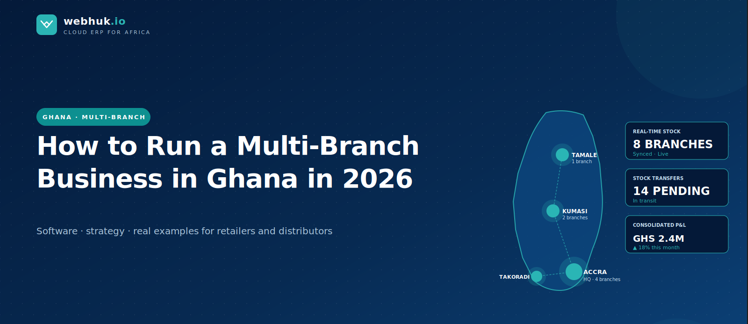
The hardest year in any growing Ghanaian business is the one where you open the second branch.
Until then, you can run almost any operation on memory, WhatsApp and a few notebooks. The owner is the system. The owner sees everything. The owner knows when stock is running low at the front, when the cashier was a bit late, when a customer complained, when the supplier delivered a short carton.
The second you open the second branch, the system breaks. You cannot be in two places. The owner-as-system model collapses. And what fills the vacuum, in most cases, is improvisation. Someone runs the second shop the way they think you would run it. Stock moves between locations on a verbal arrangement nobody writes down. Cash takings get banked at different times by different people. Three months in, your bank balance is lower than it should be and nobody can quite explain why.
Multi-branch is not a software problem. It is a control problem. Software is the tool that makes control possible across distance. This guide is for the Ghanaian business owner about to open branch two, branch three, or branch ten — and the operator who is already there and feels like the wheels are wobbling.
The five things that break first when you go multi-branch
Cash. Two branches mean two tills, two daily cash counts, two banking trips. Without a system that tracks cash by location and by employee, leakage is almost guaranteed.
Stock. What is in the warehouse, what is in branch one, what is in branch two, what is in transit between them. Five answers. Reality is one of them. Without real-time stock visibility per location, you cannot serve customers reliably or order intelligently.
Pricing. A discount given in Adum needs to be visible in East Legon. A new product at one shop needs to be priced consistently at the other. Multi-branch without centralised pricing control means inconsistent customer experience and arguments at the till.
Staff accountability. Who is on shift, who rang up which sales, who voided which transactions, who made which discounts. In one shop with you watching, you can see it. Across multiple shops without a system, you cannot.
Reporting. Are all branches profitable? Which branch grew last month? Which products sell better in Tema than in Spintex? Without consolidated reporting that also breaks down by location, you cannot make any decision worth making.
These are the five places multi-branch businesses bleed money silently. The right software stops the bleeding. The wrong software just gives you a more expensive version of the same problem.
What multi-branch software needs to do — at minimum
Real-time stock per location, with transfers in workflow. Branch A initiates a transfer to Branch B. The system records dispatch. Branch B confirms receipt. Stock moves on system in lockstep with the physical movement. No more "oh, that crate? Yes I think we sent it last week."
Centralised pricing, optional per-branch overrides. You set the price once at head office. It propagates everywhere. If a specific branch needs a local promotion, that override is logged, time-bound, and visible to head office.
Per-user, per-branch access control. The cashier at the East Legon shop sees that shop's tills. The branch manager sees the whole branch. The owner sees everything. Each role has the rights it needs and nothing more.
Consolidated reporting with branch-level drilldown. A single P&L showing the whole business. One click to see branch one in isolation. Another click to see branch one's top ten products. Reports that take twenty seconds to generate, not twenty minutes to assemble in Excel.
Cash management per till, per shift, per branch. Opening float, sales taken, refunds issued, cash deposits to the safe, banking. With a clear, auditable record at the end of every shift. Discrepancies should surface as exceptions, not as monthly surprises.
Mobile money settlement reconciliation per branch. Each branch will have its own mobile money merchant codes. The system should reconcile each branch's settlement separately, then roll up.
Inter-branch accounting. When stock moves from one branch to another at a transfer price, the accounting needs to handle it cleanly. Manual journal entries are error-prone and forgotten.
The Webhuk team can walk a multi-branch business through a tailored deployment plan covering all of the above. The conversation is more useful if you go in with a clear picture of how stock physically moves between your branches today, because that flow is what the software needs to mirror.
Ghana-specific challenges nobody warns you about
Connectivity gaps. Branch internet quality varies wildly. A shop in central Accra has different uptime characteristics than one in a developing area. Multi-branch software needs offline capability per branch with automatic sync when connectivity returns. Cloud-only with no offline mode is risky in Ghana.
Currency leakage on imports. Goods imported in USD or EUR, distributed across branches in GHS, sold to customers in GHS. The cost basis must follow the goods accurately or you cannot tell which branch is genuinely profitable.
Branch managers with too much autonomy. A branch manager who has been running their shop for three years often resists central control. The software rollout is also a culture conversation. Plan for it.
Family-business dynamics. Many Ghanaian SMEs are family-run, with relatives managing branches. Software that creates clean accountability is sometimes seen as creating distrust. The framing matters: this is about visibility for everyone, not surveillance of anyone.
Multiple banking relationships. Different branches may bank with different banks for proximity reasons. Multi-branch software needs to integrate with all of them without forcing a banking consolidation that may not make practical sense.
How real businesses are using multi-branch software in 2026
Retail chains across Accra and Kumasi. Three to ten shops, centralised buying, branch-level sales reporting. The big wins are buying leverage from consolidated data and stockout reduction from inter-branch transfers.
Restaurant groups. Multiple outlets, centralised menu and pricing, consolidated customer loyalty across all branches. Kitchen-level inventory by branch tied to consolidated central buying.
Distribution businesses with depot networks. Head office in Tema, depots in Kumasi, Takoradi, Tamale. Each depot operating semi-autonomously but with full central visibility. Route accounting on delivery vans tied back to depot stock.
Pharmacy groups. Five to twenty outlets, batch and expiry tracking per branch, prescription records per branch, but consolidated regulatory reporting and consolidated buying for negotiating leverage with importers.
Hardware and building material chains. Multi-branch quotation, central price lists, project-level customer management across branches. The customer who gets a quote at one branch can pay and pick up at another, with the system holding it together.
In each case, the business that succeeded with multi-branch software is the business that prepared its data and trained its staff before going live. The business that struggled is the one that bought software, expected magic, and skipped the boring preparation work.
The implementation roadmap that actually works
Weeks one and two: Data preparation. Clean SKU master, clean customer master, clean supplier master. Standardised units of measure. Opening stock counts per branch. Opening cash floats per till. This is the unglamorous work that determines success.
Weeks three and four: Configuration and pilot at one branch. Set up the software for one branch, run a parallel period of two weeks, fix every issue that surfaces.
Week five: Roll out to second branch. Apply the lessons. Things that worked, replicate. Things that did not, fix.
Weeks six and seven: Roll out to remaining branches. With a pattern that has been tested twice.
Week eight: Consolidated reporting goes live. Head office sees the whole business in one place for the first time. Decisions start to be made on real data instead of partial data.
By month three, the business should be running differently — not just using new software. Decisions get faster. Stockouts get rarer. Cash discrepancies become exceptions rather than the norm. Branch managers stop being asked to send their daily numbers because head office can see them in real time.
For more case-style guidance and tactical playbooks on multi-branch operations across retail, hospitality, distribution and pharmacy, the Webhuk blog runs a series of sector-specific articles worth reading before you commit to a software choice.
Why this matters disproportionately in 2026
Ghanaian SMEs are scaling faster than they used to. The smart ones are reading the local market correctly — the rise of organised retail, the consolidation of distribution networks, the expansion of restaurant chains, the formalisation of pharmacy groups. The first to adopt proper multi-branch infrastructure gain compounding advantages: better buying terms, cleaner financials for bank financing, the ability to bid for institutional contracts, and the credibility to attract investment.
The businesses that try to scale on memory, paper and WhatsApp tend to plateau at three to five branches and struggle to break through. The businesses that scale with proper systems clear that ceiling and keep growing.
This is the year to choose your path.
Frequently Asked Questions
Q1. What is the best multi-branch software for businesses in Ghana?
The best multi-branch software for Ghanaian SMEs in 2026 is a cloud-based platform with real-time stock per location, centralised pricing control, per-branch access management, offline capability, mobile money reconciliation per branch, and consolidated reporting. Webhuk.io is purpose-built for African multi-branch operations. ERPNext with a strong implementation partner is also capable. Single-shop POS systems generally do not stretch well to multi-branch operations.
Q2. How do I manage stock across multiple branches in Ghana?
Multi-branch stock management requires a system that tracks inventory in real time per location, supports stock transfers with dispatch and receipt confirmation, and consolidates reporting at head office. Inter-branch transfers should follow a clear workflow with audit trails. Without a real-time multi-branch system, businesses typically lose stock visibility and end up over-ordering at one branch while running out at another.
Q3. Can a small business with two shops afford multi-branch software in Ghana?
Yes. Cloud SME platforms in Ghana now offer multi-branch capabilities at price points starting around GHS 500–1,500 per month for two locations. Compared to the cost of stock leakage, cash discrepancies and missed sales from poor coordination, the software typically pays for itself within the first quarter for any business with two or more branches.
Q4. Does multi-branch software work without internet connection?
The good ones do. Internet quality varies across Ghanaian locations and branches in less central areas may experience outages. Multi-branch software with offline mode allows each branch to continue selling and receiving stock during outages, with automatic synchronisation to head office when connectivity returns. Cloud-only systems without offline support are risky for businesses operating outside major urban centres.
Q5. How long does it take to roll out multi-branch software across several locations?
A structured rollout for a Ghanaian business with three to five branches typically takes six to eight weeks: two weeks of data preparation, two weeks for the first branch pilot, then progressive rollout to the remaining branches over the following weeks. Larger businesses with ten or more branches plan for three to six months. The speed depends much more on data readiness and staff training than on the software itself.