If you have ever sat through a SARS VAT review and watched the auditor's eyebrow lift at one of your invoices, you understand why South African business owners take accounting software seriously.
South Africa's tax environment is not particularly forgiving. SARS is digitising fast — eFiling, mandatory e-invoicing on the horizon, monthly EMP201 submissions, biannual EMP501 reconciliations, VAT201 returns every two months for most VAT-registered businesses. The era of the shoebox of receipts and a quarterly visit to the accountant has been over for some time. The era of disconnected accounting on a desktop in the back office is ending now.
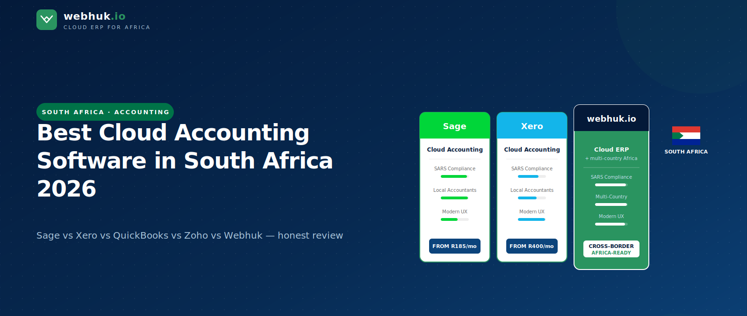
This is the honest 2026 comparison of the cloud accounting software competing for South African SMEs. No vendor brochures. No "all options are great". Just what each platform actually does well, where each one falls short, and which one fits which kind of business.
What South African SMEs actually need from cloud accounting in 2026
SARS-compliant VAT handling. Standard rate, zero rate, exempt, and the various special cases. Automatic VAT201 return preparation. The ability to file directly from the platform or to export the right schedules.
Local bank feeds. FNB, ABSA, Standard Bank, Nedbank, Capitec, Investec — the banks SMEs in South Africa actually use. Working bank feeds eliminate hours of manual capture every week.
Payroll integration or strong payroll links. Monthly EMP201, biannual EMP501, IRP5 generation at year end. Payroll cannot be a separate island that creates reconciliation work.
Multi-currency for businesses with cross-border activity. South African SMEs increasingly trade with the rest of the continent and globally. ZAR plus USD plus EUR is common. Multi-currency must work without spreadsheet workarounds.
Local payment integrations. PayFast, Yoco, Peach Payments, Ozow, SnapScan — the payment rails customers actually use. Manual capture of payment platform settlements is a daily time-sink.
Realistic SME pricing in ZAR. Dollar-denominated subscriptions create cost volatility every time the rand moves. ZAR-priced platforms are easier to budget for.
The reports a business actually uses. P&L by month and year. Cash flow forecasts. Aged debtors with names. Top customers by margin. Stock turnover by category. Generic balance sheets are not what owners look at on a Friday afternoon.
The five platforms competing seriously in South Africa in 2026
1. Sage Business Cloud Accounting
Deep South African roots. The evolution of what was once Pastel. Strong SARS compliance out of the box, ZAR-priced subscriptions starting from competitive entry tiers, and a vast network of Sage-trained accountants and bookkeepers in every major city.
The strengths are real: VAT201 preparation is straightforward, payroll integration with Sage Payroll is tight, and local accountants generally know the platform. The user interface is functional rather than beautiful, but the practical compliance fit for a South African SME is excellent.
Best for: Established South African SMEs working with Sage-trained accountants who value local compliance depth and accountant familiarity.
2. Xero
Beautiful interface, strong global brand, excellent bank feed automation, deep app ecosystem. Xero's SA presence is growing, with PayFast, Yoco and SimplePay integrations all available.
Where it falls short for some South African businesses: native SARS VAT201 generation is less polished than Sage's, the dollar-influenced pricing structure costs more than Sage's entry tiers, and local accountant fluency varies more than with Sage. For modern, tech-comfortable businesses with cross-border operations, Xero is genuinely excellent. For traditional SA SMEs, Sage often fits better.
Best for: Modern businesses with international operations, e-commerce companies, and SA SMEs who prioritise user experience over local-network depth.
3. QuickBooks Online
Globally recognised, locally serviceable. QuickBooks does what it does well — particularly for service businesses, consultants and small businesses with simple books. Less strong than Sage on SARS-specific reporting nuances and less strong than Xero on UX and integrations.
Best for: Service businesses, consultants and freelancers with straightforward books and no urgent multi-currency or e-commerce complexity.
4. Zoho Books
Aggressive pricing, generous free tier for very small businesses, capable feature set. Zoho's SA fit has improved, with VAT201 reports, multi-currency and reasonable bank feed coverage.
The trade-off is depth. Zoho is excellent value but the SARS-specific edge cases sometimes need manual handling. For very small businesses watching every rand, this is acceptable. For larger SMEs, the time savings of a more locally-mature platform usually outweigh the subscription savings.
Best for: Solo entrepreneurs, very small businesses and tech-comfortable founders managing their own books.
5. Webhuk.io
Cloud accounting inside a full ERP, with native African multi-country tax handling including South African VAT. Strong fit for South African SMEs that want accounting connected to inventory, sales and HR in one system, particularly those operating across multiple African countries.
Webhuk is less established in South Africa than Sage, which means fewer local Sage-trained-style accountants are familiar with it. Where it wins is for businesses with operations in multiple African markets — Ghana, Nigeria, Kenya, South Africa — needing one system that handles all of them rather than separate accounting systems per country.
Best for: SA-headquartered businesses with operations across multiple African markets, and SMEs who want their full operational stack in one platform rather than accounting bolted onto separate tools.
Speak to the Webhuk team about cross-border African accounting requirements if your business spans multiple countries — this is where the comparison shifts most clearly in Webhuk's favour.
How to choose between Sage and Xero — the real question
For most South African SMEs, the honest decision is between Sage Business Cloud and Xero. The other platforms occupy adjacent niches but the centre of the market is these two.
Choose Sage if: Your accountant already uses it, your business is purely or primarily South African, you value local SARS depth over user experience, and you want the lowest-friction relationship with the accounting profession in South Africa.
Choose Xero if: You have international operations or cross-border transactions, you sell e-commerce or services online, you value modern UX and integrations, and you can absorb slightly higher subscription costs in exchange for capability and ecosystem.
For a deeper side-by-side comparison covering specific scenarios — manufacturing, retail, services, e-commerce — the Webhuk blog has detailed accounting platform comparisons by sector.
The hidden cost most comparisons skip
Subscription cost is the smallest part of the total cost of accounting software. The bigger numbers are:
Migration cost. Moving historical data into the new platform. Cleaning up the chart of accounts. Mapping customer and supplier lists. For a typical SA SME, plan for forty to one hundred hours of bookkeeper time during migration.
Training cost. Your bookkeeper, your finance team, your operations staff who interact with the system. Training and adoption time is significant in the first three months.
Integration cost. Connecting the accounting system to your point of sale, your e-commerce platform, your payroll, your bank feeds, your payment processors. Each integration can be straightforward or messy depending on the combination.
Ongoing accountant fees. A platform your accountant knows well costs you less in monthly fees than one they have to learn. This is a real factor for SA SMEs working with traditional accounting practices.
A platform that costs ZAR 200 per month more than the cheapest option but reduces accountant fees by ZAR 1,000 per month is a better economic choice. Look at total cost, not subscription cost.
SARS digitisation — what is coming and what it means
SARS is moving toward mandatory e-invoicing in phases through the rest of the decade. Real-time or near-real-time transaction visibility is the direction of travel, mirroring trends in other jurisdictions globally.
The platforms most likely to handle this gracefully are the ones that already have strong API capability and active local development cycles — Xero, Sage Business Cloud, and platforms with African focus like Webhuk. Platforms with thinner local engineering presence are more likely to require workarounds when SARS requirements tighten.
Plan as if mandatory e-invoicing is two years away, not five. The businesses that move early will look prescient. The businesses that wait will scramble.
The straight answer
For most established South African SMEs in 2026, Sage Business Cloud Accounting remains the most pragmatic choice. Local depth, accountant familiarity, ZAR pricing, SARS compliance — the boxes that matter for a typical SA business get ticked.
For modern, internationally-oriented or e-commerce-focused SMEs, Xero is the better fit despite the higher cost.
For very small businesses watching every rand, Zoho Books is genuinely good value.
For service businesses with simple needs, QuickBooks Online works.
For SA-headquartered businesses operating across multiple African countries, or for SMEs wanting accounting connected to a full operational ERP, Webhuk.io is the most natural fit and worth a serious look.
Whichever you choose, run a thirty-day trial with your real chart of accounts and your real transactions. The right platform reveals itself in the first month. The wrong one reveals itself a year later, more painfully.
Frequently Asked Questions
Q1. Which accounting software is best for small businesses in South Africa in 2026?
For most established South African SMEs in 2026, Sage Business Cloud Accounting is the most pragmatic choice due to local SARS compliance depth, ZAR pricing and the wide network of Sage-trained accountants. Xero suits modern, internationally-oriented businesses. Zoho Books offers strong value for very small businesses. Webhuk.io fits SA businesses operating across multiple African countries or wanting accounting inside a full ERP.
Q2. Is Xero better than Sage in South Africa?
It depends on the business. Xero offers a better user experience, stronger global integrations, and better fit for international operations. Sage has deeper SARS compliance, better-established accountant familiarity in South Africa, and more competitive ZAR pricing at entry tiers. For traditional SA SMEs, Sage typically wins on practical fit. For modern or internationally-oriented businesses, Xero typically wins on capability and UX.
Q3. Does cloud accounting software handle SARS VAT201 returns?
All major cloud accounting platforms in South Africa handle VAT201 preparation with varying levels of sophistication. Sage offers the most polished native VAT201 generation and direct submission to SARS. Xero, Zoho Books and QuickBooks generate the schedules needed but may require additional steps for filing. Always verify the specific filing workflow during a trial before committing.
Q4. Can cloud accounting software integrate with FNB, ABSA, Standard Bank and other SA banks?
Yes, the major South African banks — FNB, ABSA, Standard Bank, Nedbank, Capitec and Investec — are supported by all leading cloud accounting platforms via bank feeds. Quality of integration varies; Xero and Sage are generally regarded as having the most reliable feeds. Working bank feeds eliminate hours of manual capture every week and are a major reason to switch from desktop to cloud accounting.
Q5. How much does cloud accounting software cost in South Africa per month?
South African cloud accounting subscriptions in 2026 range from around ZAR 185 per month for Sage Accounting Start, to ZAR 400–800 per month for mid-tier plans on Sage, Xero and QuickBooks, to ZAR 1,000+ per month for full ERP platforms with multiple users and modules. Always factor in migration, training and integration costs in addition to subscription, as these often exceed the first year of subscription fees.