Every South African business owner has the same conversation with their accountant at some point. It usually starts with "SARS is asking for…" and ends with the owner trying to remember where a particular invoice from eighteen months ago might have ended up.
This is the conversation that SARS-compliant accounting software is designed to make extinct. By the end of this guide you will know what "SARS compliant" actually means in 2026, what is changing in the next two to three years, and how to choose software that keeps your business clean, audit-ready and growth-ready.
What "SARS compliant" actually means in 2026
The phrase gets thrown around. It means specific things:
Correct VAT handling. Standard rate at 15%, zero-rated goods and services treated correctly, exempt supplies properly classified, and the special cases — second-hand goods, going concerns, accommodation — handled per the VAT Act. Compliant software should not allow you to accidentally apply the wrong VAT treatment.
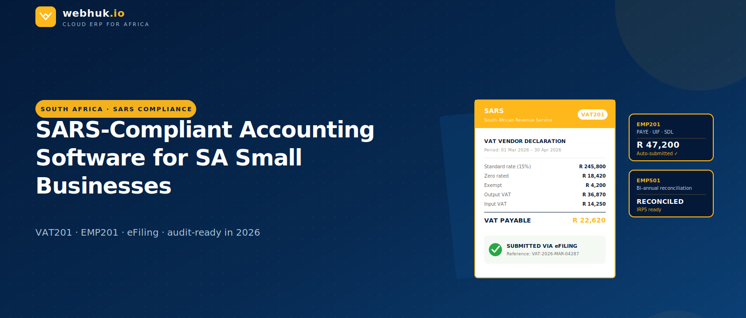
VAT201 return ready in two minutes, not two days. All input and output VAT correctly aggregated, zero-rated and exempt sales separately reported, the boxes on the SARS VAT201 form populated automatically. Direct submission via eFiling integration where supported.
Audit trail that holds up. Every invoice, credit note, journal entry and adjustment must leave a permanent, time-stamped record showing who did what and when. Silent edits to historical records are the audit risk that gets businesses into trouble.
Bank reconciliation that ties out. Bank feeds importing transactions automatically, matched to recorded invoices and bills, with a clean audit trail of any unreconciled items. SARS reviewers look at unreconciled cash as a red flag.
Payroll compliance. EMP201 submissions every month, EMP501 reconciliations twice a year, IRP5 generation at year end. Whether the payroll is in the same system or integrated with one, the data has to flow cleanly into your tax submissions.
Document retention. Five years of invoices, receipts, bills, statements and supporting documents accessible in seconds, not buried in a filing cabinet at the back office.
Readiness for e-invoicing. SARS is on a phased path toward mandatory e-invoicing through the second half of the decade. Software with strong API capability and active local development is positioned to handle this gracefully. Software without is positioned to scramble.
The SARS digitisation trajectory — what to expect
SARS has signalled the direction clearly through its modernisation programme. In broad terms:
Now and through 2026. eFiling for everything tax-related. Increasing use of third-party data matching by SARS — comparing what you submit against what your bank, your suppliers and your customers report. Payroll already largely electronic.
Through 2027 and 2028. Phased introduction of e-invoicing for VAT-registered businesses, starting with larger taxpayers and rolling down. Real-time or near-real-time transaction reporting becomes the norm rather than the exception.
By 2029 and beyond. Manual VAT filing largely phased out. Most VAT-registered businesses operating on near-real-time digital infrastructure.
The takeaway: businesses that adopt cloud, API-capable accounting software now will absorb the changes incrementally. Businesses still on desktop systems or paper will face a step-change migration when their compliance deadline lands.
What to verify before you buy
One: Live VAT201 demo using realistic transaction data. Ask the vendor to walk you through generating a VAT201 from a representative month's transactions. Watch how it handles zero-rated, exempt and standard-rated. Watch how it deals with credit notes and corrections. Watch how it integrates with eFiling for submission.
Two: Bank feeds for your actual bank. A platform that supports "South African banks" generically may have a weak feed for your specific bank. Test with FNB, ABSA, Standard Bank, Nedbank, Capitec, Investec, or whichever you use — your real account, in trial.
Three: Audit log access. Can you see every change made to historical records? Can you see who made each change? Can you export the audit log if SARS requests it? If any of these are not straightforward, the platform is not audit-ready.
Four: Document attachment. Can you attach the supplier invoice PDF directly to the entry in your books? When SARS asks for supporting documentation eighteen months later, you should be able to retrieve it in seconds.
Five: Multi-user with role-based access. Your bookkeeper, your accountant, your operations manager, you. Each with the rights they need and nothing more. Particularly important for businesses with external accountants who need read access without write access to certain areas.
Six: API or open integrations. Even if you do not need it today, the option matters. As SARS digitisation accelerates, integration becomes more important, not less.
The Webhuk team can run a SARS-readiness assessment of your current setup and identify the specific gaps before they become audit findings.
The platforms that handle SARS compliance well in 2026
Sage Business Cloud Accounting. Deep SARS compliance, native VAT201 generation, direct eFiling submission integration, and the most South African accountants familiar with it. The default safe choice for most established SA SMEs.
Xero. Strong VAT handling, good reporting, growing local app ecosystem. eFiling integration via partners. Excellent for modern SMEs with international or e-commerce operations.
QuickBooks Online. Solid for service businesses and simple operations. SARS-specific edge cases sometimes need manual handling. Less polished than Sage on direct VAT submission.
Zoho Books. Capable, well-priced, growing SA presence. Good for very small businesses and tech-comfortable founders.
Webhuk.io. SARS VAT compliance built in, with the additional advantage of cross-border African tax handling. Strong fit for SA businesses with operations in other African markets where consolidating accounting in one platform is valuable.
For a sector-by-sector breakdown of SARS compliance considerations across retail, manufacturing, services and e-commerce, the Webhuk blog has detailed sector-specific guides.
The audit scenario: what good software looks like under pressure
Imagine a SARS verification on your most recent VAT201. The reviewer wants to see the supporting invoices for fifty selected transactions. They want to see the bank statement showing receipt or payment. They want to see the credit notes for any reversals. They want to see how a particular zero-rated sale was supported.
A business running on cloud accounting with proper attachments answers each request in seconds. The reviewer leaves with what they asked for and the case closes quickly.
A business running on a mix of desktop accounting, paper invoices in folders and bank statements emailed monthly takes hours to produce each item. By the time the audit closes, the cost in time and stress dwarfs whatever was saved on software subscriptions.
The economic case for compliant software is not the subscription versus the alternative subscription. It is the cost of an unprepared audit versus a prepared one.
Common SARS compliance mistakes SMEs make
Mixing personal and business transactions in the business bank account. Creates noise in reconciliations and confusion under audit.
Not raising credit notes for cancelled sales. Leaving the original invoice as-is and just deleting later is an audit trail problem.
Capturing VAT-inclusive amounts as VAT-exclusive. A common manual error that desktop tools often allow without warning. Cloud platforms with proper VAT handling catch this.
Failing to keep supplier invoices for input VAT claims. Without the source document, the input VAT claim is exposed under audit.
Late capture, then back-dating. Posting an invoice in March that was actually issued in January, dated January. Audit logs catch this. Manual systems hide it. Honest practice avoids it entirely.
Treating zero-rated and exempt as the same thing. Different categories with different reporting treatment. Software that defaults to standard rate without prompting for the special cases creates errors.
What to do this quarter
If you are still on a desktop accounting system or on spreadsheets, this is the year to migrate. The cost of waiting until SARS forces the change is higher than the cost of moving on your own schedule.
If you are on cloud accounting but not using it well, this is the quarter to tighten up. Get bank feeds connected. Attach documents to entries. Run the VAT reconciliation properly. Train your bookkeeper on the audit log.
If you are on cloud accounting and using it well, this is the quarter to test your audit readiness. Pick ten random transactions from the past year. Try to produce the source document, the bank reference, the journal entry. If any of those takes more than thirty seconds, you have process gaps that a real SARS query would expose.
The businesses that take SARS compliance seriously sleep better, pay less in penalties, qualify for funding more easily, and spend their accountant's time on tax planning rather than tax firefighting. That is the actual benefit of compliant software. Everything else is detail.
Frequently Asked Questions
Q1. What does SARS compliant accounting software actually mean?
SARS compliant accounting software handles South African VAT correctly across standard, zero-rated and exempt categories, generates VAT201 returns automatically, integrates with eFiling for submission, maintains a permanent audit trail of every transaction and change, supports payroll tax submissions (EMP201, EMP501, IRP5), and retains source documents for the statutory five-year period. Software without these capabilities cannot be considered fully SARS compliant regardless of marketing claims.
Q2. Is QuickBooks SARS compliant in South Africa?
QuickBooks Online handles standard South African VAT and generates the data needed for VAT201 returns, but its native SARS-specific reporting is less polished than Sage Business Cloud or Xero. Direct eFiling submission integration varies by configuration. For most service businesses and simple operations it is workable. For VAT-complex businesses with frequent zero-rated or exempt transactions, locally focused alternatives often fit better.
Q3. Does cloud accounting software submit VAT201 directly to SARS?
Some platforms support direct VAT201 submission via eFiling integration; Sage Business Cloud Accounting has the most polished direct submission flow. Other platforms — Xero, QuickBooks, Zoho Books — generate the schedules and exports needed but may require manual upload to eFiling. Always verify the specific submission workflow during a trial before assuming end-to-end automation.
Q4. How will SARS e-invoicing affect South African businesses?
SARS is on a phased path toward mandatory e-invoicing for VAT-registered businesses through the second half of the decade, starting with larger taxpayers and rolling down to smaller ones. Businesses on cloud accounting platforms with strong API capability and active local development will absorb the change incrementally. Businesses on desktop systems or paper-based processes will face a more abrupt migration when their phase is enforced.
Q5. Can cloud accounting software help with a SARS audit?
Yes, significantly. Cloud accounting with attached source documents, bank feed reconciliation and full audit trails allows a business to respond to SARS verification requests in minutes rather than days. Auditors can be given read-only access to the system. The visible record of correct treatment, supporting documentation and reconciled cash position makes audits dramatically less stressful and shorter.