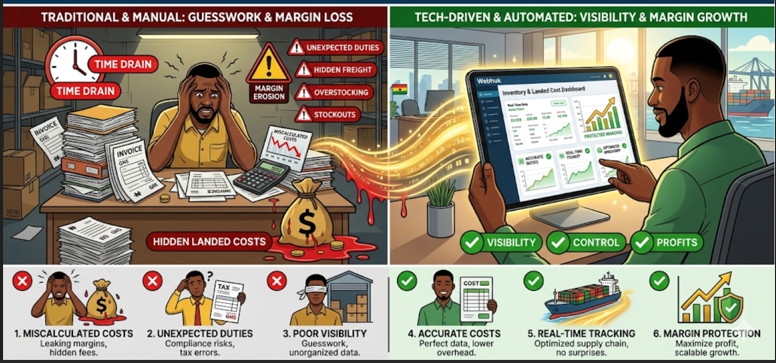
If you import goods for resale, you already know that the price you pay your supplier is not your true cost. Between the supplier’s invoice and the moment that product sits on your shelf ready for sale, a long chain of additional costs accumulates: freight charges, customs duties, port handling fees, inland transport, insurance, clearing agent fees, and sometimes storage charges if containers are delayed.
Together, these make up your landed cost — the true total cost of getting each item into your inventory. And for most importing businesses, this number is either calculated manually, calculated late, or not calculated accurately at all.
The consequence is simple: you do not know your real margins. And if you do not know your real margins, you cannot price correctly, you cannot identify which products are actually profitable, and you cannot make informed decisions about what to import next.
Where Businesses Go Wrong: The Landed Cost Black Hole
Most importers track their supplier invoices carefully. They know exactly what they paid for 1,000 units of a particular product. But the costs that follow — shipping, customs, port charges, local transport — are often handled separately, recorded in different places, and allocated to products using rough estimates or not allocated at all.
The result is a gap between what you think each item costs and what it actually costs. This gap might be five percent. For some businesses importing by sea container with variable duties and fluctuating freight rates, it can be fifteen percent or more.
The problem gets worse when you import multiple products in a single container. If one container holds three different product lines with different weights, volumes, and duty rates, allocating the shared costs — freight, handling, customs clearance — to each product correctly requires a systematic approach. Most businesses default to splitting costs evenly or by value, which misrepresents the true cost of each item.
A Scenario You Might Recognise
Fatima imports kitchenware and small appliances from Guangzhou into Tema port. Each container typically holds four or five product categories. She tracks the supplier cost per item in a spreadsheet. Freight, duty, and clearing costs arrive as lump sums from her logistics provider and clearing agent, often weeks after the goods are already in her warehouse and being sold.
By the time Fatima calculates the actual landed cost per item, she has already quoted prices to her wholesale buyers based on estimates. On her last shipment, the actual freight cost was 18 percent higher than she estimated because of a fuel surcharge she had not factored in. Her blenders, which she thought she was selling at a 25 percent margin, were actually moving at 12 percent. She only discovered this during her quarterly review — after three months of selling at the wrong price.
Meanwhile, her inventory spreadsheet showed 200 units of a ceramic plate set in stock. A physical count revealed only 140. The discrepancy came from returns and inter-branch transfers that were never recorded. She had been turning away wholesale enquiries for that product, believing she did not have enough stock to fulfil large orders.
What This Is Costing You
Margins You Think You Have But Do Not
When landed costs are estimated rather than calculated, your quoted prices are based on assumptions. If those assumptions underestimate true costs — which they usually do, because ad hoc costs are easy to forget — you are selling at lower margins than you believe. Over hundreds of transactions, this compounds into significant lost profit.
Capital Trapped in Invisible Inventory
Without real-time, branch-level inventory visibility, importers routinely over-order popular items while slow movers accumulate. Industry data suggests that excess inventory ties up 20 to 60 percent of working capital for small distributors and retailers. That is cash that could be funding the next profitable shipment.
Stockouts That Kill Momentum
The flip side of over-ordering is under-ordering. When your inventory data is unreliable, you cannot see which items are genuinely running low until a customer order fails. Each stockout is a lost sale and, for wholesale businesses, potentially a lost customer who finds a more reliable supplier.
Pricing Decisions Made in the Dark
Without accurate landed costs feeding into your price lists, every pricing decision is a gamble. You might underprice a high-cost item because you underestimated duties, or overprice a low-cost item and lose competitive deals. Either way, you are optimising for the wrong numbers.
A Better Way to Operate: Automated Landed Cost Allocation and Real-Time Inventory
The solution for importers is a system that connects procurement, inventory, and costing in one flow. When a container arrives, the system should capture all associated costs — supplier invoice, freight, duties, clearing, transport — and allocate them to each SKU based on rules you define (by weight, volume, value, or quantity). The resulting landed cost per unit then flows automatically into your inventory valuation, your price lists, and your quote generation.
This means every quote you send to a customer reflects the true cost of the goods. Your margins are real, not estimated. And when you review product profitability, the numbers actually tell you something useful.
On the inventory side, real-time tracking across all branches eliminates the gap between what your spreadsheet says and what your warehouse actually holds. Every inbound receipt, outbound sale, return, and inter-branch transfer updates the count automatically. Reorder alerts based on actual movement data replace the guesswork that leads to overstocking and stockouts.
How Webhuk Solves This for Importers
Webhuk was built with importers, distributors, and traders at the centre of its design. The platform includes container-based pricing logic that lets you define how shared costs are allocated across products within a shipment. As costs are captured — freight invoices, customs duty receipts, clearing charges — Webhuk allocates them to each SKU automatically, updating your inventory valuation and cost of goods sold in real time.
Your multi-branch inventory is tracked at the SKU level across all locations, including goods in transit. When a container clears port but has not yet reached your warehouse, Webhuk shows it as in-transit stock, giving you and your sales team visibility into incoming supply before it physically arrives.
Price lists and quotations pull directly from the latest landed cost data, so every quote you generate reflects your true margins. No more manual spreadsheet updates after each shipment. No more discovering margin erosion months after the fact.
For businesses trading across borders, Webhuk also handles multi-currency invoicing with automatic exchange rate management, ensuring that currency fluctuations are captured in your cost calculations rather than becoming an unpleasant surprise at month-end.
Importing goods without a clear view of your true costs? Start your free 7-day Webhuk trial and see your real margins for the first time.
Explore: Webhuk Multi-Branch Inventory with Container Tracking
Learn more: Multi-Currency Invoicing for Cross-Border Trade
Frequently Asked Questions
What is landed cost and why is it important for importers?
Landed cost is the total cost of a product once it reaches your warehouse, including the supplier price plus freight, customs duties, port handling, insurance, clearing fees, and inland transport. It is the only accurate basis for pricing and margin analysis. Without it, you are guessing at profitability.
How do most importers currently calculate landed costs?
Most importing SMEs use spreadsheets, often updating them weeks or months after goods arrive. Shared container costs are typically split using rough estimates. This approach is slow, error-prone, and often results in incorrect product-level costing.
Can Webhuk handle multiple products in a single container?
Yes. Webhuk’s container-based pricing allows you to allocate shared costs across multiple SKUs in a single shipment using configurable rules based on weight, volume, value, or quantity.
How does real-time inventory tracking help importers?
Real-time tracking eliminates the gap between spreadsheet data and actual stock. It prevents over-ordering, catches stockouts before they affect customers, and gives sales teams confidence in quoting available stock across multiple branches.
Does Webhuk track goods that are still in transit?
Yes. Webhuk shows in-transit inventory for containers that have shipped but not yet arrived at your warehouse, giving you and your team forward visibility into incoming supply.