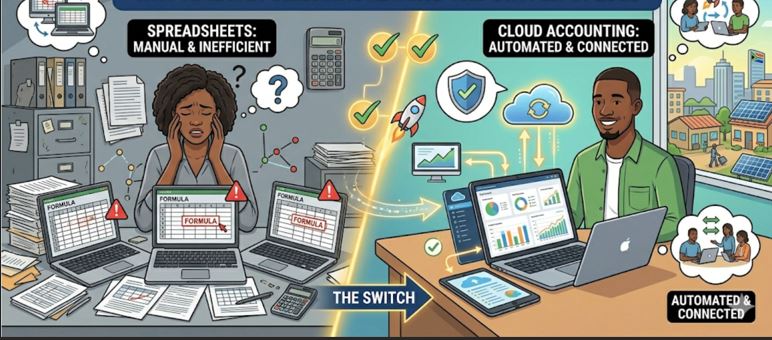
Across Africa, many small businesses are still powered by familiar tools: Excel sheets, handwritten cashbooks, WhatsApp confirmations, and invoice files scattered across laptops. It feels manageable in the beginning. The owner knows the numbers. The accountant knows which sheet matters. The sales person remembers which customer still owes money. But as the business grows, this informal setup starts breaking down. That is why more African SMEs are moving from spreadsheets to cloud accounting in 2026. Your content strategy frames this topic exactly around that shift for Ghana and South Africa, targeting business owners who are still in the “Excel stage” but starting to feel the pain.
This shift is not a niche trend. African SMEs remain the backbone of the continent’s economy. The African Development Bank says SMEs account for over 90% of African businesses and almost 80% of employment. When a segment this large begins changing the way it handles accounting, invoicing, and reporting, it is not just a software trend. It is an operational shift.
The real question is no longer whether spreadsheets are useful. They are. The real question is whether spreadsheets are still enough once a business begins handling stock, receivables, multiple staff, branch activity, multi-currency payments, VAT, payroll, or approval workflows. In most cases, the answer is no.
Why spreadsheets feel comfortable in the beginning
There is a reason so many SMEs start with spreadsheets. They are cheap, familiar, fast to open, and flexible. You can make a sales tracker in an hour, adjust a formula in five minutes, and send the file over WhatsApp or email before lunch.
For a very early-stage business, this feels efficient. There is no setup process, no subscription anxiety, and no onboarding curve. The sheet becomes the system.
But the problem is that spreadsheets do not grow with the business in a structured way. They usually grow in fragments. One file becomes five. One worksheet becomes ten tabs. One sales tracker becomes a sales tracker, a collections tracker, a purchase sheet, a stock file, a petty cash log, and a separate month-end report. At that point, the business still thinks it is “organized,” but in reality it is depending on memory, manual discipline, and luck.
Where spreadsheets start failing African SMEs
The biggest weakness of spreadsheets is not that they are simple. It is that they were never designed to be a full operating system for a growing business.
Oracle’s own guidance on spreadsheet risk warns that when spreadsheets are used beyond their intended scope, they create risks such as data entry errors, calculation errors, security vulnerabilities, scalability problems, and compliance shortcomings. That list maps almost perfectly to the problems African SMEs face when they try to run accounting, invoicing, and reporting through Excel alone.
Here is how that failure shows up in real life.
A number is typed incorrectly and nobody notices until month-end.
A formula is copied down one row too far and the receivables report becomes inaccurate.
An invoice is updated on one laptop but not on another copy of the file.
A staff member leaves and the business cannot easily see which records they last changed.
A branch manager keeps a separate stock file, so head office and warehouse figures stop matching.
A phone or laptop is stolen and the most recent version of the records disappears with it.
These are not dramatic enterprise problems. They are ordinary SME problems. That is exactly why they are dangerous. They happen quietly and repeatedly.
Cloud accounting changes the conversation
Cloud accounting does not just replace a spreadsheet with a prettier screen. It changes how the business works.
Instead of everyone maintaining their own version of the truth, the business works from one live system.
Instead of manually rebuilding reports at the end of the month, the data is already structured.
Instead of keeping invoices in one folder and payment notes in another, the records can sit in a connected flow.
Instead of asking, “Who has the latest file?” the team can work from the same source of truth.
That is the real advantage.
Cloud accounting brings three things spreadsheets struggle to provide consistently: visibility, control, and continuity.
Visibility means management can see what is happening now, not only after someone finishes updating a workbook.
Control means access can be managed by role, approval, or workflow rather than by forwarding files around.
Continuity means the business is less dependent on one device, one staff member, or one office location.
Why this matters so much in Africa
This matters everywhere, but it matters even more in African SME environments where businesses often face operational friction from multiple angles at once: lean finance teams, fragmented payment methods, mobile-led communication, location-based staff, unreliable local file practices, and pressure to keep costs low while still growing.
IFC says MSMEs are vital to growth, jobs, and poverty reduction in emerging markets. At the same time, African SMEs still face major finance constraints, and record quality remains part of that broader readiness problem. In South Africa, FinMark notes that small informal businesses often do not keep formal records of their income and expenses, which makes lenders view them as higher risk and makes access to finance harder. IFC’s South Africa MSME material also points to poor financial record keeping as a recurring constraint in the sector.
That does not mean cloud accounting automatically gets you a loan. It does mean cleaner records make the business easier to understand, easier to manage, and easier to defend when a lender, investor, auditor, or tax authority asks questions.
For a Ghanaian trader, this may mean clearer sales and receivables tracking.
For a South African retailer, it may mean tighter stock and cash visibility.
For a services business with multiple employees, it may mean fewer billing gaps and faster month-end.
The hidden cost of staying on spreadsheets
Most SME owners think spreadsheets save money because they avoid subscription fees.
What they often miss is the hidden cost of staying manual.
That hidden cost shows up in delayed invoicing, missed follow-ups, duplicate entries, bad stock decisions, payment confusion, and reporting that arrives too late to guide real action.
It also shows up in owner dependence. When the business depends on the founder to interpret scattered spreadsheets, the business is not really systemized. It is just being held together by personal oversight.
This is one of the biggest turning points in SME growth. At first, manual control feels responsible. Later, it becomes a bottleneck.
A spreadsheet can tell you what you typed into it. A good cloud accounting system can tell you what is happening in the business right now.
That difference becomes expensive once the business is handling more customers, more products, more invoices, and more staff than one person can comfortably supervise.
A simple before-and-after scenario
Imagine a small trading business selling goods in Accra or Johannesburg.
Before
The owner tracks sales in Excel.
Inventory is counted manually.
Invoices are made in Word or Excel.
Payments are followed up on WhatsApp.
Outstanding balances are checked at month-end.
If the accountant needs numbers, someone exports them manually.
If the owner travels, reporting slows down.
After moving to cloud accounting
Sales, customers, invoices, payments, and stock sit in one system.
Outstanding invoices are visible immediately.
The owner can check the dashboard remotely.
Finance does not have to rebuild reports from scratch.
Stock movement becomes easier to track.
Receivables are easier to follow up.
Management can act faster because the numbers are already organized.
That is why the move from Excel to cloud accounting is not just about convenience. It is about operational speed.
Why cloud systems are stronger for growth
The strongest argument for cloud accounting is not “modernization.” It is scalability.
Spreadsheets can be stretched. Cloud systems can be structured.
Once a business adds branches, sales staff, inventory locations, approval workflows, payroll inputs, or multiple currencies, spreadsheets start multiplying complexity instead of managing it.
Webhuk’s public site positions it exactly in this gap. It describes itself as ERP for SMEs with CRM, inventory, accounting, invoicing, payments, HR & payroll, procurement, and reporting in one platform, built for African businesses. Its pricing page publicly shows a 14-day free trial, Startup at $7 per user/month billed annually, and Business at $15 per user/month billed annually. That matters because SMEs moving away from spreadsheets usually want two things at once: more control and lower friction.
Webhuk also highlights features that matter specifically to African SMEs, including multi-currency accounting, inventory workflows, CRM, and cloud-based access. For businesses that operate across local currency and foreign-currency payments, or that want accounting connected to sales and stock instead of isolated from them, that is a practical advantage.
The audit trail advantage
One of the biggest weaknesses in spreadsheet-based operations is the lack of reliable audit trail.
Who changed the number?
When was the invoice updated?
Which file is the approved version?
Was the payment adjustment reflected in the receivables report?
These questions are simple, but spreadsheet environments answer them badly.
Cloud accounting systems are stronger because they are built around process rather than isolated files. That makes them more useful not only for finance, but also for compliance, approvals, and internal accountability.
This matters in both Ghana and South Africa. Businesses are under more pressure to maintain clean records, issue accurate invoices, and respond confidently to tax and reporting needs. Even where the immediate trigger is not a formal audit, the daily discipline of structured records still makes the business stronger.
Why 2026 is the right time to switch
The timing matters.
In 2026, many African SMEs are at the exact stage where spreadsheet-based management becomes risky. They are no longer one-person operations, but they are not yet large enough to tolerate inefficiency. They need better systems before the pain becomes expensive.
They are also working in markets where customer expectations are rising, competition is sharper, and digital workflows are becoming normal. If your business still relies on manual invoice creation, disconnected payment follow-up, and stock files that only one person understands, you are not only slowing yourself down. You are making it easier for a better-organized competitor to move faster.
This is why the cloud-accounting conversation has become more urgent. It is no longer only for “big companies.” It is increasingly the normal next step for serious SMEs.
So, should every business abandon spreadsheets completely?
Not necessarily.
Spreadsheets still have a place in analysis, planning, forecasting, and one-off reporting. They are useful tools.
The problem comes when spreadsheets stop being support tools and become the main operating system of the business.
That is the threshold SME owners need to recognize.
Use spreadsheets for flexible analysis.
Do not use them as the foundation of accounting, invoicing, stock control, and business visibility once your operations become more complex.
That is usually where cloud accounting starts paying for itself very quickly.
Final verdict
For African SMEs in 2026, spreadsheets are still useful, but they are no longer enough for a growing business.
They are too fragile for live operations, too manual for fast reporting, too dependent on individual discipline, and too weak for businesses that need visibility across sales, invoices, payments, stock, and management reporting.
Cloud accounting gives SMEs something spreadsheets rarely give consistently: one connected view of the business.
That is why more businesses in Ghana and South Africa are making the switch now. And that is why platforms like Webhuk are gaining attention. Webhuk is positioning itself around exactly the pain SMEs feel when Excel is no longer enough: scattered workflows, poor visibility, manual follow-up, and disconnected operations. With cloud accounting, inventory, CRM, invoicing, and reporting in one platform, plus transparent pricing and a free trial, it offers a practical path for SMEs ready to move beyond manual systems.
For many businesses, the real decision is not whether spreadsheets are bad.
It is whether the business has outgrown them.
In 2026, a growing number of African SMEs already have.
FAQs
1. Is Excel enough for small business accounting?
Excel can work in the very early stages, but once a business starts handling regular invoicing, multiple users, stock, receivables, or growth across locations, spreadsheets usually become too manual and error-prone.
2. What is the main advantage of cloud accounting over spreadsheets?
The biggest advantage is having one live source of truth. Cloud accounting improves visibility, structure, collaboration, and continuity across the business.
3. Why are African SMEs switching to cloud accounting in 2026?
Because many are reaching the stage where spreadsheets create more problems than they solve. Better visibility, remote access, cleaner records, and stronger control are becoming essential. African SMEs also account for over 90% of businesses on the continent, so this shift matters at scale.
4. Can better accounting records help with access to finance?
Better records do not guarantee funding, but weak or informal records can make lenders more cautious. FinMark and IFC materials both point to record quality as part of the broader SME finance challenge.
5. Is cloud accounting expensive for SMEs?
Not always. Many SME-focused systems now use transparent subscription pricing. Webhuk, for example, publicly offers a 14-day free trial and paid plans starting at $7 per user/month billed annually.
6. What should I look for when moving from spreadsheets to accounting software?
Look for ease of use, invoicing, reporting, inventory visibility, receivables tracking, role-based access, multi-currency support where needed, and pricing clarity.
See also: Excel vs. Cloud ERP: 5 Signs Your Business Has Outgrown Spreadsheets