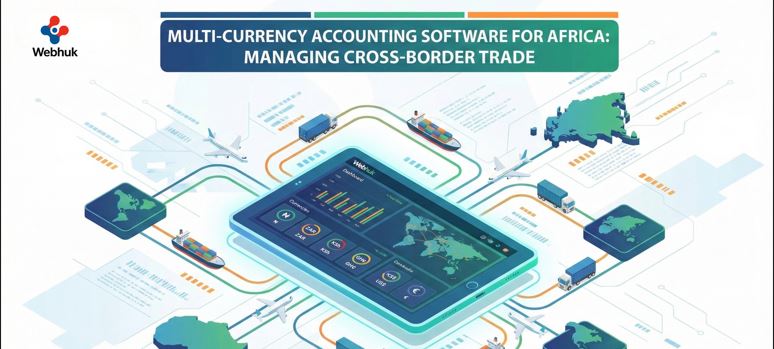
Africa is open for business.
Whether you are a Ghanaian importer buying electronics from China, a Nigerian tech firm paying for servers in USD, or a South African retailer exporting wine to Europe, your business does not live in a single currency bubble.
But doing business across borders brings a massive headache: Exchange Rate Volatility.
The Cedi, Naira, and Rand fluctuate daily against the Dollar. If you are tracking these transactions on a spreadsheet, you are guessing. You might sell a product for a "profit" today, only to realize next month that the exchange rate shift wiped out your entire margin when you went to restock.
This is why Multi-currency accounting software in Africa is not a luxury—it is a survival tool.
In this final guide, we will explore how modern software automates the complex math of international trade, helping you trade globally while reporting locally.
The "Spreadsheet Risk" in International Trade
Imagine you send an invoice for $1,000 when the rate is 15.0. By the time the customer pays 30 days later, the rate is 14.5.
- You received the same $1,000.
- But in your local currency, you just lost money.
On a spreadsheet, this "Forex Loss" is invisible unless you are an Excel wizard. In the real world, it eats your cash flow. Without a system that tracks Realized vs. Unrealized Gains/Losses, you are flying blind. You might think your business is healthy because your sales volume is high, even as your actual value is shrinking due to currency depreciation.
How Multi-Currency Software Solves the Chaos
Modern cloud software is built for the global economy. Here is how it handles the heavy lifting for you.
1. Automated Exchange Rate Feeds
Stop Googling "USD to GHS rate today." Good multi-currency software connects to live forex feeds (like OANDA or XE). Every time you raise an invoice or record a bill, it grabs the exact live rate for that minute. This ensures your books are always accurate to the penny.
2. Invoicing in Your Customer’s Currency
If you want to look professional, you can't ask a US client to pay you in Cedis. You need to invoice them in Dollars. The software allows you to issue the invoice in USD, but it records the transaction in your "Home Currency" (e.g., GHS) for your financial reports. It maintains two ledgers simultaneously: one for the client, one for your accountant.
3. Handling "Landed Costs" for Importers
For importers, the cost of a product isn't just the supplier price. It's the price + shipping + insurance + duties. If you pay the supplier in USD, the shipper in EUR, and the customs agent in Local Currency, calculating the true cost of that item is a nightmare. Integrated software tracks all these different currencies and rolls them into a single "Cost of Goods Sold" figure. This is essential for inventory management best practices, ensuring you set a selling price that covers all your costs.
Realized vs. Unrealized: The Critical Difference
This is where software saves your accounting team hours of work.
- Unrealized Gain/Loss: You sent an invoice for $100. The rate changed. You haven't been paid yet, but on paper, the value of that debt has changed. The software re-values your "Accounts Receivable" automatically at the end of the month so your Balance Sheet is honest.
- Realized Gain/Loss: The payment arrives. The rate is different from the invoice date. The software automatically calculates the difference and posts it to a specific "Forex Gain/Loss" expense account.
This visibility helps you understand cash flow vs profit in a volatile market. You see exactly how much money you are making from operations vs. how much you are losing to currency shifts.
Payment Gateways & Global Wallets
African businesses are increasingly using tools like Payoneer, PayPal, or Wise to hold foreign currency. Your accounting software must treat these like bank accounts.
- You can have a "USD Bank Account" and a "ZAR Bank Account" inside the system.
- When you transfer money between them, the software handles the transfer fee and the exchange rate automatically.
Conclusion: Trade Without Borders
The African Continental Free Trade Area (AfCFTA) is creating massive opportunities. But to seize them, your back-office needs to be as global as your ambition.
Don't let the fear of complex math stop you from expanding. Multi-currency accounting software for Africa handles the complexity for you. It lets you buy in Tokyo, sell in Cape Town, and report in Accra—seamlessly.
Ready to take your business global? Discover how Webhuk’s multi-currency engine empowers African businesses to invoice, track, and grow in any currency, anywhere.
Frequently Asked Questions (FAQs)
1. How often are exchange rates updated in the software?
Most leading platforms update their rates once every 24 hours using a mid-market rate from a reliable provider (like XE.com). However, you usually have the option to manually override the rate if you received a specific spot rate from your bank.
2. Can I hold foreign currency in my software without a foreign bank account?
Yes. You can create a "dummy" foreign currency bank account in the software to track cash you might hold in a safe or in a digital wallet like PayPal, even if you don't have a traditional USD bank account.
3. How does multi-currency affect my tax returns?
Your local tax authority (like GRA or SARS) requires you to report in your local currency. The software handles this by converting every foreign transaction into your local currency at the date of the transaction, ensuring your tax reports are perfectly compliant.
4. What happens if I make a payment in a third currency?
(e.g., Your base is GHS, you have a USD invoice, but you pay in EUR). This is complex "triangulation." Professional software handles this by converting the payment to the base currency first to settle the ledger, ensuring accurate reporting.
5. Is this feature expensive?
Historically, yes. But modern cloud ERPs often include multi-currency features in their "Standard" or "Premium" tiers, making it accessible even for small startups involved in international trade.