If you sell anything in Ghana, the GRA's E-VAT system is no longer a future problem. It is a now problem. The Ghana Revenue Authority has been progressively onboarding businesses into the certified invoicing system, and the days of issuing handwritten or generic computerised receipts and hoping for the best are over.
The penalties for non-compliance are real. The audits are real. And the businesses that get this wrong are paying more than the cost of the right software many times over in fines, back taxes and lost recoverable VAT.
This guide is the plain-English version of what E-VAT actually requires, what your software must do to keep you on the right side of the GRA, and how to choose between the platforms claiming compliance in 2026.
What "GRA E-VAT compliant" actually means
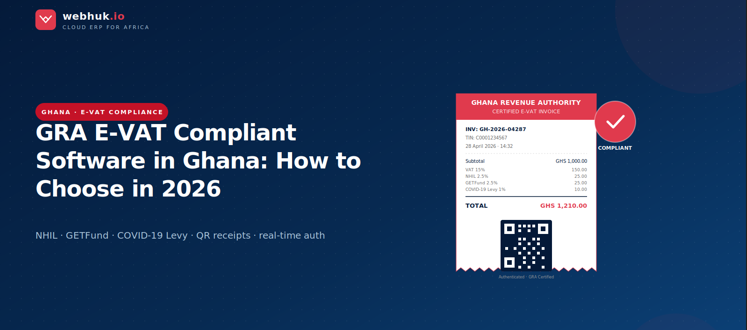
The GRA's Electronic VAT system is a real-time invoicing regime. Every taxable sale must be issued on a receipt that includes a unique invoice reference, a QR code, the seller's TIN, the buyer's TIN where applicable, the breakdown of VAT and levies, and a digital signature confirming the receipt has been authenticated against GRA's central system.
In practice, this means your invoicing software has to do four things automatically:
1. Calculate the standard VAT plus the three levies — National Health Insurance Levy (NHIL), Ghana Education Trust Fund Levy (GETFund), and the COVID-19 Health Recovery Levy. 2. Generate a unique reference and QR code per invoice. 3. Transmit invoice data to GRA in real time or near real time. 4. Store every issued receipt for the statutory retention period in a format the GRA can audit.
Software that calculates "15% VAT" and prints a normal receipt is not compliant. It has not been compliant for some time. If your current system does this, you are exposed.
The four levies, broken down
Ghana's VAT system is famously layered. A standard taxable sale of GHS 100 typically carries:
- Standard VAT at 15% applied on the value plus the levies
- NHIL at 2.5%
- GETFund Levy at 2.5%
- COVID-19 Health Recovery Levy at 1%
The order of calculation matters because the levies are stacked, not added flat. Compliant software handles this in the background. Spreadsheets and basic accounting tools usually do not, which is how businesses end up under-collecting and owing the GRA money they did not realise they owed.
For a clear, plain-language reference on how the levies stack and what they fund, the Ghana Revenue Authority's own guidance is the source of truth. Any software vendor that cannot show you how their system handles the layered calculation is not selling you compliant software, regardless of what their website says.
What to look for in compliant software in 2026
One: Direct integration with the GRA E-VAT certified invoicing platform. Not a workaround. Not a CSV export you have to upload manually. The software should authenticate every invoice with GRA in real time, the same way a card payment is authenticated with the bank.
Two: Automatic levy stacking. The four levies must be configured correctly out of the box. You should be able to mark an item as zero-rated, exempt or standard-rated and have the system apply the correct treatment without manual intervention.
Three: QR code receipt printing. Whether you are issuing on a thermal printer, an A4 printer or via WhatsApp, the issued receipt must carry the GRA QR code. Customers — particularly business customers claiming input VAT — increasingly check.
Four: Audit trail. Every invoice issued, edited or cancelled must leave a permanent log. The GRA can ask for this history on demand. Software that allows silent edits to past invoices is a compliance accident waiting to happen.
Five: Multi-channel issuance. A modern Ghana business issues invoices from a POS at the counter, from a back-office system on a laptop, and increasingly from a mobile phone in the field. All three channels must produce compliant E-VAT invoices, and all three must update the same audit trail.
Webhuk's compliance team can walk you through how its E-VAT module handles all five requirements, including the levy stacking logic and the GRA authentication flow, before you commit.
The platforms claiming compliance — and what to verify
Several platforms in Ghana describe themselves as GRA E-VAT compliant in 2026. The list includes Webhuk.io, Ebizframe, Tally with the Ghana add-on, certain configurations of ERPNext, and a number of locally developed POS systems including SellarPro, Seesail, mPos Ghana and BritsoftSales.
The mistake businesses make is assuming "compliant" means the same thing across all of them. It does not. Some are fully integrated with GRA's authentication system. Some generate compliant-looking receipts but require a separate manual upload to GRA. Some handle the levy stacking correctly but miss the audit trail requirement. Before you sign anything, ask the vendor four direct questions:
1. Show me a live invoice being authenticated with GRA in real time. Not a screenshot. A live demo on a real test environment. 2. Show me how a cancelled invoice is logged. Can it be silently deleted, or does it leave a permanent record? 3. Show me the levy calculation on a GHS 1,000 sale to a VAT-registered customer. Walk through the maths. 4. What happens if the GRA system is down when I issue an invoice? Does my POS lock up, or does it queue and authenticate later?
Any vendor unable to answer all four cleanly is not the partner you want.
Industries with extra exposure
Some sectors face heightened scrutiny under E-VAT in 2026:
Retail and supermarkets. High transaction volume, high public-facing risk. A single non-compliant receipt is a customer complaint waiting to happen.
Pharmacies. Mixed standard-rated, zero-rated and exempt items. Levy treatment varies by product. Manual configuration is a recipe for errors.
Restaurants and hospitality. Service charges, tips and packaged versus dine-in items have different VAT treatments. Get this wrong and your monthly returns will not reconcile.
B2B traders and distributors. Customers claim input VAT on your invoices. If your invoice is not GRA-authenticated, your customer cannot claim the input VAT, and they will eventually move to a supplier whose invoices are. Compliance becomes a sales problem, not just a tax problem.
For deeper sector-specific guidance, the Webhuk blog covers compliance considerations for retail, pharmacy, hospitality and B2B distribution in standalone articles worth reading before you choose a system.
What it costs to get this wrong
The visible cost is the GRA penalty for non-compliance, which can run from a few thousand cedis to tens of thousands depending on the volume and duration of the non-compliance.
The invisible costs are larger. Customers claiming input VAT will reject your invoices, costing you sales. Your accountant will spend hours every month reconciling discrepancies between what you charged and what GRA records. And if you ever need a bank loan or want to bid on government tenders, your tax compliance certificate becomes the first thing they ask for.
Getting compliant software is, by some distance, the cheaper option.
The shortcut for the typical Ghanaian SME
If you sell goods or services to the public, your shortlist in 2026 is short:
- A cloud ERP with native GRA integration — Webhuk.io is the cleanest fit for SMEs needing the full operational stack alongside compliance.
- Ebizframe for established manufacturers with deep industry-specific needs.
- A locally focused POS like SellarPro or Seesail if your needs are purely retail point-of-sale and you do not need full ERP.
Avoid plain QuickBooks, plain Xero, and any "global" accounting software without explicit, demonstrated GRA E-VAT integration. They are excellent products in their home markets. They were not built for Ghana's tax regime.
Final word
E-VAT is not a passing inconvenience. It is the new normal, and the GRA's enforcement capacity is growing. The businesses that move now — pick a compliant system, migrate cleanly, train their staff — are the ones who will spend 2026 focused on growing their revenue rather than firefighting compliance.
The right software is not the one with the loudest marketing. It is the one that, when you ask the four hard questions above, answers all four with a working demo.
Frequently Asked Questions
Q1. What is GRA E-VAT compliance and who needs it?
GRA E-VAT compliance means your invoicing software is connected to the Ghana Revenue Authority's electronic VAT system and issues authenticated invoices with QR codes, unique references and correct levy calculations. Every VAT-registered business in Ghana selling taxable goods or services needs E-VAT compliant software. The GRA is progressively rolling out enforcement and the penalties for non-compliance are escalating.
Q2. Which levies must GRA E-VAT software calculate automatically?
Compliant software in Ghana must automatically calculate four charges on every standard-rated taxable sale: standard VAT at 15%, the National Health Insurance Levy (NHIL) at 2.5%, the Ghana Education Trust Fund Levy (GETFund) at 2.5%, and the COVID-19 Health Recovery Levy at 1%. The levies stack rather than add flat, so the order of calculation matters.
Q3. Can I use QuickBooks or Xero for GRA E-VAT in Ghana?
Not without significant customisation. QuickBooks and Xero are excellent global accounting platforms but they were not built for Ghana's GRA E-VAT system. They do not natively integrate with GRA's authentication platform, and getting them to handle the stacked levies correctly typically requires a local partner and ongoing maintenance. Ghana-built or Ghana-localised systems like Webhuk.io are the safer choice.
Q4. What happens if I issue an invoice when the GRA system is down?
Compliant software handles offline operation gracefully. The invoice is issued to the customer with a temporary reference, then automatically authenticated with GRA when connectivity returns. The receipt should clearly mark its authentication status. Any system that locks up or refuses to issue an invoice when GRA is offline is not built for Ghanaian conditions and will cost you sales every time the connection drops.
Q5. What are the penalties for not using GRA E-VAT compliant software?
Penalties for non-compliance with GRA E-VAT requirements range from monetary fines to denial of input VAT claims by your customers, which can damage business relationships. Repeat or wilful non-compliance can escalate to suspension of the business's tax compliance certificate, which blocks tender participation and can affect banking relationships. The cost of compliant software is a fraction of the cost of getting it wrong.