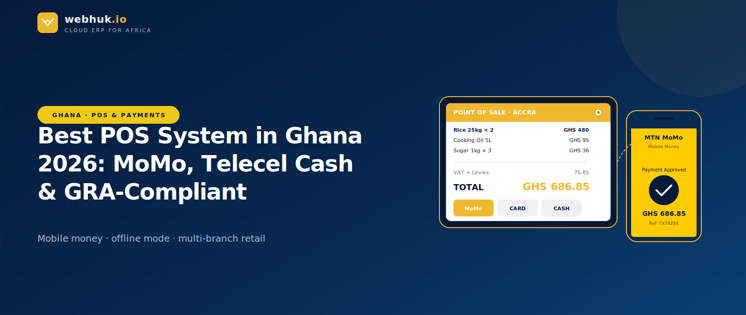
If you have ever stood at a counter in Madina or Adum at peak hour, watched a customer try to pay by MoMo, watched the cashier punch the amount manually into a separate phone, watched the customer walk out before the receipt printed — you have seen exactly why POS choice matters in Ghana in 2026.
The right POS in this market does three things at the same time, smoothly: it processes the sale, it accepts mobile money without manual reconciliation, and it issues a GRA E-VAT compliant receipt. Most don't. The ones that do are not always the ones with the biggest marketing budgets.
This is a no-nonsense comparison of what is actually working for Ghanaian retailers in 2026, what each platform costs, and where each one falls short.
What "good" looks like for a Ghana POS in 2026
Forget feature checklists for a moment. A POS earns its place in your shop by passing five tests:
Test 1: It rings up a sale in under fifteen seconds, including a MoMo payment. Not a card payment. MoMo. The customer types in your merchant short code, your POS sees the payment hit, the sale closes, the receipt prints. Fifteen seconds. If your current system takes longer, your queue is longer than it needs to be, and you are losing customers to faster competitors.
Test 2: It works when the internet drops. Power cuts and ECG outages still happen. Telecom networks still have weak patches. A POS that locks up the moment connectivity drops is a POS that cannot be your only sales channel. Offline mode that automatically syncs when the connection returns is not optional in Ghana.
Test 3: It issues a GRA E-VAT compliant receipt. With QR code. With NHIL, GETFund and COVID-19 Levy correctly stacked. Without you having to do a separate manual upload at the end of the day.
Test 4: It tracks your stock in real time across every shop. If you have one shop, this is a "nice to have". If you have two or more, it is the entire reason you are buying a POS in the first place.
Test 5: Your staff can use it without a week of training. A good POS is intuitive enough that a new shop assistant can ring up sales by the end of day one and handle returns and discounts by day three. Anything more complex is a sign of bad design, not a sign of advanced capability.
A POS that fails any of these five tests does not belong on your 2026 shortlist, however prominent its branding.
The platforms most Ghanaian retailers are using in 2026
1. Webhuk.io POS
Cloud POS module sitting inside the broader Webhuk ERP, which means your sales, stock, accounting and customer data live in one place by default. Native MTN MoMo, Telecel Cash and AT Money integration. GRA E-VAT compliant out of the box. Offline mode with automatic sync. Multi-branch from day one — a fundamentally different experience from POS systems that bolt multi-branch on later. Book a Webhuk POS demo at your shop and have them ring up a live MoMo sale on your real products.
Best for: Retailers, restaurants, pharmacies and multi-branch businesses who want the POS and the back office in one system.
2. SellarPro
Ghana-built POS with strong adoption among small and mid-sized retailers. Pricing starts around GHS 99 per month. Solid offline mode, MoMo integration, multi-branch on the higher tiers. Less full-featured on the back-office accounting side than a true ERP, so businesses outgrowing it tend to bolt on a separate accounting system.
Best for: Single-shop and small multi-shop retailers, pharmacies and convenience stores who want a focused POS without ERP complexity.
3. Seesail
All-in-one business management with a strong POS focus. MoMo, card and cash in one screen, AI-flavoured analytics on inventory and sales. Marketed heavily on the small business loan-readiness angle — clean POS records support loan applications. Pricing competitive with SellarPro.
Best for: Smaller retailers and restaurants prioritising clean financial records to qualify for SME loans.
4. mPos Ghana
Free tier available, premium tiers monthly or annually. Mobile money, Paystack, bank transfer integrations. Cloud-based, multi-branch capable on premium plans.
Best for: Startups and micro-businesses testing the waters before committing to paid software.
5. BritsoftSales
Standard subscription at GHS 1,197 per year, advanced at GHS 1,997 per year. Activated via mobile money. Solid foundational POS with stock, sales and reporting. Less sophisticated on real-time multi-branch and integration depth.
Best for: Single-location retailers with straightforward needs and a strong preference for annual pricing.
6. ClarusPOS
Built explicitly for Ghana retail with E-VAT compliance, MoMo integration and offline mode. Less brand visibility than the platforms above but solid in its niche.
Best for: Mid-sized retailers wanting a Ghana-purpose-built POS.
7. Tally Prime with POS add-on
Tally is everywhere among traders. The POS add-on works but feels grafted on. Strong for businesses where the accountant runs the show and the POS is secondary. Weak on modern UX and on real-time mobile money.
Best for: Traditional traders and distributors already running Tally for accounting.
8. Square / Lightspeed / international SaaS POS
Skip these in Ghana. They have no GRA E-VAT integration, no MoMo support, and pricing in dollars. Excellent in their home markets, wrong tool for this market.
The MoMo question
Mobile money is not a payment method in Ghana. It is the dominant payment method, ahead of cash for many demographics and well ahead of cards. Your POS must handle MoMo as a first-class citizen, not as a manual entry workaround.
What "first-class" means in practice:
- Customer initiates payment to your merchant short code.
- POS sees the payment hit your MoMo merchant account in real time.
- POS automatically marks the sale as paid and prints the receipt.
- End-of-day reconciliation matches every MoMo transaction to a sale automatically.
If any of those four steps requires manual intervention, you are losing time at the counter and losing accuracy in your books. MTN MoMo, Telecel Cash (formerly Vodafone Cash) and AT Money (the merged AirtelTigo Money) all support merchant integration. Your POS vendor either supports them or does not. Ask before you buy.
Hardware: keep it simple
A modern POS in Ghana does not need a special till. A reliable Android tablet, a Bluetooth thermal receipt printer, a barcode scanner and a cash drawer cover ninety percent of retail use cases. For higher-volume environments — supermarkets, busy pharmacies, fast-casual restaurants — a dedicated POS terminal is worth the investment for durability.
The total hardware cost for a single station, sourced sensibly in Accra, lands between GHS 4,000 and GHS 12,000 depending on quality and durability. For comparison, a year of POS software typically costs between GHS 1,200 and GHS 6,000 per location depending on platform and tier.
Industry-specific notes
Restaurants and quick-service food. You need split bills, table management, kitchen display screens and ingredient-level inventory. Generic retail POS struggles with all four.
Pharmacies. You need expiry date tracking, batch management, prescription records and tight stock control. The wrong POS is a regulatory and financial risk.
Wholesale and cash-and-carry. You need price lists by customer tier, credit limits, salesperson tracking and rapid bulk billing. A consumer-style POS is the wrong tool.
Multi-branch retail across Accra, Kumasi and beyond. You need real-time consolidated reporting, stock transfer between branches and centralised pricing control. Single-location POS systems break under this load.
For sector-by-sector breakdowns, the Webhuk blog has standalone deep-dive articles on POS choice for restaurants, pharmacies, wholesale and multi-branch retail.
The honest recommendation
For most Ghanaian retailers in 2026, the rational shortlist is short:
If you want POS plus full back-office in one system: Webhuk.io. If you want a focused, Ghana-built POS only: SellarPro or Seesail. If you are starting out and budget is tight: mPos Ghana free tier, then upgrade. If you are a traditional trader running Tally already: Tally with POS add-on, fully aware of its limitations.
Whatever you choose, run a thirty-day pilot in one shop before rolling out across multiple locations. Watch what happens at peak hour. Watch what happens when the internet drops. Watch what happens when a customer asks for a refund. The right POS reveals itself under pressure. The wrong one reveals itself in different ways — usually at peak hour, on a Saturday, when you cannot afford the friction.
Frequently Asked Questions
Q1. What is the best POS system for small businesses in Ghana in 2026?
For most Ghanaian small businesses, the best POS in 2026 is one with native MTN MoMo, Telecel Cash and AT Money integration, GRA E-VAT compliance, offline mode and real-time multi-branch capability. Webhuk.io covers all four and adds full back-office ERP. SellarPro and Seesail are strong Ghana-built POS-focused alternatives. The right pick depends on whether you also need accounting and inventory in the same system.
Q2. How much does a POS system cost in Ghana?
POS software in Ghana ranges from free entry tiers (mPos Ghana) to roughly GHS 99–500 per month for SME plans (SellarPro, Seesail, Webhuk POS), to GHS 1,200–6,000 per year for annual plans like BritsoftSales. Hardware for a single station typically costs GHS 4,000–12,000. Multi-branch operations should expect to pay per location.
Q3. Does my POS need to integrate with MTN MoMo and Telecel Cash?
Yes, in 2026 mobile money is the dominant payment method for many Ghanaian retail customers. A POS that cannot accept MTN MoMo, Telecel Cash and AT Money payments natively forces your cashiers into manual reconciliation, slows down checkout, and creates errors at end of day. Native mobile money integration should be a non-negotiable on any 2026 Ghana POS shortlist.
Q4. Can a POS system in Ghana work without internet?
The good ones can. Internet connectivity in Ghana is improving but still drops without warning, and you cannot tell a queue of customers that the system is down. Look for a POS with offline mode that allows continued sales during outages and automatically syncs all transactions to the cloud when connectivity returns. Cloud-only POS systems without offline support are risky in Ghanaian conditions.
Q5. Is a POS system GRA E-VAT compliant by default?
No, not all of them. Locally focused platforms like Webhuk.io, SellarPro, Seesail and ClarusPOS have built-in GRA E-VAT compliance, generating receipts with QR codes, the four stacked levies, and proper authentication. Imported global POS systems like Square or Lightspeed have no native GRA integration. Always confirm E-VAT compliance with a live demo before purchasing.