There is a stubborn myth among business owners in Ghana and South Africa.
It goes like this: "If I can see the server blinking in my office, my data is safe. If my data is in the 'Cloud', it’s floating in the sky where hackers can grab it."
This mindset is understandable, but it is dangerous.
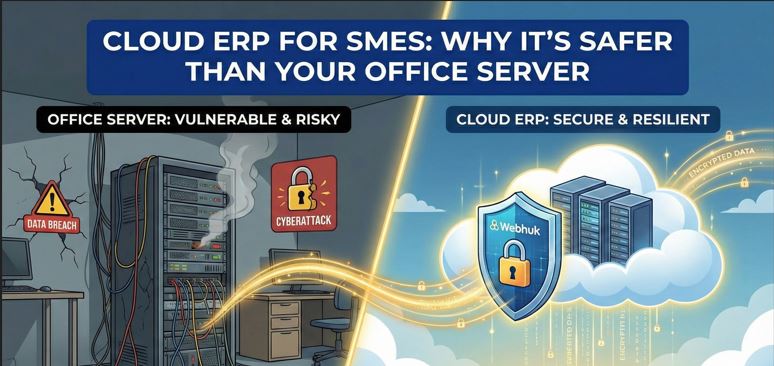
In reality, the small server tower sitting under your accountant's desk is the most vulnerable point in your entire business. It is vulnerable to power surges (Dumsor/Load Shedding). It is vulnerable to physical theft. It is vulnerable to a coffee spill.
The shift to Cloud ERP for SMEs isn't just about "new technology." It is a security upgrade.
In this guide, we will debunk the fears surrounding cloud software and explain why moving your business online is the safest decision you can make in today's high-risk environment.
The Reality of Physical Server Risks
Let’s look at the actual risks facing an on-premise server in Accra or Johannesburg.
1. Physical Theft
Crime is a reality. If burglars break into your office, high-value electronics like servers are the first things they take. If your ERP is on that hard drive, your entire business history—every invoice, every customer record—is gone instantly. With Cloud ERP, the hardware in your office is just a screen. If your laptop is stolen, you buy a new one, log in, and keep working. Your data never left the secure data center.
2. The Power Surge Problem
Electricity infrastructure in Africa can be unstable. Frequent outages and voltage spikes destroy hard drives. Even with a UPS, batteries fail. Cloud servers live in Tier-3 data centers with massive diesel generators and redundant cooling systems. They don't go down when your neighborhood grid fails.
3. The "Ransomware" Trap
Small business servers are rarely updated with the latest security patches because IT support is expensive. This makes them easy targets for Ransomware attacks. Cloud ERP providers update their security daily. They have teams of engineers whose only job is to fight hackers. They build "digital fortresses" that a small business could never afford to build on its own.
What Does "Cloud ERP" Actually Mean?
"Cloud" is just a buzzword for "Remote Server."
When you use Cloud ERP for SMEs, you are renting a tiny slice of a super-computer owned by a giant like Amazon (AWS) or Google.
- Bank-Grade Encryption: Your data is scrambled (encrypted) before it leaves your computer. Even if someone intercepts it, they can't read it.
- Redundancy: Your data isn't saved in one place. It is mirrored across multiple locations. If the server in Cape Town fails, the backup in London takes over instantly. You won't even notice.
The Business Case: CapEx vs. OpEx
Beyond security, the financial model of Cloud ERP is superior for growing SMEs.
The Old Way (On-Premise):
- Buy Server Hardware: $3,000
- Buy Software License: $5,000
- Pay IT Consultant for Setup: $2,000
- Total Upfront Risk: $10,000+
The New Way (Cloud ERP):
- Monthly Subscription: $50 - $100
- Total Upfront Risk: $0
This moves your cost from CapEx (Capital Expenditure) to OpEx (Operational Expenditure). It frees up your cash flow to invest in stock or marketing, rather than depreciating hardware.
Access: The "Work From Anywhere" Revolution
The modern African SME is mobile.
- The owner is sourcing goods in China.
- The sales manager is visiting clients in Kumasi.
- The accountant is working from home in Pretoria.
A physical server chains you to the office. To access it remotely, you need complex VPNs that are slow and often break. Cloud ERP for SMEs is designed for the mobile web. It works on your smartphone or tablet via 4G. It allows you to approve a Purchase Order from a taxi or check stock levels from a client’s warehouse floor.
Conclusion: Security is a Service
You are in the business of selling products or services, not managing IT security.
Trying to protect your own server is like trying to keep your cash under your mattress because you don't trust the bank. The bank has a vault; you have a locked door.
Moving to Cloud ERP for SMEs lets you outsource that stress. You get world-class security, automatic backups, and 99.9% uptime, all for a simple monthly fee.
Don't wait for a crash or a break-in to realize your data was vulnerable. Secure your business today with Webhuk, the cloud platform built to protect and power African SMEs.
Frequently Asked Questions (FAQs)
1. Who owns my data if it's in the cloud?
You do. The software provider is just the "custodian." In your Service Level Agreement (SLA), it should clearly state that the data belongs to you, and you can export it (usually to Excel/CSV) whenever you want to leave the service.
2. What if my internet connection is slow?
Modern Cloud ERPs are "lightweight." They don't transfer huge files; they transfer text data, which requires very little bandwidth. They work perfectly fine on standard mobile 4G or decent ADSL connections found across Ghana and South Africa.
3. Can I customize a Cloud ERP?
Yes, but differently. Traditional software allowed you to change the core code (which made updates impossible). Cloud ERP allows "Configuration"—you can change workflows, add custom fields, and build reports without breaking the upgrade path.
4. Is Cloud ERP compliant with data laws (POPIA/GDPR)?
Yes. Reputable cloud providers are fully compliant with global data privacy laws. They provide the encryption and access controls required by South Africa's POPIA and Ghana's Data Protection Act.
5. How often is the data backed up?
Usually, it is backed up in real-time (continuous replication). Most providers also perform daily "snapshot" backups that are retained for 30 days, so if you accidentally delete a file, you can restore it from yesterday's version.