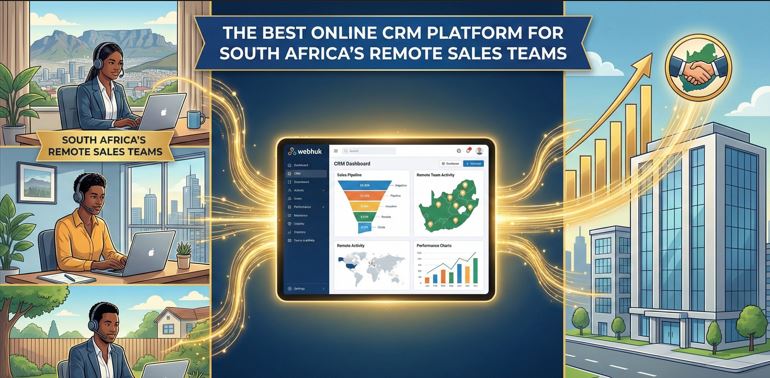
The South African workplace has changed forever.
A few years ago, "Sales Management" meant walking around the office in Sandton to see who was on the phone. You could see the energy in the room. You could hear the deals being closed.
Today, your top sales rep might be working from a home office in Cape Town (thanks to the "Semigration" trend). Your account manager might be in a coffee shop in Durban. Your lead generator might be a freelancer in Pretoria.
The office is empty, but the targets are still high.
This creates a massive anxiety for business owners: “If I can’t see them, are they working?”
You cannot manage a remote team with WhatsApp messages and Friday zoom calls. You need a digital nervous system. You need a robust Online CRM platform.
In this guide, we will explore how shifting to a web-based CRM solves the visibility gap, keeps your remote team honest, and helps you build a sales culture that thrives without an office.
The Problem with "Offline" Sales
When sales reps work remotely without a central system, they become "Lone Wolves."
They keep their own spreadsheets. They save client numbers on their personal phones. They promise discounts that you never approved.
- Information Silos: If a rep gets sick, no one knows the status of their deals.
- Lost Leads: Inquiries from your website get buried in email inboxes and ignored.
- Zero Accountability: You have no idea if a rep made 5 calls today or 50.
An online CRM platform breaks these silos. It forces transparency. Every call, every email, and every note is logged in the cloud, visible to the Manager in real-time.
3 Reasons SA Sales Teams Need Cloud CRM
1. The "Semigration" Reality
South Africa is seeing a massive shift of talent moving to coastal cities while keeping their Gauteng-based jobs. To make this work, you need a "Virtual Sales Floor." An online CRM provides a live dashboard. You can open it at 9:00 AM and see exactly what is in the pipeline for the day. You can see who is closing deals and who is struggling, regardless of whether they are in Clifton or Centurion.
2. Surviving Load Shedding
Remote work is great until the power goes out. If your sales data is on a server in the office, and the office has Stage 4 Load Shedding, your remote team is blind. An online CRM platform lives in global data centers. Even if your HQ is dark, your rep in Cape Town (who has solar) can still access client data and close deals. It ensures business continuity.
3. Standardizing the Process
In the office, you can overhear a junior rep giving a bad pitch and correct them. Remotely, you can't. A CRM standardizes the process. You can build "Stages" (e.g., Qualification -> Demo -> Quote). The system guides the rep on what to do next. It ensures that every customer gets the same high-quality experience, no matter who they talk to.
Features That Power Remote Teams
When choosing an online CRM platform, look for these specific features that aid remote collaboration:
Mobile App (The Road Warrior's Friend)
Sales reps hate opening laptops in their cars. A good CRM has a fast mobile app. A rep can finish a meeting, pull out their phone, dictate a voice note ("Client wants a 10% discount"), and save it instantly. This real-time data entry is far more accurate than trying to remember details 8 hours later.
Automated "Nagging" (Task Management)
You can't tap a remote employee on the shoulder to remind them to follow up. The CRM does it for you. "Hey John, you haven't spoken to this lead in 3 days. Send a WhatsApp now." This automation ensures that leads are nurtured consistently without you having to be the "bad guy."
Integration with VoIP/WhatsApp
South Africa runs on WhatsApp. Top-tier CRMs can integrate with WhatsApp Web. When a rep chats with a client, the conversation is synced to the CRM profile. This protects your business data—if the rep leaves, you still have the chat history.
Building Trust Through Data
Many reps resist CRM because they feel it is "Big Brother" watching them. You need to flip the script. An online CRM platform isn't a tracking tool; it is a success tool.
- It proves to the boss that you are working hard, even if you are at home.
- It ensures you get commission for every deal you started, even if someone else finished it.
- It saves you from writing boring weekly reports (the dashboard is the report).
Conclusion: Manage Outcomes, Not Hours
The era of clock-watching is over. In a remote world, all that matters is results.
Implementing an online CRM Software gives you the confidence to let your team work freely. You stop worrying about where they are and start focusing on what they are delivering. It turns a scattered group of individuals into a synchronized sales army.
Ready to unite your remote team? Webhuk provides the intuitive, mobile-friendly CRM tools that South African businesses rely on to sell smarter, from anywhere.
Frequently Asked Questions (FAQs)
1. Is an online CRM secure for client data?
Yes. Reputable platforms use HTTPS encryption and secure servers (often AWS or Azure). This is far more secure than emailing Excel spreadsheets back and forth, which can easily be intercepted or forwarded to competitors.
2. Can I track my sales team's GPS location?
Some mobile CRM apps have "Geo-fencing" or "Check-in" features. When a rep visits a client, they click "Check In," and the app records their GPS location. This validates that field visits are actually happening.
3. Does it work if the internet is down?
Most web-based CRMs have an "Offline Mode" in their mobile apps. Reps can view data and add notes while offline, and the app automatically syncs everything to the cloud once the connection is restored.
4. How much training does my team need?
If the CRM is simple and intuitive (like Webhuk), training takes less than a day. The key is to strip away complex features and focus on the basics: Logging a Lead, updating a Stage, and adding a Note.
5. Can I see who changed a record?
Yes. This is called an "Audit Trail." The CRM logs every click. If a phone number was deleted or a deal value was changed, you can see exactly who did it and when. This accountability is crucial for remote teams.