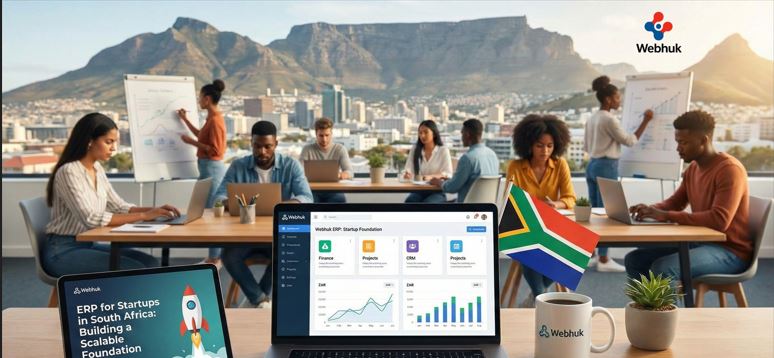
In the bustling tech hubs of Cape Town’s Silicon Cape or Johannesburg’s Sandton, South African startups are moving fast.
You have a great product, a hungry market, and a pitch deck that investors love. But there is one thing that often kills high-growth startups before they reach their potential: Operational Debt.
This happens when you build your business on a patchwork of cheap tools—a spreadsheet for leads, a free app for invoicing, and WhatsApp for team communication. It works when you are three people in a garage. It collapses when you hire your 20th employee or land your first big corporate contract.
This is why forward-thinking founders are adopting ERP for startups in South Africa much earlier than before. They aren't waiting to become corporates; they are building the infrastructure of a corporate from Day 1.
In this guide, we will explore why an ERP (Enterprise Resource Planning) system is the "growth engine" your startup needs to survive the "Valley of Death" and scale successfully.
Why Startups Need "Big Business" Tools
The old advice was "keep it lean." But lean doesn't mean "broken." If your developer team has to stop coding to help the sales team find an invoice, you aren't being lean—you are being inefficient.
An ERP unifies your chaos. It connects your CRM, Finance, and Project Management into one brain.
1. Investor Readiness (Due Diligence)
When venture capitalists (VCs) look at your South African startup, they don't just look at your revenue; they look at your data.
- "What is your Churn Rate?"
- "What is your Customer Acquisition Cost (CAC)?"
- "Show me your real-time P&L." If you have to scramble for days to answer these, you look risky. An ERP gives you these metrics on a live dashboard. It proves you have the maturity to handle their money.
2. POPIA Compliance from the Start
The Protection of Personal Information Act (POPIA) is now in full force. Startups are not exempt. Storing customer data in loose Excel sheets on laptops is a compliance nightmare. An ERP provides a secure, encrypted database where you can manage "Consent" and "Right to be Forgotten" requests instantly. It builds privacy into your DNA.
3. Managing the "Hybrid" Workforce
South African startups are remote-first by necessity (thanks to traffic and talent shortages). You cannot manage a remote team effectively if your data is stuck on an office server. ERP for startups in South Africa is cloud-native. It allows your developer in Stellenbosch, your sales rep in Durban, and your admin in Lagos to work off the same "Single Source of Truth."
Core Modules Every Startup Needs
You don't need a heavy manufacturing module if you are a SaaS company. But you do need the core three:
1. Financial Management (Beyond Bookkeeping)
You need more than just a record of expenses. You need to manage cash flow vs profit. Startups often burn cash fast. An ERP helps you track your "Runway" (how many months of cash you have left) in real-time, alerting you before you hit a wall.
2. CRM (Customer Relationship Management)
Your first 100 customers are your lifeblood. You cannot afford to lose a lead. Integrated CRM helps you nurture these relationships. It ensures that when a deal is closed, the invoice is generated automatically, helping you reduce unbilled hours if you are in the service space.
3. Procurement (Spend Control)
Startups are famous for "uncontrolled spending"—buying software subscriptions that no one uses. An ERP allows you to automate your purchase orders. You can set rules like, "Software under R500 is auto-approved; anything over needs the CTO's click." This keeps your burn rate healthy.
The Myth of "Too Expensive"
"ERP" sounds expensive. It used to be. But modern ERP for startups in South Africa is built on a subscription model (SaaS).
- Modular Pricing: You only pay for the users and modules you need. You don't pay for the "Warehouse" module until you actually get a warehouse.
- Low CapEx: No servers to buy. No IT team to hire.
- Scalability: When you expand to Kenya or Nigeria, the system expands with you. You don't have to rip and replace it.
Conclusion: Scale Without the Chaos
In the startup world, speed is everything. But speed without structure is just a crash waiting to happen.
Investing in an ERP isn't "corporate bureaucracy"—it is the foundation that allows you to move fast without breaking things. It frees you from the admin grind so you can focus on what you do best: disrupting the market.
Is your startup ready to grow up? Webhuk provides the agile, scalable tools that South African founders trust to manage their burn rate, compliance, and growth.
Frequently Asked Questions (FAQs)
1. When is the right time for a startup to get an ERP?
The best time is usually when you hire your first dedicated finance or ops person, or when you cross the 10-employee mark. Waiting until you are at 50 employees makes the migration much harder and more painful.
2. How does an ERP help with fundraising?
Investors love data. An ERP provides accurate, real-time reports on your unit economics (LTV, CAC, MRR). Being able to pull these numbers instantly during a meeting builds massive trust and credibility.
3. Can I integrate an ERP with payment gateways like PayFast or Yoco?
Yes. Modern ERPs like Webhuk are built with open APIs. They can integrate seamlessly with local South African payment gateways, ensuring that when a customer pays online, your accounting records are updated instantly.
4. Is cloud ERP safe given South Africa's cybercrime rates?
Yes. Cloud providers spend millions on security (firewalls, encryption, penetration testing) that a small startup could never afford on its own. Your data is far safer in an encrypted cloud than on a laptop that could be stolen from a car.
5. Does an ERP handle foreign currency for global startups?
Absolutely. If your startup raises funds in Dollars but spends in Rands, or sells software to Europe, an ERP handles the multi-currency accounting automatically, ensuring you don't lose money on exchange rate miscalculations.