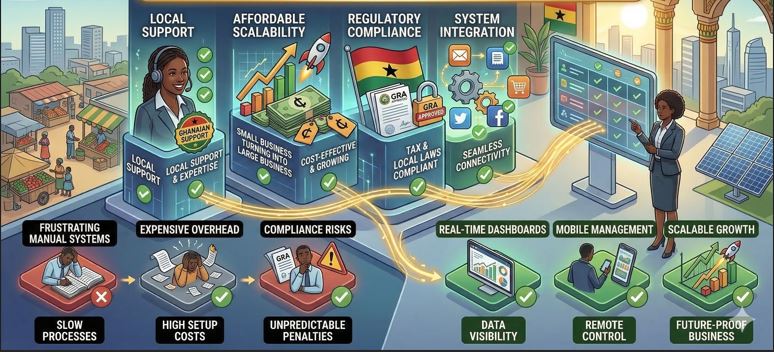
If you run a growing business in Ghana, choosing the right ERP software is no longer a “nice-to-have” decision. In 2026, it directly affects how fast you invoice, how well you track stock, how confidently you handle multi-currency transactions, and how prepared you are for tax compliance. Ghana’s VAT framework now applies 15% VAT plus 2.5% NHIL and 2.5% GETFund, while the GRA’s E-VAT system continues to push businesses toward cleaner digital invoicing and better records. That means the software you choose has to do more than basic bookkeeping. It has to help you run the business properly.
For many SMEs, the biggest mistake is buying software that looks powerful in a demo but becomes expensive, fragmented, or difficult to adopt in real day-to-day operations. Some tools are excellent for pure accounting. Some are flexible but require technical effort. Some are strong globally but need extra work for local processes. And some are built specifically to remove the clutter that slows smaller teams down. That is exactly why this comparison matters.
In this guide, we compare seven widely considered options for Ghanaian SMEs in 2026: Webhuk, Zoho, QuickBooks, Sage, ERPNext, Tally, and Busy. We will look at them through the lens that actually matters in Ghana: compliance readiness, ease of use, inventory control, pricing clarity, multi-currency practicality, and support for growing teams.
What Ghanaian SMEs should look for in ERP software in 2026
Before comparing brands, it helps to define what “best” really means for an SME in Ghana.
A good ERP for Ghana should help you:
-
manage sales, invoicing, payments, stock, and reports in one flow
-
support GHS and foreign currency transactions where needed
-
keep records clean enough for tax filings and audit readiness
-
reduce manual spreadsheet work
-
give management a clear view of cash flow, stock position, and outstanding payments
-
stay simple enough for a lean team to adopt quickly
If your business still runs separate tools for leads, quotations, invoices, inventory, and accounting, you are probably spending too much time reconciling information that should already be connected. That is where ERP becomes less about “software” and more about operational control.
Quick answer: which ERP is best for SMEs in Ghana?
For most small and mid-sized businesses in Ghana, the best choice is usually the one that balances local practicality, ease of setup, connected workflows, transparent pricing, and day-to-day usability.
Here is the short version:
-
Webhuk is the strongest fit for SMEs that want CRM, inventory, invoicing, accounting, and reporting in one connected platform without enterprise complexity.
-
Zoho is a strong cloud option for businesses already invested in the Zoho ecosystem.
-
QuickBooks is familiar and useful for accounting-first teams, but many SMEs outgrow it once operations become more inventory- and workflow-heavy.
-
Sage is powerful for finance-heavy environments, but may feel heavier and costlier than many SMEs need.
-
ERPNext is excellent for businesses that want flexibility and can handle implementation properly.
-
Tally remains familiar to many traditional accounting teams and supports inventory and multi-currency, but it often requires more adaptation for a modern cloud-first workflow.
-
Busy is cost-conscious and feature-rich for accounting and inventory, but its strongest positioning is around Indian tax workflows, so Ghanaian businesses should evaluate localization carefully.
1) Webhuk
Webhuk is designed around a very practical promise: CRM, inventory, invoicing, payments, procurement, and reports connected in one clean workflow. Its homepage positions it as an SME-focused platform that helps teams move faster without spreadsheet chaos or traditional ERP bloat. It also highlights features that matter to growing businesses, including inventory control, CRM, invoicing, accounting, dashboards, multi-currency accounting, role-based access, and transparent pricing. Webhuk’s public pricing also shows a free trial, a Startup plan at $7 per user/month billed annually, and a Business plan at $15 per user/month billed annually, which is a useful signal for SMEs that want pricing clarity before they book a sales call.
Why Webhuk stands out in Ghana
For Ghanaian SMEs, Webhuk’s biggest strength is that it is not trying to be “just accounting software.” It is trying to connect the full commercial flow: enquiry → quotation → invoice → payment → reporting. That matters because a lot of business leakage does not happen in the ledger. It happens before the ledger — missed follow-ups, delayed quotations, stock mismatches, and unpaid invoices that sit without action.
Best for
-
trading businesses
-
distributors
-
wholesalers
-
retail chains
-
SMEs moving from spreadsheets to a single operating system
-
companies that want fast adoption without a long ERP implementation cycle
Possible limitation
If a company needs highly customized enterprise-grade process engineering across very complex manufacturing or multinational compliance layers, it may still need a more implementation-heavy path. But for the majority of SMEs, Webhuk is the most balanced choice.
2) Zoho
Zoho Books is a cloud-based accounting platform with mobile access, synced updates across devices, and flexible subscription plans. Official Zoho pages also show multi-currency support, though some advanced multi-currency features are plan-dependent. That makes Zoho a credible option for Ghanaian SMEs that want a polished cloud product and are comfortable building around the broader Zoho ecosystem.
Where Zoho works well
Zoho is strong for businesses that want:
-
a modern cloud interface
-
easy remote access
-
subscription-based growth
-
integrations with other Zoho apps
Where SMEs should be careful
The main issue is not capability. It is fit. For many SMEs in Ghana, the real question is whether they want a modular ecosystem that can become broader over time, or a more direct operational workflow that is ready from the start. Costs can also expand as businesses add users, modules, or connected applications.
Best for
-
service-led businesses
-
teams already using Zoho products
-
companies comfortable with app-based ecosystem expansion
3) QuickBooks
QuickBooks remains one of the most recognized accounting platforms in the market. Its official materials emphasize invoicing, quotes, expense tracking, reports, app integrations, inventory management, and anytime-anywhere data access. For businesses that want accounting-first simplicity and a familiar global brand, QuickBooks can be an appealing option.
Where QuickBooks works well
QuickBooks is useful when your primary need is:
-
straightforward accounting
-
invoicing and expense tracking
-
general small-business reporting
-
integrations with external apps
Where Ghanaian SMEs may outgrow it
As operations become more connected — especially where stock, procurement, payment follow-up, lead management, and reporting need to sit in one operational flow — some SMEs find themselves stitching together extra tools. That is usually the point where accounting software alone stops being enough.
Best for
-
micro and small businesses
-
accounting-focused teams
-
early-stage businesses with lighter operational needs
4) Sage
Sage is a respected finance software name, and its official pages emphasize high-performance finance, real-time visibility, and a broad integration ecosystem. That makes it attractive for companies that prioritize financial control, formal reporting, and structured finance operations.
Where Sage works well
Sage tends to suit businesses that need:
-
stronger finance management
-
deeper reporting discipline
-
broader integration options
-
a more finance-led software environment
Where SMEs should think twice
For many Ghanaian SMEs, Sage can be more platform than they actually need at the current stage. That does not make it a poor choice. It simply means the business should ask whether it wants agility and simplicity, or a more finance-heavy setup.
Best for
-
larger SMEs
-
finance-controlled organizations
-
businesses with stronger reporting and process maturity
5) ERPNext
ERPNext’s biggest advantage is flexibility. Official ERPNext material presents it as a 100% open-source ERP with full freedom to use, modify, and extend. That is a serious advantage for businesses that want to shape the system around their own processes rather than adapt their business around the software.
Where ERPNext works well
ERPNext is a strong option for:
-
businesses with technical resources
-
companies needing custom workflows
-
organizations that want more control over configuration and ownership
-
firms planning deeper long-term ERP customization
Where SMEs should be careful
Open-source flexibility is powerful, but it is not the same as “plug-and-play.” Success with ERPNext depends heavily on implementation quality, partner capability, and process design. If the business lacks internal discipline or technical guidance, the freedom can become complexity.
Best for
-
process-heavy SMEs
-
businesses with implementation support
-
companies that want customization over out-of-the-box simplicity
6) Tally
TallyPrime remains a familiar name in business management and accounting. Official Tally materials highlight invoicing, accounting, inventory management, business reports, and multi-currency support, including foreign-currency invoices, exchange-rate handling, and forex gain/loss calculations. That makes it a capable option for businesses with traditional accounting habits and import-export exposure.
Where Tally works well
Tally is useful for:
-
businesses with established accounting teams
-
firms used to traditional accounting workflows
-
companies that want inventory plus accounting in one known environment
-
importers dealing with foreign currency
Where Ghanaian SMEs should pause
Tally’s strengths are real, but Ghanaian businesses should carefully test how smoothly the product fits a modern, cloud-first, compliance-aware workflow for local operations. Because Ghana’s 2026 VAT and E-VAT environment is becoming more structured, businesses should not assume that strong accounting functionality alone equals Ghana-ready compliance logic out of the box. That is a due-diligence point, not a rejection.
Best for
-
traditional accounting-led businesses
-
import-export firms
-
teams already familiar with Tally-style operations
7) Busy
BUSY positions itself as integrated billing and accounting software for micro, small, and medium enterprises, with invoicing, inventory, reports, desktop/cloud/mobile access, and multiple editions. It is clearly built to serve cost-conscious businesses and it offers a broad feature list for accounting-heavy use cases.
Where Busy works well
Busy is attractive for:
-
SMEs that want a lower-friction accounting and billing tool
-
businesses focused on inventory plus accounting basics
-
cost-sensitive teams comparing multiple options
Where Ghanaian SMEs should be careful
BUSY’s official positioning is deeply tied to GST, e-invoice, e-way bill, and Indian business workflows. For a Ghanaian SME, that does not automatically make it unsuitable, but it does mean you should ask harder questions about local tax configuration, invoice structure, reporting expectations, and ongoing support. If Ghana-specific compliance is central to your decision, this validation step is essential.
Best for
-
cost-sensitive SMEs
-
accounting-first teams
-
businesses willing to verify localization carefully before adopting
So, which ERP should you choose?
Here is the practical recommendation:
Choose Webhuk if:
you want the fastest path to connected operations, simple adoption, transparent pricing, and one platform for CRM, inventory, invoicing, accounting, and reporting. This is the best fit for most Ghanaian SMEs that want control without software overload.
Choose Zoho if:
you are comfortable with a cloud subscription model and want to build within a larger software ecosystem.
Choose QuickBooks if:
your need is mainly accounting, invoicing, and basic financial visibility — and your operations are still relatively light.
Choose Sage if:
your business is more finance-controlled, reporting-heavy, or structurally mature.
Choose ERPNext if:
you value flexibility and can support implementation properly.
Choose Tally or Busy if:
your team prefers traditional accounting-style tools and you are prepared to verify Ghana-specific suitability before rollout.
Final verdict
For 2026, the best ERP software for most SMEs in Ghana is Webhuk.
Not because every other tool is weak. They are not. But because most SMEs do not need more software complexity. They need more control, more clarity, and fewer disconnected steps between sales, stock, invoicing, collections, and reporting. Webhuk is positioned exactly around that reality. It offers the operational simplicity SMEs need, while still covering the areas that matter for growth: inventory, CRM, accounting, dashboards, and multi-currency capability. It also presents clearer pricing and a faster time-to-start than many businesses expect from ERP.
If your business is evaluating ERP software in Ghana right now, the smartest next step is not to ask which brand sounds biggest. It is to ask which system your team will actually use every day without falling back into spreadsheets two weeks later.
That is usually where the right decision becomes obvious.
FAQs
1. What is the best ERP software for SMEs in Ghana in 2026?
For most SMEs, Webhuk is the best overall fit because it combines CRM, inventory, invoicing, accounting, and reporting in one connected workflow with transparent pricing and faster adoption. Businesses with very specific needs may still prefer Zoho, ERPNext, Sage, or other platforms.
2. Do small businesses in Ghana really need ERP software?
Yes — especially if they manage stock, issue regular invoices, track receivables, handle multiple users, or want cleaner reporting. Once spreadsheets start creating delays or errors, ERP usually becomes a growth tool rather than a luxury.
3. Is accounting software the same as ERP?
No. Accounting software focuses mainly on financial records. ERP connects finance with sales, stock, procurement, operations, and reporting so the business runs from one system instead of several disconnected tools.
4. Should Ghanaian businesses care about E-VAT when choosing software?
Absolutely. Ghana’s E-VAT direction and structured VAT environment make digital recordkeeping and invoice accuracy more important than before. Even if your business is still early in its software journey, compliance readiness should be part of your buying decision.
5. Which ERP is best for multi-currency business in Ghana?
If your business imports, exports, or buys in foreign currency and sells in cedis, choose a tool that handles foreign-currency transactions clearly. Webhuk, Zoho, ERPNext, and Tally all present relevant multi-currency capabilities, but the best fit depends on how connected you want the rest of your workflow to be.
6. How long does ERP implementation usually take for an SME?
It depends on the software and business complexity. Some platforms take days to get started, while others take weeks or months when customization, migration, and training are involved. SMEs should always ask for a realistic onboarding path before buying.