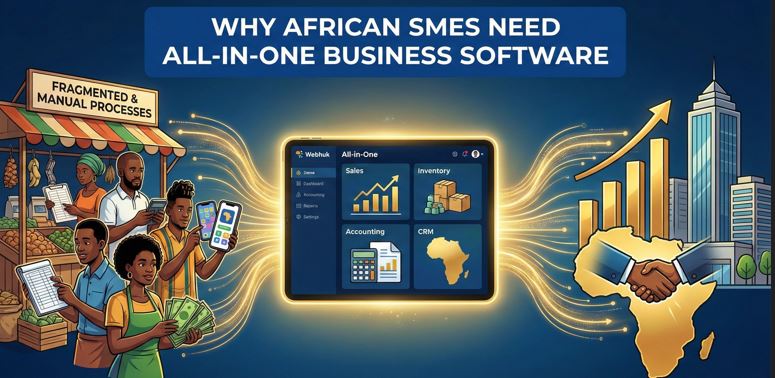
Let’s look at the typical "Tech Stack" of a modern African SME:
- Sales Team: Uses a CRM (priced in Dollars).
- Finance Team: Uses accounting software (priced in Pounds or Dollars).
- Warehouse: Uses a standalone inventory app (or Excel).
- HR: Uses a payroll tool.
- Project Manager: Uses a task management app like Trello or Asana.
It looks like a modern setup, but it’s actually a trap.
First, you are bleeding money. Every month, your credit card is hit with 5 or 6 different subscriptions. Worse, most of these are billed in foreign currency. When the Cedi or Rand weakens against the Dollar, your operational costs suddenly jump—even if you haven't added a single new user.
Second, none of these tools talk to each other. Your CRM doesn't know you are out of stock. Your accounting software doesn't know a project is delayed. You have created "Data Silos."
The solution isn't to buy more software; it's to buy smarter software.
Enter All-in-one business software.
In this guide, we will explore why consolidating your tools into a single platform is the ultimate efficiency hack for businesses in Ghana and South Africa.
The "Spaghetti" Problem
Imagine trying to trace a single customer order through your business.
- Step 1: Sales rep wins deal in CRM. He has to email the Finance guy.
- Step 2: Finance guy manually types the invoice into Accounting software. He has to call the Warehouse.
- Step 3: Warehouse manager checks stock in Excel. He forgets to tell Finance that the item is damaged.
This manual hand-off is where mistakes happen. Orders get lost. Invoices get sent with the wrong prices. Customers get angry.
All-in-one business software removes the spaghetti. It is a single platform where the CRM, Inventory, Accounting, and Project modules share one database. When Sales wins the deal, the Invoice is auto-generated, and the Inventory is auto-deducted. No emails. No phone calls. Just flow.
3 Financial Reasons to Switch
Beyond efficiency, the financial argument for consolidation is undeniable.
1. Currency Protection
For businesses in Accra or Johannesburg, paying for software in USD is risky.
- January: Subscription is $100 (Exchange rate 15.0) = Cost 1,500.
- June: Subscription is $100 (Exchange rate 18.0) = Cost 1,800. Your cost went up 20% just because of forex. Switching to an all-in-one business software provider that understands the African market (and bills in local currency or offers stable pricing) insulates you from this volatility.
2. The "Bundle" Discount
It is always cheaper to buy a combo meal than to buy the burger, chips, and soda separately. Software is the same. Buying a CRM ($20), Accounting ($30), and Inventory ($50) tool separately costs $100/month. An all-in-one suite might offer all those features for $60/month. Over a year, that is a massive saving that goes straight to your bottom line.
3. Reducing Administration Time
How much time do you spend managing user logins? If you have 5 apps, you have to create 5 accounts for every new employee. You have to remember 5 passwords. You have to pay 5 different invoices. Consolidating to one platform reduces your admin overhead significantly.
Is "All-in-One" Too Generic?
A common fear is: "Jack of all trades, master of none." People worry that an all-in-one tool will have a weak CRM or a basic Inventory module.
Ten years ago, this was true. Today, it is a myth. Modern cloud suites are built specifically for SMEs. They know that a small business doesn't need the complexity of Salesforce (CRM) or SAP (ERP). You need the essential 80% of features that actually drive revenue.
- You don't need AI-predicted sales forecasting; you need a simple pipeline.
- You don't need multi-warehouse robotic automation; you need accurate stock counts.
All-in-one business software focuses on these essentials, making them easier to use than the complex, standalone giants.
The Simplicity Factor for Staff
Training your team is hard. If you use 5 different apps, your staff has to learn 5 different interfaces.
- "Where is the 'Save' button in this app?"
- "How do I print in that app?"
With a unified system, the interface is consistent. The "Save" button is in the same place for an Invoice as it is for a Quote. Once an employee learns one part of the system, they intuitively understand the rest. This drastically reduces training time and frustration.
Conclusion: Complexity is the Enemy of Execution
As your business grows, complexity creeps in naturally. You don't need to add to it with your tech stack.
The most successful African SMEs are those that stay lean and agile. They don't waste time bridging the gap between disconnected apps. They use all-in-one business software to create a single, truthful view of their entire operation.
Stop juggling passwords and overpaying in Dollars. Discover Webhuk, the complete business toolkit designed to unify your Sales, Operations, and Finance in one affordable platform.
Frequently Asked Questions (FAQs)
1. Can I keep my existing email if I switch to all-in-one software?
Yes. All-in-one platforms integrate with your existing email providers (like Gmail or Outlook). You don't need to change your email address; the software simply connects to it to track conversations.
2. What if I only need CRM and Accounting right now?
That is the beauty of modular all-in-one systems. You can usually "turn off" or hide the modules you don't use (like Manufacturing or HR) and simply enable them later when your business expands, without paying extra installation fees.
3. Is it hard to migrate data from 3 different apps?
It takes a bit of planning, but it’s straightforward. You export data from your current apps into Excel (CSV format). The all-in-one system will have an "Import Wizard" to map your Contacts, Products, and Past Invoices into the new database.
4. Is an all-in-one system secure?
Yes. In fact, it is often more secure than using multiple apps. With multiple apps, you have 5 potential entry points for hackers. With one unified system, you can enforce strict security (like Two-Factor Authentication) on a single gateway, making it easier to protect your data.
5. Does it work on mobile?
Yes. Modern all-in-one business software is cloud-based and mobile-responsive. This is crucial for African businesses where managers and owners are often on the road or visiting sites.