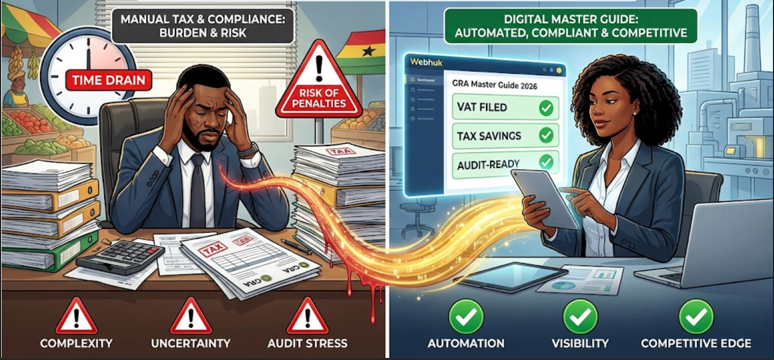
For decades, many businesses in Ghana—from the manufacturing hubs of Tema to the retail giants in Makola—viewed tax compliance as a "manual chore" reserved for the end of the quarter. You’d gather a mountain of paper invoices, sit down with an accountant, and hope for the best.
However, as we move through 2026, the Ghana Revenue Authority (Authority) has fundamentally changed the landscape. With the full-scale rollout of the Virtual Sales Data Controller (VSDC) and the mandatory E-VAT system, compliance is no longer a periodic event. It is a real-time digital handshake between your business and the government.
For the modern manufacturer or trader, the question is no longer "Should I comply?" but "How can I comply without slowing down my operations?"
1- Understanding the New Landscape of E-VAT in Ghana
The GRA's digital transformation isn't just about collecting money; it’s about data integrity. In the past, manual invoicing allowed for "grey areas"—errors in calculation, lost receipts, or mismatched TIN numbers.
The current E-VAT system requires that every sale is recorded electronically and transmitted to the GRA in real-time. This means:
- Instant Fiscal Receipts: Every customer must receive a receipt with a unique GRA-generated QR code.
- Real-time Ledger Syncing: Your sales data must match what the GRA sees on their portal.
- Verified TIN/GHANA CARD IDs: Transaction data must be linked to verified taxpayer identities.
If you are a manufacturer producing thousands of units a day, doing this manually is impossible. You need a GRA compliant software in Ghana that performs these handshakes in the background while you focus on production.
2- The Math of Compliance: Beyond 15% VAT
One of the biggest pain points for Ghanaian businesses is the "levy stack." Unlike other countries with a simple flat tax, Ghana utilizes a complex breakdown of levies that must be displayed accurately on every invoice:
- VAT (Value Added Tax): 15%
- NHIL (National Health Insurance Levy): 2.5%
- GETFund (Ghana Education Trust Fund Levy): 2.5%
- COVID-19 Health Recovery Levy: 1%
Many generic ERPs or accounting tools like QuickBooks or Wave are built for the US or European markets. They struggle to calculate these "levies on levies" or show the specific line-item breakdowns required by Ghanaian law. Webhuk ERP was reimagined specifically to handle this "Ghanaian Stack." It automates the calculation so that when you enter a product price, the system back-calculates or adds the exact levies, ensuring you are never a pesewa off.
3- Why Manufacturers are Especially at Risk
Manufacturers in Ghana face a unique compliance challenge: The Input-Output Gap. You buy raw materials (Input VAT) and sell finished goods (Output VAT). If your record-keeping is disorganized, you cannot claim your VAT credits efficiently. You end up overpaying taxes because you can't prove what you already paid to suppliers.
By using an integrated system, your Procurement and Inventory modules talk directly to your Accounting module. When you record a purchase of raw materials, the system flags the Input VAT. When you sell the finished product, it calculates the Output VAT. At the end of the month, your VAT return is generated in one click, showing exactly what you owe or what credit you are due.
4- Transitioning from "Excel Chaos" to ERP Clarity
Let’s be honest: many businesses in Accra and Kumasi still run on Excel. While Excel is a powerful tool, it is the enemy of compliance.
- No Audit Trail: Anyone can delete a row in Excel. The GRA hates this.
- Version Control: Is "Invoice_Final_V2" the one you actually sent?
- Security: Excel files are easily stolen or corrupted.
A cloud-based ERP provides a Single Source of Truth. Whether your warehouse manager is in Tema or your sales office is in East Legon, everyone sees the same data. Every transaction is timestamped, locked, and compliant.
5- Managing the "Tradeboard": Sales, Enquiries, and Quotes
For traders, compliance starts long before the invoice. It starts at the Enquiry stage. Webhuk’s unique Tradeboard allows you to track the journey from a customer enquiry to a formal Quote, and finally to a Tax Invoice.
- Vendor RFQs: In a volatile market, getting the best price from suppliers is key. Sending a professional RFQ link allows you to compare prices digitally, which the system then converts into a Purchase Order—linking your supply chain directly to your tax records.
6- The 7-Day Digital Revolution
The biggest myth in Ghana is that "software takes too long to set up." Many business owners fear that installing an ERP will halt their operations for months. This is why the "No-Bloat" philosophy is critical. You don't need a system that does 1,000 things you don't understand. You need a system that does the 10 things that matter:
- Inventory tracking.
- GRA-compliant invoicing.
- Multi-currency accounting (handling Cedi, Dollar, and Naira).
- Payroll for your local staff.
- Real-time Cashflow dashboards.
With the right partner, a Ghanaian manufacturer can go from "paper-based" to "cloud-compliant" in just 7 days. This speed is a massive competitive advantage. While your competitors are stuck in queues at the GRA office, you are scaling your production.
7- Multi-Currency Trade and the Cedi Reality
For those trading across West Africa or importing from overseas, the exchange rate is a daily battle. A compliant system must do more than just record taxes; it must manage Forex fluctuations. Webhuk allows you to invoice in USD but report in GHS. It tracks "unrealized gains and losses," ensuring that your tax filings reflect the actual value of your business, protecting you from overpaying tax on money you haven't technically "made" yet due to currency drops.
Conclusion: Leadership through Transparency
In 2026, the most successful businesses in Ghana won't be the ones with the most secrets; they will be the ones with the best systems. GRA compliance should not be feared—it should be used as a badge of honor. It tells your investors, your bank, and your suppliers that you are a professional, modernized entity.
By automating your workflow with a localized, SME-focused ERP like Webhuk, you aren't just "fixing your taxes." You are building a foundation for a business that can last for generations.
Frequently Asked Questions (FAQs)
Q1: What is a VSDC and do I need one? The Virtual Sales Data Controller is the GRA’s software-based monitor. If you are a VAT-registered business in Ghana, you are required to use a VSDC-compatible system to issue fiscal receipts. Webhuk is built to be fully compatible with these requirements.
Q2: Can Webhuk handle the 2.5% NHIL and 2.5% GETFund separately? Yes. Unlike international software that lumps everything into "Sales Tax," Webhuk breaks down each levy on the invoice to ensure you meet GRA's specific reporting standards.
Q3: Is my data safe in the cloud? Webhuk uses enterprise-grade encryption. For Ghanaian businesses, this is often safer than a local server which could be damaged by power surges (dumsor) or physical theft.
Q4: Does the system work for both manufacturing and simple trading? Yes. It includes a robust Resource Planning module for manufacturers (raw materials to finished goods) and a streamlined Tradeboard for wholesalers and retailers.
Q5: How do I get started with the 7-Day Challenge? Simply visit the Webhuk website and request a live demo. Our local team understands the Ghanaian market and will guide you through the setup.