In the manufacturing world, your profit isn't just made when you sell a finished product; it's made when you buy your raw materials. Whether you are producing plastic goods in Accra, processing food in Lagos, or assembling machinery in Tema, your supply chain is your lifeline.
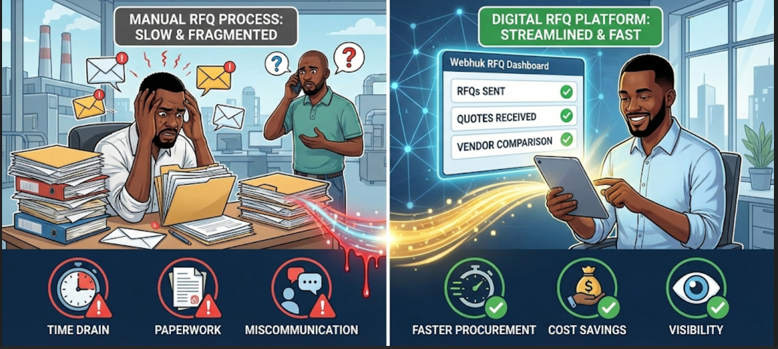
However, for many African manufacturers, procurement is the slowest part of the business. It often involves a chaotic mix of phone calls, physical visits to suppliers, and endless WhatsApp threads. By the time you get a quote from three different vendors, prices have changed, or your production line has already sat idle for two days.
The secret to breaking this cycle is Digital RFQ (Request for Quotation) Automation. ###
1. The Bottleneck
The "Old Way" of Procurement In a traditional setup, when a manufacturer needs raw materials (like industrial chemicals, spare parts, or packaging), the process looks like this:
- The procurement officer identifies the need.
- They manually type out a list of items for 3–5 different vendors.
- They send these via email or WhatsApp.
- They spend the next 48 hours chasing those vendors for prices.
- Finally, they manually compare the prices in a spreadsheet.
This "Old Way" is slow, prone to errors, and makes it impossible to track historic pricing trends. In a volatile market where the Cedi or Naira fluctuates daily, every hour lost in procurement is money out of your pocket.
2. The Webhuk Innovation: RFQs with a Magic Link
One of the most powerful features of the Webhuk Tradeboard is the ability to send Vendor RFQs with a Link. Instead of typing out messages to every supplier, you create one RFQ in the system and generate a unique link. You send this link to your vendors. When they click it, they see a professional interface where they can enter their prices, availability, and terms directly.
The result? The data flows straight back into your ERP. No manual data entry, no "I didn't see your message" excuses, and no chasing.
3. Comparing Apples to Apples (Automatically)
The real power of an automated system is the Comparison View. Once your vendors have submitted their prices through the link, Webhuk allows you to compare them side-by-side.
- Who has the lowest price?
- Who can deliver the fastest?
- Who offers the best credit terms?
In a manual system, comparing five vendors with twenty line-items each is a nightmare. In Webhuk, it’s a single screen. This transparency allows procurement managers to make data-driven decisions that can save the company thousands of dollars over a single quarter.
4. Turning Quotes into Purchase Orders (POs)
In a manual workflow, once you pick a vendor, you have to create a new document (the Purchase Order). In an integrated ERP, the quote is the foundation. Once you approve a vendor’s submission, Webhuk converts that RFQ into an official Purchase Order in one click.
- Accuracy: There is zero chance of a typo in the price or quantity because the data moved directly from the vendor's input to your PO.
- Integrity: The PO is automatically linked to your accounting and inventory, ensuring that your books stay balanced the moment the goods arrive at the warehouse.
5. Building a "Supplier Database" of Value
Many manufacturers in West Africa rely on the same two or three suppliers simply because it's "easier" than finding new ones. RFQ automation gives you the freedom to expand your vendor list without increasing your workload.
By using digital links, you can invite ten suppliers to bid just as easily as you could invite two. Over time, Webhuk builds a history of your procurement. You can see which vendors have been the most reliable and how raw material prices have trended over the year. This data is "gold" when it comes time to negotiate annual contracts.
6. Transparency and Anti-Corruption
In large-scale manufacturing, procurement is often where "leaks" happen. Manual, off-system negotiations can lead to lack of transparency. By moving the RFQ process into a digital system with a clear audit trail, the business owner can see exactly:
- Who was invited to bid.
- What prices were submitted.
- Why a specific vendor was chosen.
This creates a culture of accountability that protects the company’s capital and ensures that the best deal for the business is always the one that is signed.
Conclusion: Speed is Your New Profit Margin
In 2026, the competitive edge for African manufacturers will be agility. The ability to source raw materials faster and cheaper than your neighbor is what allows you to keep your shelves full and your prices stable.
Stop letting your procurement get stuck in WhatsApp. Embrace the power of Vendor RFQ Links and transform your supply chain into a streamlined, profit-making machine.
Frequently Asked Questions (FAQs)
Q1: Do my vendors need to have Webhuk to use the link? No. When you send the link, the vendor opens it in their web browser (on a phone or computer). They don't need to install any software or pay any fees. They just enter the prices and click "Submit."
Q2: Can I send the same RFQ to multiple vendors at once? Yes. You can generate a single link or specific links for different vendors to track who has responded and who hasn't.
Q3: How does this help with inventory management? Because the RFQ is linked to your system, once the goods arrive and the PO is closed, your inventory is updated automatically. You never have to "manually add" stock that was purchased through the system.
Q4: Is this feature useful for small traders too? Absolutely. Even if you only have three suppliers, the time saved in comparing prices and the professional look of a digital RFQ helps a small business scale faster.
Q5: Can I include attachments like technical drawings or specifications? Yes. Webhuk allows you to attach documents to your RFQ link so that vendors have all the technical details they need to give an accurate quote.