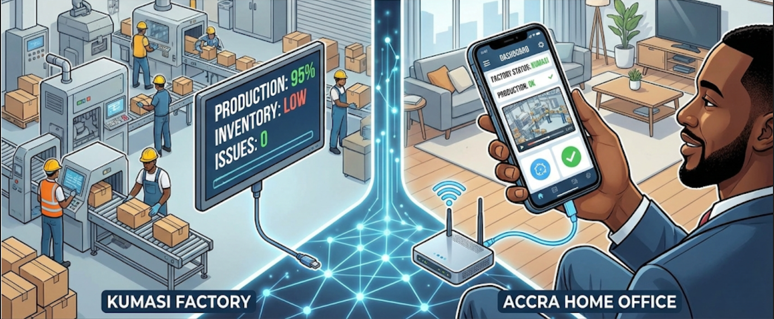
In the fast-paced economy of 2026, the traditional model of a business owner "sitting at the desk" from 8:00 AM to 5:00 PM is becoming obsolete. Ghanaian entrepreneurs are more mobile than ever. You might be attending a conference in Accra, meeting a supplier in Tema, or exploring new markets in Takoradi, all while your main manufacturing plant is based in Kumasi.
The question that keeps many owners awake at night is: "What is happening at my factory right now?" Without the right technology, being away means being blind. You rely on phone calls, WhatsApp messages that might get ignored, or spreadsheets sent at the end of the day that are already outdated. This is where Remote Business Management via a cloud-based ERP changes the game for Ghanaian SMEs.
1- The Power of Visibility: Your Business in Your Pocket
The biggest advantage of a system like Webhuk is that it is cloud-native. This means your data doesn't live on a single computer in a dusty office; it lives securely on the web.
Whether you are on a smartphone, tablet, or laptop, you can log in and see exactly what is happening:
- Real-time Sales: See every invoice being issued in Kumasi as it happens.
- Inventory Levels: Know if you are running low on raw materials before the production line stops.
- Cashflow: Check your bank balances and outstanding payments without calling your accountant.
For a Ghanaian business owner, this level of visibility reduces "management anxiety." You no longer have to worry if staff are recording sales correctly or if stock is "disappearing"—you can see the digital footprint of every transaction instantly.
2- Streamlining Communication Across Branches
If your business has a warehouse in Tema and a retail showroom in Accra, keeping them in sync is a major challenge.
- Manual method: The Tema warehouse calls Accra to say they’ve shipped goods. Accra writes it down in a book. Errors happen.
- ERP method: The warehouse records a "Stock Transfer" in Webhuk. The showroom in Accra sees the incoming stock on their dashboard immediately. No phone calls required.
By centralizing your data, you eliminate the "he-said, she-said" culture. Everyone is looking at the same Single Source of Truth.
3. Making Decisions in "Real-Time," Not "Late-Time"
Business in West Africa moves fast. Prices of raw materials change, the exchange rate fluctuates, and customer demands shift. If you only get your reports once a week, you are making decisions based on old news.
Remote management tools allow for Active Interventions. If you see on your dashboard that a particular product line is selling out twice as fast in your Takoradi branch as it is in Kumasi, you can immediately authorize a stock rebalancing. You aren't waiting for the end of the month to realize you missed a massive sales opportunity.
3- Security and Accountability from a Distance
One of the harsh realities of running a business is the risk of internal theft or "ghost stock." When the owner isn't physically present, some employees might feel tempted to bypass the system.
A cloud ERP increases accountability through Audit Trails:
- User Permissions: You can control exactly who can edit an invoice or change a stock level.
- Timestamping: See exactly what time a transaction was recorded and by whom.
- Security Alerts: Get notified of unusual activity, such as a large discount being applied to a sale.
Knowing that the "Boss is watching" through the system—even if they are 300km away—creates a culture of integrity and discipline within the workforce.
4- Overcoming the "Internet Challenge" in Ghana
A common concern for remote management in West Africa is internet stability. Modern cloud ERPs are designed for this. Webhuk is optimized to be "lightweight," meaning it works efficiently even on standard 4G connections or office Wi-Fi.
Because it’s a "No-Bloat" system, it doesn't require massive bandwidth to load your dashboard. This makes remote management practical even if you are traveling through areas with spotty coverage.
5- Balancing Work and Lifestyle
Finally, remote management is about Quality of Life. Being a business owner shouldn't mean being a prisoner to your office. With the ability to monitor your operations from your phone, you have the freedom to:
- Spend more time with family.
- Focus on high-level networking and business growth.
- Manage multiple businesses simultaneously without burning out.
Conclusion: The Future is Mobile
As Ghana continues to digitize, the "desk-bound" business owner will be outcompeted by the "mobile-first" entrepreneur. Managing a Kumasi factory from Accra isn't just a convenience—it’s a strategy for dominance in the 2026 market.
By adopting a cloud-based, SME-focused ERP like Webhuk, you are giving your business the wings to grow beyond your physical location.
Frequently Asked Questions (FAQs)
Q1: Can I really see my factory production in real-time? Yes. Through the Resource Planning and Inventory modules, every time a raw material is used or a finished good is recorded, the data is updated globally.
Q2: What happens if the internet goes down at the factory? Most modern systems allow for local data caching, and as soon as the connection is restored, all transactions are synced to the cloud so you can see them from your remote location.
Q3: Can I authorize payments or discounts remotely? Yes. Webhuk allows for "Approval Workflows." If a manager in another city needs to give a special discount, they can request it through the system, and you can approve it from your phone.
Q4: Is it expensive to set up a cloud system for multiple branches? Actually, it’s often cheaper than traditional systems because you don't need to buy expensive servers or networking hardware for each location. You just need a standard internet connection.
Q5: How many users can access the system remotely? Webhuk is built for growing teams. You can set up multiple users with different permission levels, ensuring that everyone has the access they need without compromising security.